
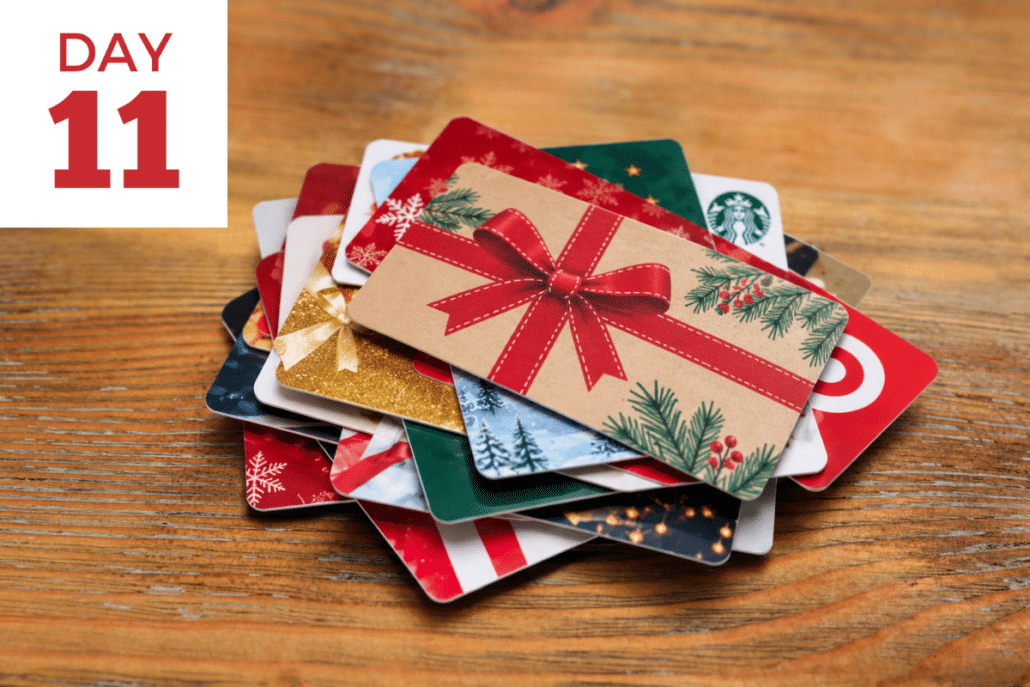
40-Day Christmas Challenge | Day 11: Find Christmas Money You Already Have


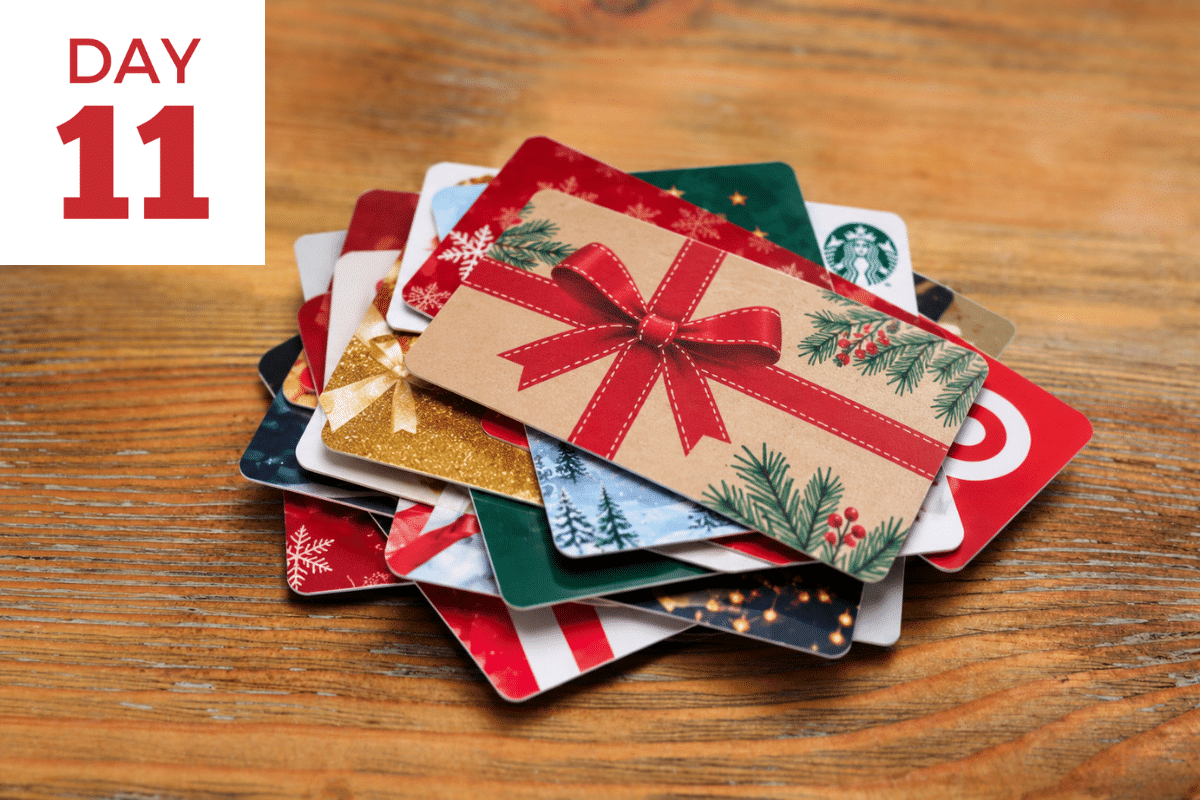
There’s something especially satisfying about finding money you forgot you had. A $20 bill in a coat pocket. A store credit buried in your email. A gift card that’s been riding around in your wallet so long you’ve stopped seeing it.
It’s not exactly a windfall. It was yours all along.
But if that forgotten money can pay for something you were already planning to buy for Christmas? Now we’ve accomplished something.
And that’s what we’re looking for today.
Today’s Challenge
Spend 15 minutes looking for money, credits and rewards you already have that could replace Christmas spending you were already planning.
That last part matters. Finding a $25 gift card does not make your Christmas budget $25 bigger.
We’re trying to spend less of the money that’s still in your bank account, not find exciting new reasons to spend more.
Do This Today
1. Go looking.
Start with the obvious places: your wallet, purse, desk, junk drawer and wherever receipts and store credits tend to land.
Look for gift cards, store credits, refund cards, prepaid cards, cash and enough loose change to be worth mentioning.
Then check the places where money has become considerably better at hiding. Your email. Store accounts. Credit card rewards. Cash-back balances. Digital gift cards. Online credits.
You may find nothing. You may find $8. You may discover you’ve been carrying around a $50 gift card for so long you can’t remember where it came from.
All perfectly acceptable outcomes.
2. Find out what it’s actually worth.
That mystery gift card in the junk drawer isn’t worth $25 just because you vaguely remember it being worth $25. Check the balance directly with the retailer or card issuer.
Do the same with store credits and rewards. Find out what you actually have and whether there are any restrictions on using it.
One caution: don’t type a gift card number into some random website that promises to check the balance for you. Go directly to the company that issued the card.
We’re looking for money today. Let’s not hand any of it to strangers.
3. Give what you found a job.
Now look at the Christmas spending you’ve already planned.
Can any of today’s discoveries replace money you expected to spend?
A store credit might cover part of a planned gift. Grocery rewards could reduce a future grocery bill. Cash back might become a statement credit or cash, depending on your program. Forgotten cash could simply stay in your Christmas fund instead of coming out of your next paycheck.
Write down what you found and what planned expense it can replace.
That’s when forgotten money becomes useful.
Quick Win
Open your wallet and check every gift card in it.
That’s it.
If you discover $17.42 you forgot you had, Day 11 is officially a success.
Found Money Does Not Increase the Budget
This is where things can go sideways. Suppose you find a $40 gift card to a store you like.
Excellent.
Then you go in to use your “free” $40 and walk out having spent $93. We have not saved $40. We’ve found a way to spend another $53.
Use what you find to replace spending you already intended to do. If there’s nothing you need from that particular store, you don’t have to use the card today.
The same goes for rewards. If you’ve earned rewards through spending you were already doing, certainly see whether they can help. But don’t spend $100 you hadn’t planned to spend because somebody is dangling $2 worth of rewards in front of you.
And if you’re already planning to shop online for something on your Christmas list, this is also a good time to remember cash-back programs like Rakuten. I’ve used Rakuten for years, and the rule is exactly the same: buy what you were going to buy anyway, then take the cash back. Don’t let the promise of a rebate talk you into spending more.
Christmas arithmetic can be terribly unromantic that way.
And Yes, Coins Still Count
If you have a jar full of coins, they’re still money.
How you turn them into spendable money depends on what makes sense for you. Check whether your bank or credit union accepts coins and under what conditions before hauling in the jar.
Coin-counting kiosks are another option, but check the terms before choosing how you want the money back. Coinstar, for example, offers no-fee eGift Card options at participating kiosks.
Just remember today’s rule: an eGift Card is only useful if it’s somewhere you intended to spend money anyway.
Why It Matters
Yesterday we looked for food we’d already bought before buying more. Today we’re doing the same thing with money.
Maybe you find $6. Maybe you find $60. Maybe you find absolutely nothing and finally get rid of three empty gift cards you’ve been carrying around since who knows when. The amount isn’t really the point.
The win is knowing what’s already yours and putting it to work before you reach for new money.
Found money isn’t really free money. It’s your money coming home.
Your Turn
What’s the best forgotten-money discovery you’ve ever made? Cash in a coat pocket? A gift card you’d completely forgotten? Store credit sitting in an account? Tell us in the comments. Today’s the rare occasion when bragging about finding money is highly encouraged.
Tomorrow
Tomorrow we’re tackling something Christmas has been doing since long before texts, group chats and social media existed: keeping in touch.
But we’re not assuming that means mailing Christmas cards to everyone you’ve ever known.
We’re going to decide who you really want to connect with this Christmas and the simplest way to actually do it.
← Previous: Day 10 | Challenge Home | Next: Day 12 — Choose How You’ll Keep in Touch →

More from Everyday Cheapskate
 https://www.everydaycheapskate.com/wp-content/uploads/Day-40-Christmas-tree-at-golden-hour-with-sun-shining-in-window.png
800
1200
Mary Hunt
https://www.everydaycheapskate.com/wp-content/uploads/EC-Logo-by-Mary-Hunt-Tagline-Trimmed.png
Mary Hunt2025-11-01 12:40:542026-09-28 22:59:2540-Day Christmas Challenge | Day 40: Go Enjoy Your Christmas
 https://www.everydaycheapskate.com/wp-content/uploads/Day-39-Woman-relaxing-near-fireplace-talking-on-the-phone-at-Christmas-time.png
800
1200
Mary Hunt
https://www.everydaycheapskate.com/wp-content/uploads/EC-Logo-by-Mary-Hunt-Tagline-Trimmed.png
Mary Hunt2025-11-01 12:39:012026-09-28 22:59:2940-Day Christmas Challenge | Day 39: Reach Out Before the Rush Is Over
 https://www.everydaycheapskate.com/wp-content/uploads/Day-38-Woman-relaxing-with-feet-up-with-Christmas-tree-in-the-background.png
800
1200
Mary Hunt
https://www.everydaycheapskate.com/wp-content/uploads/EC-Logo-by-Mary-Hunt-Tagline-Trimmed.png
Mary Hunt2025-11-01 12:38:152026-09-28 22:59:3340-Day Christmas Challenge | Day 38: Know When to Stop
 https://www.everydaycheapskate.com/wp-content/uploads/Day-37-Woman-finishing-up-wrapping-a-final-Christmas-present.png
800
1200
Mary Hunt
https://www.everydaycheapskate.com/wp-content/uploads/EC-Logo-by-Mary-Hunt-Tagline-Trimmed.png
Mary Hunt2025-11-01 12:37:062026-09-28 22:59:3740-Day Christmas Challenge | Day 37: Finish What You Started
 https://www.everydaycheapskate.com/wp-content/uploads/Day-36-Relaxed-woman-sipping-on-a-warm-mug-of-coffee-with-feet-in-cozy-socks.png
800
1200
Mary Hunt
https://www.everydaycheapskate.com/wp-content/uploads/EC-Logo-by-Mary-Hunt-Tagline-Trimmed.png
Mary Hunt2025-11-01 12:36:552026-09-28 22:59:4240-Day Christmas Challenge | Day 36: Build a Little Christmas Buffer
 https://www.everydaycheapskate.com/wp-content/uploads/Day-35-Woman-delivering-a-plate-of-pastries-to-her-neighbor-over-the-yard-fence.png
800
1200
Mary Hunt
https://www.everydaycheapskate.com/wp-content/uploads/EC-Logo-by-Mary-Hunt-Tagline-Trimmed.png
Mary Hunt2025-11-01 12:35:112026-09-28 22:59:4740-Day Christmas Challenge | Day 35: Make Generosity Fit Your Life
 https://www.everydaycheapskate.com/wp-content/uploads/Day-34-Woman-shopping-on-her-smartphone-with-Christmas-presents-in-arms-.png
800
1200
Mary Hunt
https://www.everydaycheapskate.com/wp-content/uploads/EC-Logo-by-Mary-Hunt-Tagline-Trimmed.png
Mary Hunt2025-11-01 12:34:142026-09-28 22:59:5240-Day Christmas Challenge | Day 34: Don’t Let the Algorithm Shop for You
 https://www.everydaycheapskate.com/wp-content/uploads/Day-33-Woman-looking-at-December-calendar-on-her-smartphone-while-drinking-coffee.png
800
1200
Mary Hunt
https://www.everydaycheapskate.com/wp-content/uploads/EC-Logo-by-Mary-Hunt-Tagline-Trimmed.png
Mary Hunt2025-11-01 12:33:172026-10-25 21:15:3440-Day Christmas Challenge | Day 33: Recheck the Calendar and Reclaim Some Margin
 https://www.everydaycheapskate.com/wp-content/uploads/Day-32-Woman-looking-at-Christmas-lights.png
800
1200
Mary Hunt
https://www.everydaycheapskate.com/wp-content/uploads/EC-Logo-by-Mary-Hunt-Tagline-Trimmed.png
Mary Hunt2025-11-01 12:32:532026-09-28 22:59:5940-Day Christmas Challenge | Day 32: Go See the Christmas Lights


Leave a Reply
Want to join the discussion?Feel free to contribute!