

How to Use Mosquito Dunks: Kill ‘Em Before They Bite Back

If mosquitoes are turning your backyard into a battleground, it’s time to strike first—before they even hatch. You don’t need pricey gadgets or smelly potions to win this war. There’s a simple, budget-friendly weapon that’s safe, effective, and easy to use. It’s called a mosquito dunk—and when you know how to use it, you’ll wonder why you ever wasted money on citronella candles and bug zappers.

If there’s one creature that can ruin a perfectly good summer evening faster than overcooked ribs, it’s the mosquito. They’re relentless. They’re sneaky. And they show up uninvited, like the distant cousin who only calls when he needs to borrow money.
Mosquitoes aren’t just pesky nuisance—they’re carriers of serious diseases like West Nile virus, dengue, and Zika. Their bites can cause painful itching, swelling, and in some cases, severe allergic reactions or infections. Left unchecked, mosquitoes can turn a simple backyard hangout into a health hazard, especially for children, older adults, and anyone with a weakened immune system. Taking steps to control them isn’t about being cruel; it’s about protecting your loved ones and your community from real risks.
You could spend a fortune trying to outsmart them—foggers, citronella torches, electric zappers, even those overpriced wristbands that promise to create a magical forcefield (they don’t). Or you could take a much simpler, cheaper, and more effective approach.
Let me introduce you to a humble little hero called the mosquito dunk. It doesn’t zap. It doesn’t sizzle. It doesn’t smell like burning mint leaves. But it works. And it works well—if you understand how and where to use it.
What Are Mosquito Dunks and How Do They Work?

A mosquito dunk is a small, donut-shaped disk packed with a powerful yet natural ingredient called Bacillus thuringiensis israelensis—mercifully shortened to Bti. Don’t worry, it’s not some harsh chemical brewed up in a lab. Bti is a naturally occurring bacterium found in soil, and it’s been used safely for decades.
When mosquito larvae eat it, it breaks down their digestive systems and kills them—usually within a few hours. But here’s the best part: Bti is completely harmless to people, pets, birds, bees, frogs, fish, and just about everything else. It’s even approved for use in organic gardening.
The dunk itself is biodegradable, and just one can treat up to 100 square feet of standing water for 30 days. That’s a full month of mosquito control—all from a tiny floating donut that’s easy to drop in and forget.
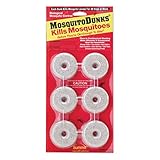
(Disclosure: This post includes an Amazon Creator Connections product. I may earn a small commission if you purchase through the link, at no additional cost to you.)
But Why Target the Larvae?

Let’s get into a little mosquito biology—just for a minute. No lab coat, goggles, or bug net required.
Mosquitoes go through four life stages:
- Egg: Laid on the surface of standing water
- Larva: Wriggly and water-bound
- Pupa: Still aquatic, gearing up for takeoff
- Adult: The flying, biting nightmare we all know too well
That middle part—larvae and pupae—is where they’re stuck in the water and at their most vulnerable. Adults? They’re harder to catch. They fly, they hide in shady corners, and they seem to have a sixth sense for avoiding swats.
But larvae? They’re sitting ducks. They have to eat to grow, and if that water is treated with Bti, their next meal will be their last.
This is why mosquito dunks work: they cut the population off at the knees before it ever grows wings.
So Do the Adults Die Off Too?
Not from dunks, no—and that’s a common misunderstanding. Some folks think mosquito dunks attract the bugs like a trap and zap them on contact. That’s not how it works.
Here’s what actually happens:
- A female mosquito lays her eggs in standing water.
- Those eggs hatch into larvae.
- The larvae munch on the Bti.
- The larvae die.
- The adult mosquito flies off to repeat the cycle elsewhere—blissfully unaware her kids never made it.
And while it would be satisfying if Mom Mosquito dropped dead after laying her eggs, she doesn’t. In fact, one female can lay hundreds (sometimes thousands) of eggs in her short lifetime, often in several different puddles, pots, and gutters.
That’s why mosquito dunks work best as part of a strategy. They’re a smart starting point—a way to break the cycle before it becomes an infestation. You’re cutting off her family tree, not hunting her down individually.
Where and How to Use Mosquito Dunks Effectively
You don’t need fancy gear or a PhD in bug science to use mosquito dunks. Just a little time, a sharp eye, and maybe a pair of gloves if murky water gives you the ick.
1. Hunt for Standing Water
This is your #1 mission. Female mosquitoes are picky—they don’t just lay eggs anywhere. They want calm, shallow, stagnant water, ideally with a bit of organic material to feed their babies.
Start your search here:
- Birdbaths (especially the ones nobody’s cleaned in weeks)
- Rain barrels
- Kiddie pools
- Buckets left out in the rain
- Tarps and pool covers that sag just enough to trap water
- Clogged gutters—out of sight, but prime real estate
- Flowerpot saucers
- Old tires
- Yard ditches or low spots that stay soggy after a storm
- Tree stumps or hollows that collect water
Basically, if water sits undisturbed for more than 48 hours, it’s open season for mosquitoes.
2. Decide: Drain or Dunk?
If you can dump it, do it. No need to waste a dunk on a bucket you can just turn over.
But if the water’s sticking around—like in a decorative pond, rain barrel, or stubborn puddle—drop in a dunk.
- One full dunk treats up to 100 square feet of surface water.
- For smaller containers, you can snap the dunk into halves, quarters, or even smaller pieces.
- If you’re using the water for gardening (like in a rain barrel), tie the dunk to a string and suspend it inside.
3. Repeat Every 30 Days
Consistency is key. Mark your calendar, set a reminder, or slap a sticky note on your fridge—whatever works for you. Once a month, check your trouble spots and refresh the dunks.
Even if you don’t see larvae, don’t skip it. The beauty of dunks is they prevent problems before they start—killing off the next generation before they ever take flight.
A Few Handy Tips from the Mosquito Trenches
Gutters matter—big time. Keep them clean and clear. Clogged gutters can hold standing water for days, turning your roofline into a mosquito maternity ward.
Mind the drains. Don’t skip storm drains, catch basins, or even those tricky spots around downspouts. Some cities drop Bti tablets in public storm drains—and there’s no reason you can’t do the same in your own yard if needed.
Pond with fish? You’re good. Bti is totally safe for aquatic life, including frogs, turtles, and fish. Bonus: some fish actually snack on mosquito larvae—nature doing its thing.
Pet bowls and birdbaths need refreshers. Change out the water every few days. It takes mosquitoes about 7–10 days to go from egg to adult, so interrupt their schedule before they even get started.
Always do a post-rain check. Rain has a way of uncovering things you forgot were out there—empty flowerpots, watering cans, that rogue Frisbee behind the shed. If it holds water, dump it or dunk it.
What About Those “Mosquito Bits”?
Great question. Think of mosquito bits as the crumble version of dunks—same active ingredient (Bti), but in a sprinkle-friendly form that’s perfect for smaller, trickier spaces.
They shine in places like:
- Potted plants and saucers
- Soggy flowerbeds that just won’t dry out
- Mulch or compost that holds onto moisture
- Rain barrels with tight openings or containers you can’t drop a full dunk into
You can even steep them in water to make a Bti “tea”—just soak for 30 minutes, then pour the mixture into tough-to-reach nooks and crannies.
Bits don’t last as long as dunks—usually 5 to 14 days, depending on conditions—but they’re great for quick response or tricky spots.

What Mosquito Dunks Can’t Do (And Why That’s OK)
Let’s keep our expectations realistic. Mosquito dunks are great, but they don’t:
- Kill adult mosquitoes
- Repel mosquitoes from entering your yard
- Work in dry conditions (no standing water = no larvae = nothing to kill)
- Create a forcefield of protection (if only!)
What they do is disrupt the mosquito life cycle by targeting larvae before they ever grow wings. Used consistently and strategically, dunks can shrink the local mosquito population in a big way.
Pair them with smart habits—like running fans on the patio (mosquitoes are weak fliers), keeping doors and windows screened, and avoiding outdoor time at dawn and dusk—and you’ll feel a noticeable difference (and fewer bites!)
How Mosquito Dunks Keep My Yard Bite-Free and Budget-Wise
Mosquito dunks are about as close to set-it-and-forget-it mosquito control as you’ll find. They’re cheap (a six-pack usually runs under $10), long-lasting (30 days per dunk), safe for everything but mosquito larvae, and simple to use. Plus, they save you from all that itchy scratching come summer.
And the best part? You’re not poisoning your yard or contributing to pesticide resistance. You’re just quietly, cleverly cutting the mosquito population at its source—before those pesky adults ever take flight.
Want proof? Hubs and I live in northern Colorado, on a third-acre. We have no pets, no birdbath, or kiddies pools. In other words, no standing water. This is how we’ve created our standing water dunk pools:
Four 5-gallon black buckets (mosquitoes are oddly attracted to black) sit tucked behind bushes, each filled with about 2 gallons of water plus grass, twigs, and yard clippings to mimic a natural pond. That’s it. We replace the water as needed adding a quarter of a dunk to each bucket every 30 days.
We’re now into our second season, and the results speak for themselves. For the adult mosquitoes, we use a DynaTrap on the patio—our “mosquito morgue”—and it’s catching far fewer pests than in previous years. This two-step approach—targeting larvae with dunks and adults with the trap—is working brilliantly for us, and it could for you too.


Question: What’s your weirdest mosquito bite story—or your go-to trick to keep them away? I’m all ears.
EverydayCheapskate™ is reader-supported. We participate in the Amazon Services LLC Associates Program and other affiliate advertising programs, designed to provide a means for us to earn from qualifying purchases, at no cost to you.

More from Everyday Cheapskate
 https://www.everydaycheapskate.com/wp-content/uploads/20261024-A-cup-of-coffee-notebook-and-pen-on-a-table.png
800
1200
Mary Hunt
https://www.everydaycheapskate.com/wp-content/uploads/EC-Logo-by-Mary-Hunt-Tagline-Trimmed.png
Mary Hunt2026-10-24 13:13:592026-10-24 13:13:59What Is Frugal Living? It’s Probably Not What You Think
https://www.everydaycheapskate.com/wp-content/uploads/20261024-A-cup-of-coffee-notebook-and-pen-on-a-table.png
800
1200
Mary Hunt
https://www.everydaycheapskate.com/wp-content/uploads/EC-Logo-by-Mary-Hunt-Tagline-Trimmed.png
Mary Hunt2026-10-24 13:13:592026-10-24 13:13:59What Is Frugal Living? It’s Probably Not What You Think https://www.everydaycheapskate.com/wp-content/uploads/20261023-Paper-calendar-and-digital-calendar-on-a-smartphone-side-by-side.png
800
1200
Mary Hunt
https://www.everydaycheapskate.com/wp-content/uploads/EC-Logo-by-Mary-Hunt-Tagline-Trimmed.png
Mary Hunt2026-10-23 11:55:302026-10-23 11:55:30Paper or Digital Calendar? Turns Out, You May Need Both
https://www.everydaycheapskate.com/wp-content/uploads/20261023-Paper-calendar-and-digital-calendar-on-a-smartphone-side-by-side.png
800
1200
Mary Hunt
https://www.everydaycheapskate.com/wp-content/uploads/EC-Logo-by-Mary-Hunt-Tagline-Trimmed.png
Mary Hunt2026-10-23 11:55:302026-10-23 11:55:30Paper or Digital Calendar? Turns Out, You May Need Both https://www.everydaycheapskate.com/wp-content/uploads/20261017-Woman-opening-refrigerator-stocked-with-fresh-food-and-condiments.png
800
1200
Mary Hunt
https://www.everydaycheapskate.com/wp-content/uploads/EC-Logo-by-Mary-Hunt-Tagline-Trimmed.png
Mary Hunt2026-10-17 12:16:242026-10-17 12:16:24What Temperature Should a Refrigerator and Freezer Be?
https://www.everydaycheapskate.com/wp-content/uploads/20261017-Woman-opening-refrigerator-stocked-with-fresh-food-and-condiments.png
800
1200
Mary Hunt
https://www.everydaycheapskate.com/wp-content/uploads/EC-Logo-by-Mary-Hunt-Tagline-Trimmed.png
Mary Hunt2026-10-17 12:16:242026-10-17 12:16:24What Temperature Should a Refrigerator and Freezer Be? https://www.everydaycheapskate.com/wp-content/uploads/20261012-Woman-using-smartphone-while-checking-monthly-cellular-data-usage-on-laptop.png
800
1200
Mary Hunt
https://www.everydaycheapskate.com/wp-content/uploads/EC-Logo-by-Mary-Hunt-Tagline-Trimmed.png
Mary Hunt2026-10-12 10:51:112026-10-12 10:51:11Do You Really Need Unlimited Data? Check Before You Pay
https://www.everydaycheapskate.com/wp-content/uploads/20261012-Woman-using-smartphone-while-checking-monthly-cellular-data-usage-on-laptop.png
800
1200
Mary Hunt
https://www.everydaycheapskate.com/wp-content/uploads/EC-Logo-by-Mary-Hunt-Tagline-Trimmed.png
Mary Hunt2026-10-12 10:51:112026-10-12 10:51:11Do You Really Need Unlimited Data? Check Before You Pay https://www.everydaycheapskate.com/wp-content/uploads/20261011-Woman-Adjusting-Smart-Home-Device-on-the-Wall-how-to-lower-your-electric-bill.png
800
1200
Mary Hunt
https://www.everydaycheapskate.com/wp-content/uploads/EC-Logo-by-Mary-Hunt-Tagline-Trimmed.png
Mary Hunt2026-10-11 23:01:562026-10-11 23:01:56Stop Chasing Pennies on Your Electric Bill. Do This
https://www.everydaycheapskate.com/wp-content/uploads/20261011-Woman-Adjusting-Smart-Home-Device-on-the-Wall-how-to-lower-your-electric-bill.png
800
1200
Mary Hunt
https://www.everydaycheapskate.com/wp-content/uploads/EC-Logo-by-Mary-Hunt-Tagline-Trimmed.png
Mary Hunt2026-10-11 23:01:562026-10-11 23:01:56Stop Chasing Pennies on Your Electric Bill. Do This https://www.everydaycheapskate.com/wp-content/uploads/20261007-red-present-sitting-in-autumn-leaves-Amazon-Prime-Big-Deal-Days-gifts.png
800
1200
Mary Hunt
https://www.everydaycheapskate.com/wp-content/uploads/EC-Logo-by-Mary-Hunt-Tagline-Trimmed.png
Mary Hunt2026-10-06 23:09:432026-10-06 23:09:43Christmas Shopping in October? These Prime Day Gifts Make Sense
https://www.everydaycheapskate.com/wp-content/uploads/20261007-red-present-sitting-in-autumn-leaves-Amazon-Prime-Big-Deal-Days-gifts.png
800
1200
Mary Hunt
https://www.everydaycheapskate.com/wp-content/uploads/EC-Logo-by-Mary-Hunt-Tagline-Trimmed.png
Mary Hunt2026-10-06 23:09:432026-10-06 23:09:43Christmas Shopping in October? These Prime Day Gifts Make Sense https://www.everydaycheapskate.com/wp-content/uploads/20261006-prime-big-deal-days-have-landed.png
800
1200
Mary Hunt
https://www.everydaycheapskate.com/wp-content/uploads/EC-Logo-by-Mary-Hunt-Tagline-Trimmed.png
Mary Hunt2026-10-05 11:01:432026-10-07 09:02:53EC’s Top Picks from Amazon Prime Big Deal Days 2026
https://www.everydaycheapskate.com/wp-content/uploads/20261006-prime-big-deal-days-have-landed.png
800
1200
Mary Hunt
https://www.everydaycheapskate.com/wp-content/uploads/EC-Logo-by-Mary-Hunt-Tagline-Trimmed.png
Mary Hunt2026-10-05 11:01:432026-10-07 09:02:53EC’s Top Picks from Amazon Prime Big Deal Days 2026 https://www.everydaycheapskate.com/wp-content/uploads/20261004-reduce-healthcare-costs-with-three-habits-healthy-couple-walking-in-autumn-leaves.png
800
1200
Mary Hunt
https://www.everydaycheapskate.com/wp-content/uploads/EC-Logo-by-Mary-Hunt-Tagline-Trimmed.png
Mary Hunt2026-10-04 23:08:572026-10-04 23:09:47How to Reduce Healthcare Costs With 3 Free Daily Habits
https://www.everydaycheapskate.com/wp-content/uploads/20261004-reduce-healthcare-costs-with-three-habits-healthy-couple-walking-in-autumn-leaves.png
800
1200
Mary Hunt
https://www.everydaycheapskate.com/wp-content/uploads/EC-Logo-by-Mary-Hunt-Tagline-Trimmed.png
Mary Hunt2026-10-04 23:08:572026-10-04 23:09:47How to Reduce Healthcare Costs With 3 Free Daily Habits https://www.everydaycheapskate.com/wp-content/uploads/20241004-news-you-can-use-october-everyday-cheapskate-top-news-articles.png
800
1200
Mary Hunt
https://www.everydaycheapskate.com/wp-content/uploads/EC-Logo-by-Mary-Hunt-Tagline-Trimmed.png
Mary Hunt2026-10-04 01:04:052026-10-26 12:58:02News You Can Use • October 2026
https://www.everydaycheapskate.com/wp-content/uploads/20241004-news-you-can-use-october-everyday-cheapskate-top-news-articles.png
800
1200
Mary Hunt
https://www.everydaycheapskate.com/wp-content/uploads/EC-Logo-by-Mary-Hunt-Tagline-Trimmed.png
Mary Hunt2026-10-04 01:04:052026-10-26 12:58:02News You Can Use • October 2026Please keep your comments positive, encouraging, helpful, brief,
and on-topic in keeping with EC Commenting Guidelines
Last update on 2026-10-27 / Affiliate links / Images from Amazon Product Advertising API


Reminder: pets need fresh clean water EVERY day.
Have you been bitten by a mosquito lately, they asked. All the time, I replied. I was 3 months pregnant with an excruciating headache. Turns out I had viral meningitis. Fortunately my baby was born side-effects free although I was told she could have been born deaf. Thank God.
JM, that sounds terrifying, especially while pregnant! I’m so glad you and your baby came through safely. Mosquitoes aren’t just annoying. They can be seriously dangerous. Thanks for sharing your story. Tt’s a powerful reminder to stay vigilant.
I’ve been using mosquito dunks for years in my rain barrels. They work! I have to scoop buckets of water out from the top. Because I’m often using the water for the garden, I put a small piece of a dunk into an empty recycled mesh tea bag. A small chunk fits in easily. I sew the bag closed with a needle and thread, or sometimes tie it closed with the attached string. I also attach an orange or red bread bag clip. That makes it easy to spot if I accidentally scoop it up with a bucket and pour it on my garden. Then I return it to the barrel to let it keep doing its thing.
I’m trying to understand the “black bucket” theory. I would think this “attracts” mosquitos. Wasn’t clear…please…does this actually “kill” them? Thank you!
Creating a standing water “pond” in a black bucket attracts a mature female mosquito to deposit her larvae. Hundreds of them! Add a piece of mosquito dunk to the bucket kills those larvae immediately. Before they can hatch. It is a very effective way to reduce the population over a short period of time. If you have a natural or intentional standing water situation on your property, you probably don’t need to create one. Dropping a dunk into a birdbath you don’t want to drain, or a kiddie pool, or even a natural pond will do the same thing. This of course does not kill that mature female mosquito who has a rather short lifespan anyway, but it will nullify her vast number of offspring. Hope that helps
Dear Mary,
Love reading your posts! And you’re in N. Colorado :-). We’ve been here for decades (born and raised in S. Colorado for generations).
I’m curious, you haven’t a pool or birdbath, but you create standing water dunk pools…. what’s the purpose?
Thanks for the entertaining articles!
Gigi
We don’t have a pool or birdbath … but we have mosquitoes! I’ll bet you do too. If we have standing water locations on our property I would simply add mosquito dunks to all of those areas. But since we don’t, and we want to keep the mosquito population around us at a bare minimum, we create standing water (4 buckets as you read in the post) so we can lure in and eradicate the next generations of mosquitoes—the larvae. Not everyone will need to create standing water “ponds” … but for those of us who do, we use the buckets. And for anyone with standing water, skip the buckets and treat your birdbaths, pools, and all others with mosquito dunks!
I have been using mosquito dunks for years. Thanks for telling more people about them. I have had one issue in the birdbath. I actually saw a bird pick it up with it’s beak and take it away. So now I hide the dunk piece under some rocks to weigh it down.
Haha… smart birds!