

How to Build a Practical Emergency Food Stockpile

If the past few years have taught us anything, it’s this: disruptions don’t send a calendar invite. Whether it’s extreme weather, supply hiccups, or just one of those weeks when getting to the store feels like a full-contact sport, having an emergency food stockpile brings real peace of mind. The good news? You don’t need a bunker or a blow-the-budget shopping spree. With a little strategy and a steady approach, you can build a practical, flexible pantry that works for everyday life and has your back when things get unpredictable.

Most of us don’t need a report to tell us things have changed. We’ve lived it. Empty shelves, delayed deliveries, storms that overstay their welcome, and prices that make you pause before tossing anything in the cart. It doesn’t take a major disaster to throw off a routine anymore.
Recent national surveys found that while most people expect they’ll be impacted by a disaster at some point, only about half feel truly prepared. At the same time, more households are taking small steps: building basic supplies, setting aside a little extra, and creating an emergency food stockpile for peace of mind.
But here’s the gap: awareness is high, confidence is not. In other words, a lot of people know they should be ready… they just haven’t quite gotten there yet. That’s where something as simple as a well-stocked pantry comes in. It’s one of the easiest, most doable ways to move from “I should probably do this someday” to “we’re actually in pretty good shape.”
Prepared, Not Panicked
Let’s clear this up: stocking a small reserve is not hoarding. It’s called being prepared. Think of it like keeping a spare tire in your car. You hope you never need it, but when you do, you’ll be very glad it’s there.
Stockpiling is simply a practical, steady way to prepare for disruptions that may or may not happen. It’s a form of insurance you build a little at a time, using what you already buy and use.
And yes, sometimes the word “hoarding” gets tossed around. But more often than not, it comes from the stress of being caught off guard. A well-stocked pantry isn’t about taking more than you need. It’s about making sure your household is covered so you’re not scrambling (or overpaying) when things get tight.
Start Small (and Stay Consistent)
Ideally, your long-term goal is to have enough on hand to feed your household for several months. But there’s no need to rush it. Start smaller:
- A few days’ worth of food
- Then one week
- Then two weeks
- Then a month
From there, just keep building. This kind of step-by-step approach won’t wreck your budget or push you into panic buying. A simple habit makes all the difference. Each time you shop, pick up one or two extra items for your emergency food stockpile. Over time, it adds up.
What Does “Non-Perishable” Really Mean?
Non-perishable foods are shelf-stable items that don’t spoil easily. These are the foods you can count on to last for months or much longer without refrigeration.
That said, how you store them makes a big difference. For the longest shelf life, keep items in a place that is cool, dark, and dry. Heat, light, and moisture are the biggest threats to shelf life, so a little attention here goes a long way.
Following is a list of foods that won’t spoil quickly, making them smart choices for building a supply you can rely on when life throws you a curveball.
Understanding Date Labels (Without Tossing Good Food)
Those dates on packages cause a lot of unnecessary food waste. Here’s the simple breakdown:
- Sell by: For stores, not you
- Best by: Peak quality, not safety
- Use by: A guideline, not a hard stop
Translation: many foods are still perfectly safe past the date if stored properly and showing no signs of spoilage.
Routine Pantry Check (The 10-Minute Habit)
A well-stocked pantry only works if you keep it in good shape. Every 6 to 12 months, take a few minutes to:
- Check for expired or damaged items
- Rotate older items to the front
- Replace what you’ve used
You don’t need a complicated system. Just a quick once-over to keep everything fresh and usable.
And don’t forget a manual can opener. It’s one of those small things that’s easy to overlook… until you really need it.
The List: 29 Smart Non-Perishable Foods

1. Beef Jerky
Shelf life: 1 to 2 years
Dried pieces of meat known as “jerky” are a delicious snack item in a non-perishable food stockpile. It’s lean, dry, and salted… a combination of qualities that contribute to its longevity if it’s kept in an unopened package.
2. Canned Vegetables
Shelf life: 1 to 2 years past “best by” date
Generally, commercially canned foods are good for two to five years from the date they were packed. High acid food like tomato sauce will not keep as long as a can of beans, for example. Canned varieties can provide you with essential nutrients, making these a great hurricane food or natural disaster option.
If not subjected to extreme heat, canned fruits and vegetables stay good for at least one year and possibly two years past the “best by” date on the can. Cans with swollen tops or sides should be discarded, as this may indicate the presence of bacteria.
3. Canned Protein
Shelf life: 3 to 5 years after the “best by” date
Canned proteins like tuna, salmon, chicken, corned beef, turkey, and Spam, have a very long shelf life. Provided they are stored in a dry, cool place and are not damaged, you can count on shelf life of three to five years after the “best by” date.
Canned meats provide essential protein. According to the USDA Meat and poultry hotline, vacuum-packed pouches have a shorter shelf life but will last at least six months. Vacuum-sealed packs may come in handy if you don’t have a can opener.
Pro Tip
When non-perishable items are on sale, buy for your immediate need plus one or two for your stockpile. Make this a regular habit and you’ll build a very impressive stockpile in no time.
4. Canned Soups and Chili
Shelf life: 1 to 2 years past “best by” date
An added benefit here is that soups and chili can be eaten straight out of the can while providing a variety of nutrients. Consider storing a variety of these items and look for low-sodium options.
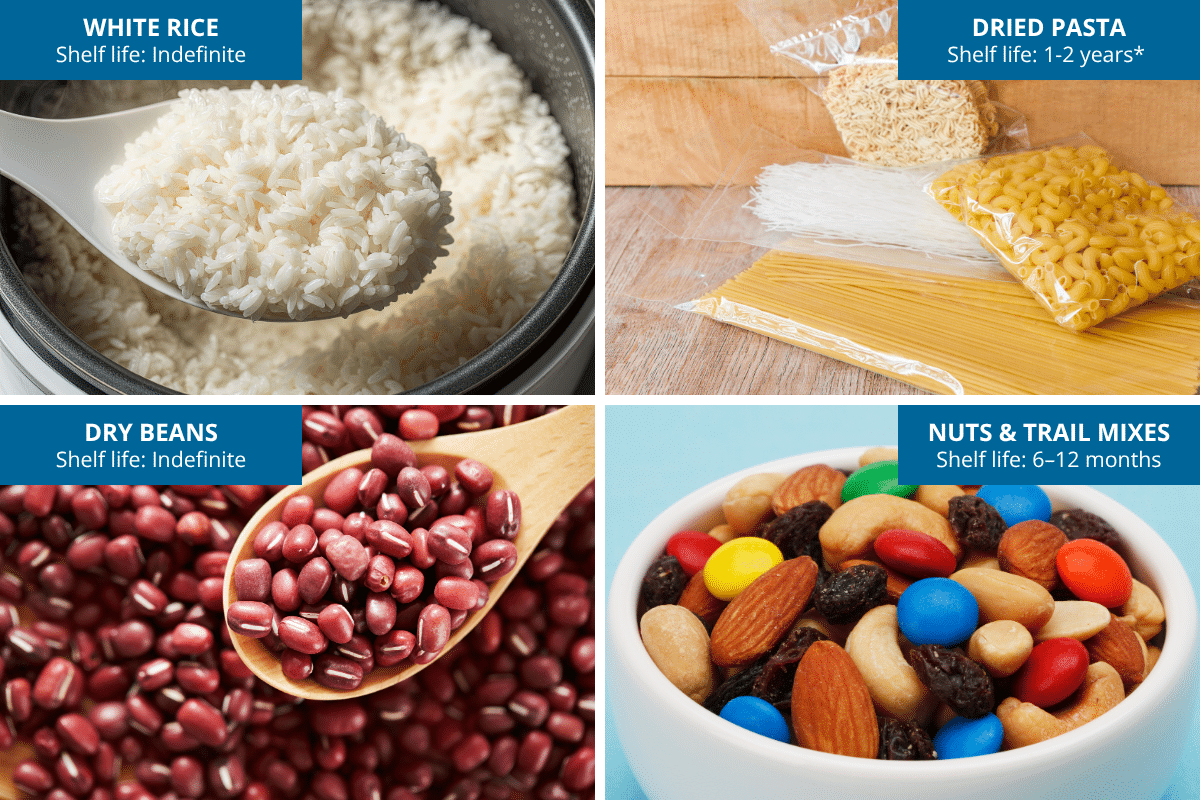
5. White Rice
Shelf life: Indefinite
Nutritionists typically are not fans of white rice, pointing out that brown rice is far superior in terms of vitamins, minerals, antioxidants, and dietary fiber. But brown rice also has a higher oil content than white rice, so it has a much shorter shelf life of just a few months.
White rice is almost indestructible with an indefinite shelf life! Its only enemies are moisture and tiny insects known as rice weevils or flour bugs that find their way into the package, or hatched from eggs that were harvested along with the rice itself.
Storing rice in airtight containers takes care of both problems. However, if you find bugs anyway, discard the rice.
6. Dried Pasta
Shelf life: 1 to 2 years past “best by” date
Fresh pasta is made with eggs and needs to be refrigerated as it is perishable. However, dried pasta made with just semolina wheat flour and water has a super long shelf life as long as the pacakge remains unopened and no moisture seeps into the package.
7. Dry Beans
Shelf life: Indefinite
Dry beans are an excellent choice for your emergency food stockpile because they last indefinitely and provide complete protein. In their dry state, they remain edible and packed with nutrition indefinitely provided they are kept away from moisture.
Dishes like rice and beans provide complete proteins, plenty of carbs, and essential nutrients, making them a reliable meal for any diet or lifestyle. If you want to level up your bean game, The Bean Cookbook from The Bean Institute is a free download packed with recipes and tips that make cooking beans simple, tasty, and even a little fun. I promise, you’ll learn more than you think!
Pro Tip
As beans age, they get even drier meaning they need a longer soak and cook time. That doesn’t make them spoiled or less nutritious. Just plan for a little extra prep, and you’ll enjoy the same hearty, protein-packed results.8. Nuts and Trail Mixes
Shelf life: 6–12 months (longer if vacuum-sealed or stored in a cool, dark place)
Stock vacuum-sealed nuts and trail mixes in your emergency food stockpile for high-energy, convenient snacks. They’re healthful and convenient for snacking during a hurricane, tornado, or another emergency. Look for vacuum-packed containers which prevent the nuts and trail mixes and losing freshness.

9. Granola Bars and Power Bars
Shelf life: Up to 6 months
Healthy and filling, these portable snacks usually stay fresh for at least six months. Plus, they’re an excellent source of carbohydrates. You can get more energy from carbohydrates without tons of food.
10. Freeze-Dried Fruits
Shelf life: Up to 25 years
Freeze-dried fruit is shelf-stable fruit that has undergone a process to remove nearly all of its moisture while retaining flavor and nutrients. It’s very light, with a dry, crispy texture and intense, concentrated fruit flavor. According to some manufacturers, freeze-dried fruit has a shelf-life of 25 to 30 years, unopened, if stored under ideal conditions
11. Apples
Shelf life: Up to 6 months
Apples are a fruit that can stay fresh and crisp for as long as six months if they’re stored in a cold, dark place like a root cellar or cool basement. If they’re kept in a fruit bowl at room temperature, they’ll generally remain at their best for at least two weeks, sometimes as long as a month.
12. Flour
Shelf life: 3 to 6 months sealed; 1 year in the fridge; up to 5 years in a freezer
Many factors influence flour’s shelf life, or the length of time it lasts before beginning to spoil. Most flours stay fresh 3–8 months at room temperature, usually long past their expiration date. However, the specific shelf life depends on the type of flour, its ingredients, and how you store it
You can count on all-purpose flour lasting well for three to six months in its sealed bag, up to one year in the refrigerator and, longer if stored in a freezer.
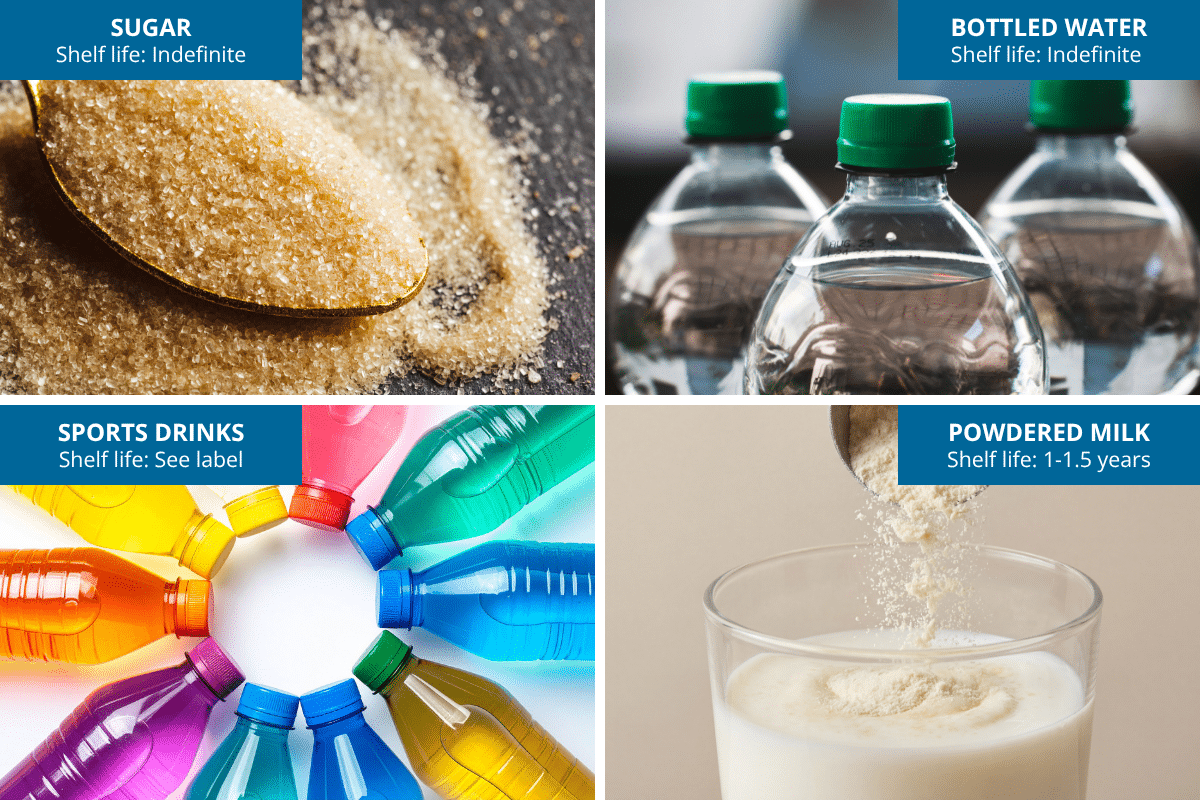
13. Sugar
Shelf life: Indefinite
Sugar is one of the few products that lasts indefinitely. The only problem it presents for cooks is that it can harden. For this reason, plan on sugar having a useful shelf life of about two years.
14. Bottled Water
Shelf life: Indefinite
Here’s the goal: Stock at least a three-day supply. You need at least one gallon per person per day. A normally active person should drink at least a half gallon of water each day. The other half gallon is for adding to food and washing. Start small. By a few bottles every time you’re at the store. Or use your own sterilized containers that you fill from the tap, keep tightly covered.
15. Sports Drinks
Shelf life: As printed on the container
The electrolytes and carbohydrates in beverages like Gatorade or Powerade will help you rehydrate and replenish fluid when water is scarce. These drinks have expiration dates printed on them, so pay attention and rotate your stock accordingly.
16. Powdered Milk
Shelf life: 1 to 1.5 years
Almost all dairy products require refrigeration, so powdered milk and also canned evaporated milk are great stockpile items. These substitutes are an excellent source of calcium and vitamin D when fresh milk is not an option. However, the flavor and texture may change after 18 months or so.

17. Seasonings
Shelf life: Indefinite for most
If you have access to a propane or charcoal stove, you may be doing some cooking. A basic supply of seasonings and sweeteners will improve the flavor of your food, and items often are forgotten when amassing a stockpile.
Pepper should be used within 5 years, after which time it may lose its potency. Other spices vary but generally have a shelf life of years while unopened.
Bouillon cubes have a shelf life of 2 years, which makes this a wonderful option for a stockpile as bouillon is a source of great flavor.
18. Freeze-Dried Coffee
Shelf life: Up to 25 years
Freeze-dried coffee is real coffee that has had all of the moisture removed, resulting in coffee “crystals.” Since all the moisture is removed, it is no longer subject to bacterial contamination. Provided you keep freeze-dried coffee sealed, it will retain all of its flavor and caffeination for many years… up to 25!
19. Ghee
Shelf life: 2 years up to indefinite in freezer
Ghee is “clarified butter,” meaning all milk solids have been removed. Because ghee contains no lactose, it has an amazingly long shelf life. A jar of ghee remains suitable for many months if stored unrefrigerated in a cool dark place. Kept in the freezer, ghee has an indefinite shelf life.
Ghee is a suitable replacement for regular butter, from spreading on toast to popping corn and everything between.
20. Dark Chocolate
Shelf life: 2 to 5 years
Chocolate is an excellent option for stockpiling. With high cacao content and little or no milk, dark chocolate will last much longer than milk chocolate, which contains dairy products subject to earlier spoilage.
High temperatures are bad for all chocolate, but the dark variety should last for a couple of years at temperatures up to about 75 F, and will keep for as long as five years if stored between 60 and 65 F.

21. Honey
Shelf life: Indefinite
Containers of honey you buy in the supermarket generally have a “best by” date. Manufacturers do this because, over time honey can change in color and or form sugar crystals, both of which are perfectly harmless. Truth be told, honey has an indefinite shelf life, even up to decades or generations. An excellent option for your stockpile.
22. Peanut Butter
Shelf life: 2 years
A great source of energy, peanut butter is chock-full of healthful fats and protein. Unless the jar indicates otherwise, you don’t have to refrigerate it after opening. An unopened jar of peanut butter kept at room temperature lasts longer than two years. However, after this time, the oil will likely separate from the solids, drying out the peanut butter. And the flavor may fade, but it is not spoiled or remains safe to eat.
Stored in a dark place at room temperature, it will remain flavorful and safe to eat for at least three months once opened, according to the National Peanut Board.
23. Multivitamins
Shelf life: As printed on the container
Supplements will help replace the nutrients you would have consumed on a normal diet. Pay attention to expiration dates, after which vitamins and other nutritional supplements will begin to lose their potency.
24. Salt
Shelf life: Indefinitely
Salt is an essential item. Humans cannot live with sodium. You can use salt to season cooked meals and make rations taste better.
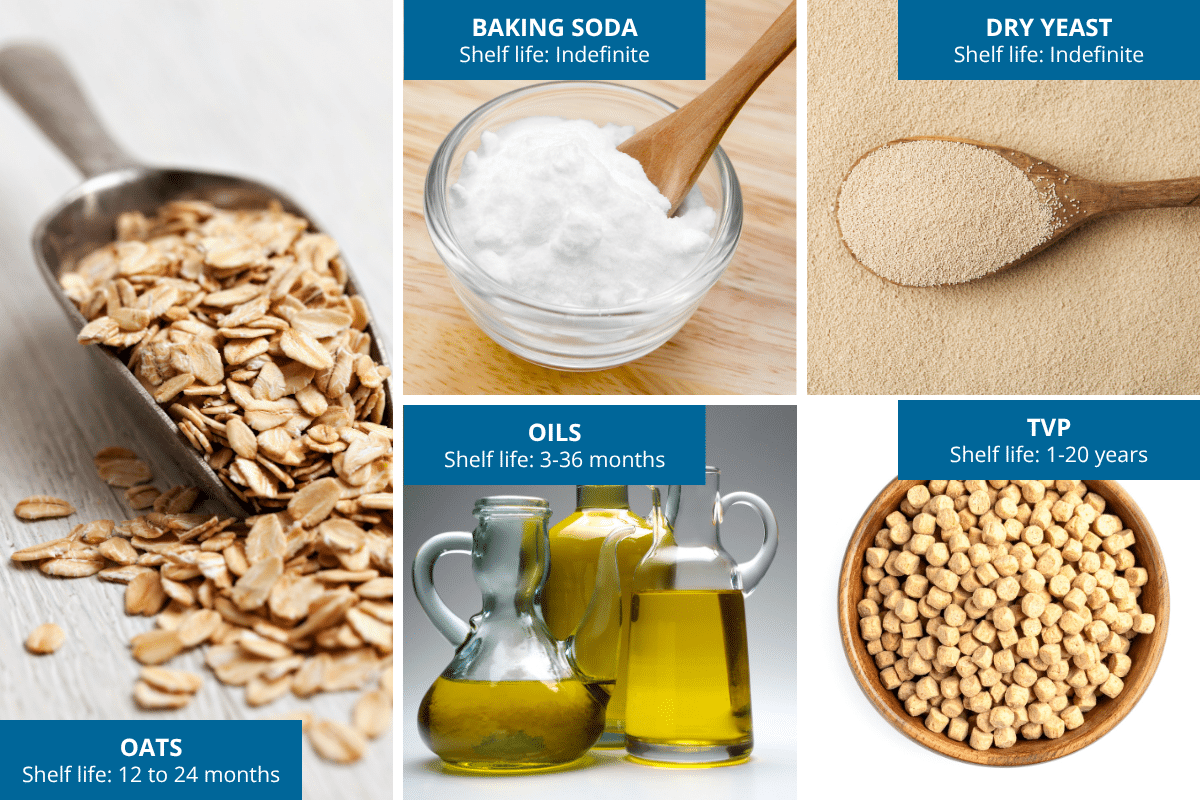
25. Baking Soda
Shelf life: Indefinitely
Cheap and easy to store, you will need this leavening agent for making quick breads and other recipes. Baking soda is a durable item. Check for its “best by” or “best before” date to see how long it should retain its potency. If your baking soda doesn’t come with a “best by” date, the average shelf life of baking soda is 2 to 3 years for unopened packs.
26. Dry Yeast
Shelf life: Indefinitely
When baking yeast is on hand, you can make dozens of foods. You can make breads, add extra protein to your diet, or even as skin and hair treatments. Opened packages of dry yeast (active dry or instant) can be stored in the refrigerator for three to four months. If your yeast is older than this, it may still be good. Proof your yeast to find out if it’s still active by adding 1 teaspoon of sugar and 2 1/4 teaspoons of yeast (one envelope) to 1/4 cup of warm water. Then, wait 10 minutes.
27. Oils
Shelf life: 6 to 36 months
Oils with healthy fats, like olive oil, coconut oil, and avocado oil, are an ideal base for sauces and dressings and store well with a shelf life of 6 months to 1 years. The shelf life of regular vegetable oil all depends on how you store it. Generally speaking, an opened bottle will be good for one to three years.
28. Oats
Shelf life: 12 to 24 months
Oats can last a long time on the shelf. Use them to make quick and hot cereals that are nutrient-dense and packed with protein. You can make oatmeal a dozen different ways, ranging from sweet to savory.
29. Textured Vegetable Protein (TVP)
Shelf life: 12 months to 20 years
Although textured vegetable protein is a standby for vegetarians and vegans, it is an excellent form of protein to have around for emergencies. TVP is lightweight and has little to no flavor, so it can be added to almost anything. Like tofu, it takes on the flavors of whatever it is cooked with. The shelf life of TVP is 10 to 20 years when stored in an airtight container at a cool place (below 70° F. The shelf life is more like one year after opening or not being stored in an airtight container
Storage Areas
When we think of storage areas, it’s usually a basement or garage, both ideal. But what if you live in an apartment, have no basement, or your garage barely fits your vehicle(s)? Get creative! Even in small apartments, you can store your emergency food stockpile in under-bed containers or closets.
- Under beds: Use shallow plastic containers for canned goods and sealed dry foods.
- Closets: Look above the door. Many closets have open space perfect for a wire shelf for lighter items. Just be careful; you don’t want cans rolling off your head.
- Under stairs: Odd-shaped or hard-to-reach spaces under stairs can work surprisingly well with some simple shelving.
Refrigerator and Freezer
What should you do about the food in your refrigerator and freezer if the electricity goes out? Do not open the refrigerator, not even to take a peek, until you absolutely need to get something.
- Refrigerator: If food has been above 40° F for more than four hours, it’s likely unsafe. But if you keep the door closed, the insulated fridge can stay at a safe temperature for an extra hour or two.
- Freezer: Frozen foods with ice crystals or cool to the touch are still safe. Once food warms to around 65° F, bacteria grows more quickly, so be cautious. Keep the freezer door closed to slow thawing.
- Heat alternatives: No electricity? If you can go outdoors, a charcoal grill or propane stove works… never indoors due to ventilation risks. Indoors, a can of Sterno (“canned heat”) can warm small amounts safely.
Bringing It All Together
Building a stockpile isn’t about turning your home into a bunker. Your emergency food stockpile ensures small disruptions don’t become major headaches. Every extra can, bag of rice, or jar of peanut butter is a step toward peace of mind.
Start small, stay consistent, and use what you already buy. Over time, these simple habits create a pantry that’s flexible, practical, and ready for life’s unpredictable moments. You don’t need to predict the next disruption… you just need to be ready when it happens.
Preparedness isn’t about fear. It’s about control, confidence, and a little foresight. With a plan in place, you’ve got all three.
Question: Are you prepared for an emergency? What’s one non-perishable item you’d never skip in your emergency pantry? Share in the comments below.
EverydayCheapskate™ is reader-supported. We participate in the Amazon Services LLC Associates Program and other affiliate advertising programs, designed to provide a means for us to earn from qualifying purchases, at no cost to you.

More from Everyday Cheapskate
 https://www.everydaycheapskate.com/wp-content/uploads/20261006-prime-big-deal-days-have-landed.png
800
1200
Mary Hunt
https://www.everydaycheapskate.com/wp-content/uploads/EC-Logo-by-Mary-Hunt-Tagline-Trimmed.png
Mary Hunt2026-10-05 11:01:432026-10-07 09:02:53EC’s Top Picks from Amazon Prime Big Deal Days 2026
https://www.everydaycheapskate.com/wp-content/uploads/20261006-prime-big-deal-days-have-landed.png
800
1200
Mary Hunt
https://www.everydaycheapskate.com/wp-content/uploads/EC-Logo-by-Mary-Hunt-Tagline-Trimmed.png
Mary Hunt2026-10-05 11:01:432026-10-07 09:02:53EC’s Top Picks from Amazon Prime Big Deal Days 2026 https://www.everydaycheapskate.com/wp-content/uploads/20261004-reduce-healthcare-costs-with-three-habits-healthy-couple-walking-in-autumn-leaves.png
800
1200
Mary Hunt
https://www.everydaycheapskate.com/wp-content/uploads/EC-Logo-by-Mary-Hunt-Tagline-Trimmed.png
Mary Hunt2026-10-04 23:08:572026-10-04 23:09:47How to Reduce Healthcare Costs With 3 Free Daily Habits
https://www.everydaycheapskate.com/wp-content/uploads/20261004-reduce-healthcare-costs-with-three-habits-healthy-couple-walking-in-autumn-leaves.png
800
1200
Mary Hunt
https://www.everydaycheapskate.com/wp-content/uploads/EC-Logo-by-Mary-Hunt-Tagline-Trimmed.png
Mary Hunt2026-10-04 23:08:572026-10-04 23:09:47How to Reduce Healthcare Costs With 3 Free Daily Habits https://www.everydaycheapskate.com/wp-content/uploads/20241004-news-you-can-use-october-everyday-cheapskate-top-news-articles.png
800
1200
Mary Hunt
https://www.everydaycheapskate.com/wp-content/uploads/EC-Logo-by-Mary-Hunt-Tagline-Trimmed.png
Mary Hunt2026-10-04 01:04:052026-10-04 22:10:11News You Can Use • October 2026
https://www.everydaycheapskate.com/wp-content/uploads/20241004-news-you-can-use-october-everyday-cheapskate-top-news-articles.png
800
1200
Mary Hunt
https://www.everydaycheapskate.com/wp-content/uploads/EC-Logo-by-Mary-Hunt-Tagline-Trimmed.png
Mary Hunt2026-10-04 01:04:052026-10-04 22:10:11News You Can Use • October 2026 https://www.everydaycheapskate.com/wp-content/uploads/20261003-woman-hugging-elderly-mother-sandwich-generation-caring-for-aging-parents.png
800
1200
Mary Hunt
https://www.everydaycheapskate.com/wp-content/uploads/EC-Logo-by-Mary-Hunt-Tagline-Trimmed.png
Mary Hunt2026-10-03 10:47:222026-10-03 10:47:25Sandwiched Between Aging Parents and Adult Children
https://www.everydaycheapskate.com/wp-content/uploads/20261003-woman-hugging-elderly-mother-sandwich-generation-caring-for-aging-parents.png
800
1200
Mary Hunt
https://www.everydaycheapskate.com/wp-content/uploads/EC-Logo-by-Mary-Hunt-Tagline-Trimmed.png
Mary Hunt2026-10-03 10:47:222026-10-03 10:47:25Sandwiched Between Aging Parents and Adult Children https://www.everydaycheapskate.com/wp-content/uploads/20261002-cake-mix-chocolate-chip-cookies.png
800
1200
Mary Hunt
https://www.everydaycheapskate.com/wp-content/uploads/EC-Logo-by-Mary-Hunt-Tagline-Trimmed.png
Mary Hunt2026-10-02 19:44:302026-10-02 19:44:30Cake Mix Chocolate Chip Cookies That Taste Homemade
https://www.everydaycheapskate.com/wp-content/uploads/20261002-cake-mix-chocolate-chip-cookies.png
800
1200
Mary Hunt
https://www.everydaycheapskate.com/wp-content/uploads/EC-Logo-by-Mary-Hunt-Tagline-Trimmed.png
Mary Hunt2026-10-02 19:44:302026-10-02 19:44:30Cake Mix Chocolate Chip Cookies That Taste Homemade https://www.everydaycheapskate.com/wp-content/uploads/20260930-cheap-Halloween-party-snacks-for-kids-punch-bowl-mummy-dogs-ghost-bananas.png
800
1200
Mary Hunt
https://www.everydaycheapskate.com/wp-content/uploads/EC-Logo-by-Mary-Hunt-Tagline-Trimmed.png
Mary Hunt2026-10-01 11:08:582026-10-01 11:08:59These Cheap Halloween Snacks Are Almost Too Easy to Make
https://www.everydaycheapskate.com/wp-content/uploads/20260930-cheap-Halloween-party-snacks-for-kids-punch-bowl-mummy-dogs-ghost-bananas.png
800
1200
Mary Hunt
https://www.everydaycheapskate.com/wp-content/uploads/EC-Logo-by-Mary-Hunt-Tagline-Trimmed.png
Mary Hunt2026-10-01 11:08:582026-10-01 11:08:59These Cheap Halloween Snacks Are Almost Too Easy to Make https://www.everydaycheapskate.com/wp-content/uploads/20260927-impossible-lasagna-pie-recipe-with-wooden-serving-spoon-in-white-casserole-dish.png
800
1200
Mary Hunt
https://www.everydaycheapskate.com/wp-content/uploads/EC-Logo-by-Mary-Hunt-Tagline-Trimmed.png
Mary Hunt2026-09-28 09:38:592026-09-28 22:48:34Impossible Lasagna Pie: All the Flavor, None of the Noodles
https://www.everydaycheapskate.com/wp-content/uploads/20260927-impossible-lasagna-pie-recipe-with-wooden-serving-spoon-in-white-casserole-dish.png
800
1200
Mary Hunt
https://www.everydaycheapskate.com/wp-content/uploads/EC-Logo-by-Mary-Hunt-Tagline-Trimmed.png
Mary Hunt2026-09-28 09:38:592026-09-28 22:48:34Impossible Lasagna Pie: All the Flavor, None of the Noodles https://www.everydaycheapskate.com/wp-content/uploads/20260926-pov-from-an-aisle-seat-on-an-airplane.png
800
1200
Mary Hunt
https://www.everydaycheapskate.com/wp-content/uploads/EC-Logo-by-Mary-Hunt-Tagline-Trimmed.png
Mary Hunt2026-09-27 19:14:552026-09-27 19:16:27Confessions of a Woman Who Preflights Her Own Escape
https://www.everydaycheapskate.com/wp-content/uploads/20260926-pov-from-an-aisle-seat-on-an-airplane.png
800
1200
Mary Hunt
https://www.everydaycheapskate.com/wp-content/uploads/EC-Logo-by-Mary-Hunt-Tagline-Trimmed.png
Mary Hunt2026-09-27 19:14:552026-09-27 19:16:27Confessions of a Woman Who Preflights Her Own Escape https://www.everydaycheapskate.com/wp-content/uploads/20260925-best-inexpensive-coffee-grinders-burr-manual-and-electric.png
800
1200
Mary Hunt
https://www.everydaycheapskate.com/wp-content/uploads/EC-Logo-by-Mary-Hunt-Tagline-Trimmed.png
Mary Hunt2026-09-25 11:06:342026-09-28 22:48:36The Coffee Grinder Upgrade That’s Actually Worth It
https://www.everydaycheapskate.com/wp-content/uploads/20260925-best-inexpensive-coffee-grinders-burr-manual-and-electric.png
800
1200
Mary Hunt
https://www.everydaycheapskate.com/wp-content/uploads/EC-Logo-by-Mary-Hunt-Tagline-Trimmed.png
Mary Hunt2026-09-25 11:06:342026-09-28 22:48:36The Coffee Grinder Upgrade That’s Actually Worth It

Many of these things we are storing, like rice, dried beans, etc., won’t be much use without a safe water supply. So, we have been putting as much time and effort into storing water as we do the food supplies. We also have water purification supplies on hand. There is a small stream on our property, but we wouldn’t be able to use it safely without first purifying the water we take from it.
the kitty litter i use comes in 2 gal. jugs. when empty, i catch the water i let run until it gets warm enough. when the jug is full the first time, i use it to flush. this cleans out any clay residue. then i take the label off, and fill it again. i had always been told 3 gallons daily per person, so with the 1 gallon per day, i have about a months supply of water for a family of 3, 5 on alternate weekends. i hide it behind the futon in the living room and stash the rest of it in the kitchen and laundry room. when covid hit, there was an extreme tp shortage in my area. as a veteran of the johnny carson shortage, i already had a year’s supply stashed. i shared it with friends and neighbors. when supplies were readily available again i rebuilt my stash by buying one extra package per week. i refuse to run out of water and tp! i also have about two week’s worth of knorr sides and about a month’s worth of pasta and veg broth. and sauce. and grated cheese.
I am surprised you did not mention freeze dried vegetables. I purchase individual bags from Mother Earth Products. Most companies offer freeze dried meals and not just one vegetable per bag.
Also they take up less room.
I am curious what kind of emergency we are preparing for with a six-month supply? I have always kept a full-stocked pantry and my husband and I could easily eat out of our normal pantry for at least a month, if not two. We are great for being snowed in for several days. Trying to
Imagine what kind of calamity would require 6 months worth of food?
Women in the developing world would be shocked at your advice to discard rice once it gets bugs. You can just rinse it and let the bugs float to the top. Pour off that water and repeat until the water is clear. A “prophylactic” measure to keep this from happening in the first place is indeed to freeze it for a day or 2, as some other commenters have suggested. I also put a bay leaf or 2 in my rice, flour, beans and the like.
Another good way to preserve rice and dried beans is to add some food-grade diatomaceous earth. Not only does it keep bugs at bay, but it also adds nutritional value. Just be sure to use food-grade, and not the kind used in pool filters.
Hello Mary, I am wondering about the storage life of Whey Protein Powder – highly recommended by my doctor for my health. Now that I think of it, maybe it would be much like the life of powdered milk. I will read that part again. Thanks again! I absolutely love reading your news letter each day and go back and reread posts as needed! Thank you more than I can say for all that you educate us about. I have bought 2 of the smaller vacuums you recommend and 2nd one of one of them, and gave to my daughter who loves it for her small apartment, and the Hoover Carpet Shampooer for us. Hoping to get to the carpet shampooing as soon as I do a lot of spot removal first. I will also order the circular stair brush attachment to do our stairs as needed. We have 14 stairs. Anyway, I love what you do!!! You help me more than words can say!!! Sincerely, Gail Forsberg – 75 years of age for a few more months!!! Turning 76 end of Feb of 2023! Lovin’ my life!!! Feeling soooo blessed!!! Love, blessings and gratitude to you always Mary! Rock on!!!
Hi Mary and thanks! We get our water from our well. If the electricity stops, so does the water! Could you suggest other ways to keep/store water? We also have four cats and a small dog. We’re stocking up on their dry food. I buy 6-8 16-lb. bags when I place a regular grocery order but what about when the dry food runs out? Anything you can suggest at all will help! Thanks so much for your columns!!
Shelf life of nuts and trail mixes please
Refer to the dates printed on the product packaging. You can extend that life by vacuum sealing and keeping in a cool place. Even past the date, these products may taste or smell bad but will not become toxic. Use the sniff test if they’ve been sealed well but on the shelf for years.
I can’t get the bean pdf to download. Where can I find another source. Thanks
Try this: Bean Cookbook
GREAT ideas…thanx! What about those of us who are on ‘no salt/low salt’ diets? thanx again!
General rule of thumb: Stockpile what you like to eat. If that’s low-salt items, stockpile them.
If your sugar gets hard, put a slice of bread in it and make sure whatever you use has a tight seal. It may take a day or so to soften up and you may have to stir it several times if you need more then what is on top. Works for both white and brown sugar. I have had sugar go hard many times since I don’t use a lot of it.
Active dry yeast can be stored for years in a freezer without harm or any effect on ability.
You mention using propane a number of times but during power outages knowing a neighbor or friends with a natural gas stove can allow you to eat hot meals easily. I don’t like even the thought of living without my natural gas cooking.
Thank you Mary for years of good advice and ideas. To our food storage pantry my wife and I sat down one evening and made out a 30 day menu of meals we really look forward to eating. We shopped for all these items eventually acquiring a supply to give this 30 day menu for a full year. The most important thing to remember is to store what you like to eat. We as a people don’t just plan to survive but rather to thrive so, in the event that we are caught off guard by some type of crisis we are minimally effected.
Mary – You seem to always post a post just when I need to read it, Hubbs just said to me the other day, maybe it will be a good idea to start stock piling some food stuff, and I said “What kind of stuff can I stock pile?? Then your post appears. One thing I thought of when reading your post is in the freezer, freeze some containers of water. If and when the power goes out the containers of ice will help keep your freezer cooler longer. I have done this for years, (although our power does go out frequently it is not for that reason) I freeze containers of water to help keep my freezer cold and it does not run as often saving electrical dollars.
Who lets dark chocolate sit on a shelf 2-5 years?? In my house we’re lucky if it lasts 2-5 days!
Great idea! I also freeze water in smaller washed half gallon size milk, etc. cartons/jugs for use in coolers in the summer.
Mylar bags sealed with oxygen absorbers extend the life of dry goods even longer. Flour = 10 years. Removing the oxygen also kills any pests and eggs.
I have heard if you store peanut butter upside down the oils don’t separate as easily.
Also, as a side note, I store my cottage cheese upside down in the fridge, even after opening. This increases the life by about 2 weeks I have found.
We have a great big barrel that we have pinto beans and other beans. I keep my Navy beans separate in another bucket (not as big as the barrel) for baked beans. We have I would say a least 1,000 pounds of beans in the barrel. We have had them for 10 years and they are still good. I buy a assortment of beans when we go to sprouts.
As for Rice I buy black brown and other colored rice I do have a lot of it but not as much as beans. I have a lot of white rice for the kids but my husband refuses to eat it. What I do is when I cook the other rice I add a little of the white and the white is colored by the other rices so he does not notice.
I buy lots of pasta when Smiths has it on sale and we are in the town where the store is.
Conventional wisdom says that placing a bag of white rice in the freezer for 48 hours destroys any weevil eggs etc. I have seen this advice on lots of prepper sites.
Pet parents – don’t forget to stockpile some food for your pets! Canned food is usually “best by” two years or so from the date of canning, and probably good for much longer. Same for dry food (kibble). And if you have cats, you might want to have an extra bag or five of litter stashed away somewhere.
Thanks Mary, for this timely topic. When I lived in a Mormon neighborhood, I learned that they have a wonderful tradition of keeping a stockpile of provisions for their families at all times.
We used to tease my mother that she had been a quartermaster in a previous life. She dated every can, bottle and jar that came into the house. She even dated light bulbs so she track how long they lasted! She had my dad build shelves in the basement and she rotated everything so that the oldest was always at the front and the newest at the back. I think that they could have lasted a year with what they had stored. And toilet paper! Let’s just say that when I cleaned out their house after my dad passed, I didn’t need to buy toilet paper for at least 2 years! I’m a complete slacker compared to her.
An interesting history fact about honey: honey has been found in Egyptian tombs, and after being rehydrated, is perfectly safe to eat.
I kept an earthquake closet with supplies to last at least a week. Outdoor stores sell dried meals and fruits for camping which I stocked instead of canned. I also stocked canned Boston brown bread. We ate one meal a month from the closet and replaced it regularly.
We kept a backpack in each car with a change of clothes, tennis shoes, first aid supplies to enable us to hike home in case of road collapse
After going through several rounds of pantry bugs, I now freeze all rice, grain products and beans for at least 24 hours as soon as I bring things home. I’ve even frozen crispy cereal with no change in texture. No more bugs!
Many years ago I started storing my specialty flours, dry milk, bread/graham crumbs, etc. in the freezer. I also put grain and rice products in the freezer for a day to kill any flour bugs that may be in there. If there’s room I leave them in the freezer. All of these items are stored in zipper bags.
AP flour and anything else stored at room temperature are in tightly closed containers.
I’d like to add that yeast, in a tightly sealed container will last indefinitely in the freezer.
One reminder regarding peanut butter – if it is “all natural” ie. no salt, sugar or oil added it does require refrigeration after opening.
Don’t forget “milk on the shelf ” I first found it in Switzerland years ago. Now it’s finally found it’s way to America. It professes 6 months.shelf life unopened and 2 months in the fridge after opening. Taste is remarkably similar to fresh. Brand at WalMart is Parmalat but I’ve found it at Dollar stores also.
When I purchase flour, I always place it in the freezer for 24 hours before using, to kill any unwanted “visitors”. I read that a prolonged freeze kills the bugs that are present in the product when purchased, and I no longer have that problem. I will now do the same for rice. I always wondered if similar bugs affected rice!
We were in Hurricane Andrew years ago so I already knew the value of toilet paper! When the virus started we already had a 5 year supply that we rotate. My point here is rotate. After 5 or 6 years it starts to break down so you do have to rotate it. Toilet paper is made to break down when you flush it so it starts to shred when you use it after a long time….and yes, I did share with family and friend and asked that they replace it when they can.
Unfortunately this post comes at a time when many stores are just recovering from the panic buying that took place since February when the Corona Virus hit out country. Canned goods, beans etc are still in short supply in all stores in my area.
This is a great idea..to add to my emergency pantry a few items at a time! I’m implementing it THIS week! So simple, so easy! Also, I’m now looking at alternate spaces for storage, such as under the stairs or over doors. Thank you so much!!
I fell into the habit years ago of labeling all my canned, bottled and packaged food with a permanent marker before I even put it away. I write the expiration date on the top of the package in large numbers to make it easy to see what foods need to be eaten next in the rotation. If I’m storing it in a container where I only see the tops, I also note what the food is. I would add nut butters and jam to your list. The ever popular peanut butter doesn’t need refrigeration after opening; it’s a protein source that doesn’t need cooking either. I think we’ve all learned in the past few months that a stockpile of toilet paper is a must also, along with some paper towels. Disposable plates, bowls and flatware are helpful, too. And that ever necessary can opener. Imagine if we all had a stockpile that could get us by for a few months. It would have cut down drastically on risky social contact during the pandemic.
One problem I have is the rotation thing. I store canned goods for emergencies, but I seldom eat canned goods. I much prefer fresh and frozen. One method I’ve found is keeping the food for 12-18 months, then donating it and buying new cans. Your info was good and now I need to go clean out my pantry.
Food banks are struggling this year so I am sure they will be happy to see you.
Food banks and church pantries will not accept expired foods in our area. So plan to donate at least a couple months before the best by/exp date on the items, or they may just be tossed.
We are still eating hurricane supplies from 2015. We’ve found canned tomato or fruit products will need to be rotated within a few months of exp/best by date or they will take on a metallic taste due to the acids in the food.
Tip for older dried beans/legumes: add a pinch or two of baking soda to the soak water to help them rehydrate, if really old also add a pinch or two to the cooking water. If you add too much soda, they will get really mushy but still be edible.