

How to Set Up a Homework Station Your Kids Will Actually Use


“Sit down.” “Where’s your pencil?” “Have you even started?” “Is that my pen or yours?” If you’ve said some version of that five nights a week for the last however-many years, welcome to the club. We meet every weeknight from 3:30 to bedtime. Here’s the thing nobody tells you: a homework station won’t make your kid love long division. Mine still don’t, and they’re grown. But the right setup does something almost sneaky. It quietly removes about ten tiny frictions a day that were making the whole ritual harder than it needed to be. And you can build one for under $30. Often for free, with stuff you already own.

The real problem isn’t homework. It’s the ten small stalls before homework. The pencil’s dull. Where’s the sharpener? Where’d the glue stick wander off to? The dog’s barking, the lighting’s bad, and forty-five minutes into “homework time,” not one problem has been solved.
That’s death by a thousand tiny cuts. A homework station’s whole job is to eliminate the cuts. Put everything in one spot, at the right height, with decent light and the right supplies, and kids sit down and start. Not cheerfully, necessarily. But they start. That’s most of the battle right there.
Three Things That Actually Matter (Forget the Pinterest Board)
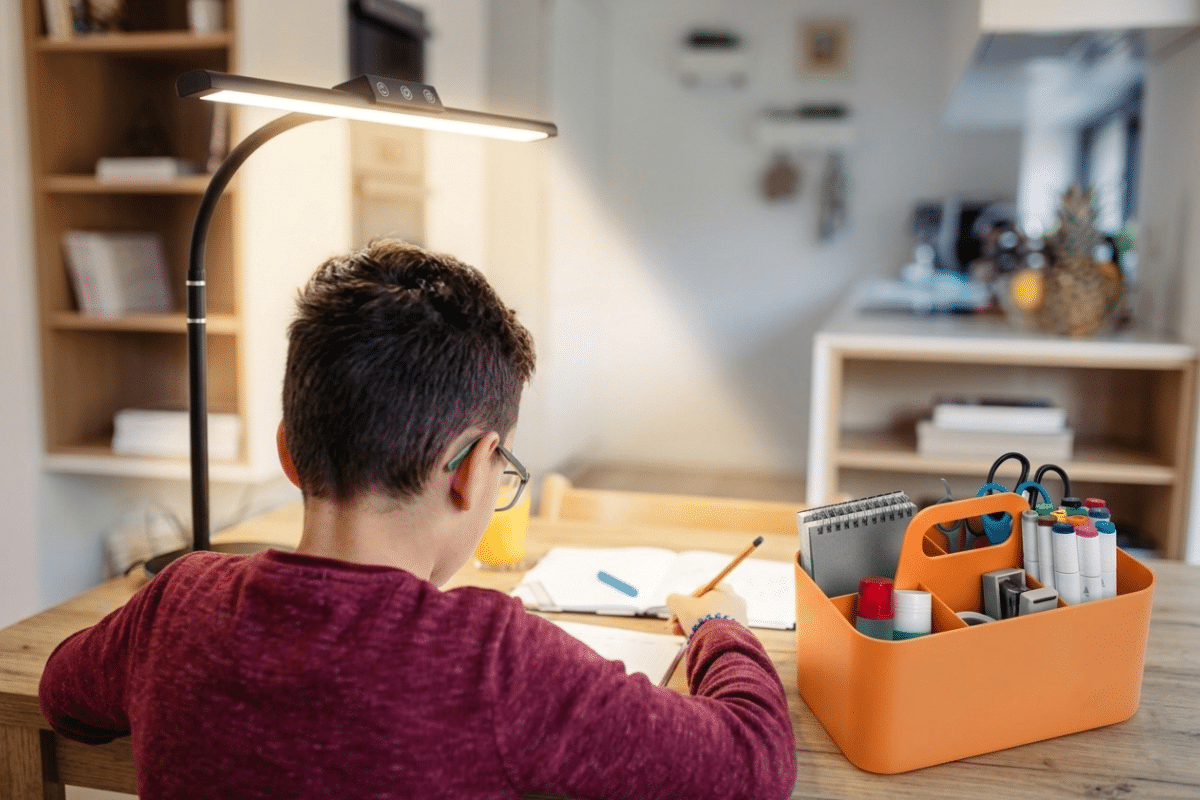
1. Put It Near You, Not Away From You
The most common mistake I see? Tucking the homework spot into a bedroom or basement “so they can concentrate.” Kids don’t want to concentrate alone. They want to be near the noise, the snacks, the dog, and you. Isolate them and they’ll stall, wander, or dig in their heels.
The best spot is in or near the kitchen. A corner of the dining table, a little desk at the end of the counter, even a rolling cart that comes out at 3:30 and disappears at 5. Close enough to help without hovering. Close enough to holler “have you started your reading?” without leaving the stove.
2. Every Supply is Within Arm’s Reach
Every trip away from the desk is an invitation to get distracted, and kids will take that invitation every single time. A small caddy or bin holds everything: pencils, an eraser, a mini sharpener, a pen, glue stick, scissors, a ruler, a highlighter, a few colored pencils, some index cards. Nobody leaves the chair.
Restock it once a month. Five minutes, and it kills the “I need a new pencil” stall tactic dead.
3. Actual Task Lighting, Not Just the Overhead Light
Overhead lighting is fine for finding the remote. It’s not enough for close reading or detail work. A small adjustable LED desk lamp, $15 to $20 anywhere, changes the whole feel of the spot. It also does something psychological: it signals “this is where homework happens,” which helps that mental switch flip.
Go warm-white, not cool-white. Easier on the eyes. And get one with an adjustable neck. Skip the fancy features, you don’t need them.
The Basic Setup, For Under $30
You don’t need new furniture. You almost certainly already own most of this.
- A table or desk you already have. The dining table corner works fine.
- A chair that fits. Feet should touch the floor, or use a footrest. A chair that’s the wrong height kills focus faster than almost anything else on this list.
- A supply caddy or bin, $5 to $10. Target, Dollar Tree, or a plastic container you already own.
- An LED desk lamp, $12 to $20.
- Basic supplies you probably already have. Pencils, pens, erasers, a sharpener, glue, scissors, a ruler, sticky notes.
- A small timer or clock, $3 to $8. A kitchen timer, or an actual clock. Phones are terrible homework tools. We’ll get to that.
That’s the whole list. Twenty to forty dollars, depending on what’s already in a drawer somewhere.
Small Additions That Punch Above Their Weight
Once the basics are handled, a few small upgrades pay for themselves fast.
- A small cork board or dry erase board, mounted at kid-eye-level. Due dates, spelling words, the weekly reading log. This is for the kid to see what’s coming, not for you to leave notes.
- A “done” tray. A shallow bin where finished work lands. It’s the finish line, and something about a physically full tray works on younger kids in a way that “you’re done!” from across the room just doesn’t.
- A basket for the Friday backpack dump. Permission slips, spelling tests, the crumpled mystery paper from the bottom pocket. One basket, sorted on Sunday night, instead of a frantic Monday morning archaeology dig.
- A dedicated spot for the water bottle. Fill it before they sit down. This alone kills the “I need water” break that somehow happens every ten minutes.
- A pre-picked snack, nearby but not on the desk. Crumbs and homework don’t mix. But hunger and focus don’t mix either, so have something ready before the “I’m starving” stall even gets a chance to start.
The Routine Matters as Much as the Station
The setup is half the system. The daily habit running on top of it is the other half, and honestly, it might be the more important half.
- Snack first, homework second. A hungry kid can’t focus, full stop. Ten minutes of a snack and some chatting before you start pays for itself.
- Same time, every day. Predictable beats motivated. For most families, 3:30 to 4:30 works. The exact hour matters less than the fact that it never changes.
- Set a timer for the tough subjects. “Twenty minutes, then a break” is an easier sell than “finish all your math.” Use an actual kitchen timer. A phone timer means a phone on the desk, and we already covered how that goes.
- Be nearby, not hovering. Do your own thing at the kitchen island while they work at the station. Available for questions, not narrating every problem over their shoulder.
- Notice the progress, not the gap. “You got through your reading and half your math, nice work” lands a lot better than “you’ve still got a page left.” Try it. It works on adults too, honestly.
A homework station was never about the perfect setup. It’s about clearing out the daily friction that turns a thirty-minute job into a ninety-minute standoff. Get that part right, and the whole school year gets easier to live with.
Question: What’s the one small thing that changed homework time at your house? A timer, a snack routine, a corner of the kitchen that finally worked? Tell me in the comments. I read every one.
EverydayCheapskate™ is reader-supported. We participate in the Amazon Services LLC Associates Program and other affiliate advertising programs, designed to provide a means for us to earn from qualifying purchases, at no cost to you.

More from Everyday Cheapskate
 https://www.everydaycheapskate.com/wp-content/uploads/20260917-fall-cleaning-checklist.png
800
1200
Mary Hunt
https://www.everydaycheapskate.com/wp-content/uploads/EC-Logo-by-Mary-Hunt-Tagline-Trimmed.png
Mary Hunt2026-09-17 17:11:012026-09-17 17:11:01Fall Cleaning Checklist: 15 Overlooked Spots to Clean
https://www.everydaycheapskate.com/wp-content/uploads/20260917-fall-cleaning-checklist.png
800
1200
Mary Hunt
https://www.everydaycheapskate.com/wp-content/uploads/EC-Logo-by-Mary-Hunt-Tagline-Trimmed.png
Mary Hunt2026-09-17 17:11:012026-09-17 17:11:01Fall Cleaning Checklist: 15 Overlooked Spots to Clean https://www.everydaycheapskate.com/wp-content/uploads/20260913-how-to-winterize-your-home-snowy-driveway-suburban-home.png
800
1200
Mary Hunt
https://www.everydaycheapskate.com/wp-content/uploads/EC-Logo-by-Mary-Hunt-Tagline-Trimmed.png
Mary Hunt2026-09-13 15:32:142026-09-13 15:32:14The Complete Guide to Winterizing Your Home This Fall
https://www.everydaycheapskate.com/wp-content/uploads/20260913-how-to-winterize-your-home-snowy-driveway-suburban-home.png
800
1200
Mary Hunt
https://www.everydaycheapskate.com/wp-content/uploads/EC-Logo-by-Mary-Hunt-Tagline-Trimmed.png
Mary Hunt2026-09-13 15:32:142026-09-13 15:32:14The Complete Guide to Winterizing Your Home This Fall https://www.everydaycheapskate.com/wp-content/uploads/20260830-best-sound-machine-for-better-sleep-woman-hiding-under-comforter.png
800
1200
Mary Hunt
https://www.everydaycheapskate.com/wp-content/uploads/EC-Logo-by-Mary-Hunt-Tagline-Trimmed.png
Mary Hunt2026-09-10 09:51:452026-09-10 09:51:45Best Sound Machine for Better Sleep: 3 Honest Picks
https://www.everydaycheapskate.com/wp-content/uploads/20260830-best-sound-machine-for-better-sleep-woman-hiding-under-comforter.png
800
1200
Mary Hunt
https://www.everydaycheapskate.com/wp-content/uploads/EC-Logo-by-Mary-Hunt-Tagline-Trimmed.png
Mary Hunt2026-09-10 09:51:452026-09-10 09:51:45Best Sound Machine for Better Sleep: 3 Honest Picks https://www.everydaycheapskate.com/wp-content/uploads/20260906-best-can-openers-manual-electric-luxury.png
800
1200
Mary Hunt
https://www.everydaycheapskate.com/wp-content/uploads/EC-Logo-by-Mary-Hunt-Tagline-Trimmed.png
Mary Hunt2026-09-06 18:07:432026-09-06 18:10:39The Best Can Openers That Actually Work (And Won’t Quit on You)
https://www.everydaycheapskate.com/wp-content/uploads/20260906-best-can-openers-manual-electric-luxury.png
800
1200
Mary Hunt
https://www.everydaycheapskate.com/wp-content/uploads/EC-Logo-by-Mary-Hunt-Tagline-Trimmed.png
Mary Hunt2026-09-06 18:07:432026-09-06 18:10:39The Best Can Openers That Actually Work (And Won’t Quit on You) https://www.everydaycheapskate.com/wp-content/uploads/20260824-house-rules-for-adult-children.png
800
1200
Mary Hunt
https://www.everydaycheapskate.com/wp-content/uploads/EC-Logo-by-Mary-Hunt-Tagline-Trimmed.png
Mary Hunt2026-08-24 12:21:382026-08-24 12:23:50House Rules for Adult Children Living at Home (Without Losing Your Mind or Your Garage)
https://www.everydaycheapskate.com/wp-content/uploads/20260824-house-rules-for-adult-children.png
800
1200
Mary Hunt
https://www.everydaycheapskate.com/wp-content/uploads/EC-Logo-by-Mary-Hunt-Tagline-Trimmed.png
Mary Hunt2026-08-24 12:21:382026-08-24 12:23:50House Rules for Adult Children Living at Home (Without Losing Your Mind or Your Garage) https://www.everydaycheapskate.com/wp-content/uploads/20260822-central-AC-maintenance-air-condenser-outdoors.png
800
1200
Mary Hunt
https://www.everydaycheapskate.com/wp-content/uploads/EC-Logo-by-Mary-Hunt-Tagline-Trimmed.png
Mary Hunt2026-08-22 14:19:562026-08-22 14:19:59How to Extend the Life of Your Central AC (5 Late-Summer Tune-Up Tips)
https://www.everydaycheapskate.com/wp-content/uploads/20260822-central-AC-maintenance-air-condenser-outdoors.png
800
1200
Mary Hunt
https://www.everydaycheapskate.com/wp-content/uploads/EC-Logo-by-Mary-Hunt-Tagline-Trimmed.png
Mary Hunt2026-08-22 14:19:562026-08-22 14:19:59How to Extend the Life of Your Central AC (5 Late-Summer Tune-Up Tips) https://www.everydaycheapskate.com/wp-content/uploads/20260817-thrift-store-sign-with-blue-cloudy-sky-in-background.png
800
1200
Mary Hunt
https://www.everydaycheapskate.com/wp-content/uploads/EC-Logo-by-Mary-Hunt-Tagline-Trimmed.png
Mary Hunt2026-08-17 09:17:472026-08-17 09:17:47The Donation Box Mistakes Thrift Stores Wish We’d Skip
https://www.everydaycheapskate.com/wp-content/uploads/20260817-thrift-store-sign-with-blue-cloudy-sky-in-background.png
800
1200
Mary Hunt
https://www.everydaycheapskate.com/wp-content/uploads/EC-Logo-by-Mary-Hunt-Tagline-Trimmed.png
Mary Hunt2026-08-17 09:17:472026-08-17 09:17:47The Donation Box Mistakes Thrift Stores Wish We’d Skip https://www.everydaycheapskate.com/wp-content/uploads/20260815-how-to-water-your-lawn-without-wasting-money.png
800
1200
Mary Hunt
https://www.everydaycheapskate.com/wp-content/uploads/EC-Logo-by-Mary-Hunt-Tagline-Trimmed.png
Mary Hunt2026-08-15 12:45:022026-08-15 12:45:02How to Water Your Lawn Without Wasting Money This Summer
https://www.everydaycheapskate.com/wp-content/uploads/20260815-how-to-water-your-lawn-without-wasting-money.png
800
1200
Mary Hunt
https://www.everydaycheapskate.com/wp-content/uploads/EC-Logo-by-Mary-Hunt-Tagline-Trimmed.png
Mary Hunt2026-08-15 12:45:022026-08-15 12:45:02How to Water Your Lawn Without Wasting Money This Summer https://www.everydaycheapskate.com/wp-content/uploads/20260813-real-hourly-wage-for-a-second-income.png
800
1200
Mary Hunt
https://www.everydaycheapskate.com/wp-content/uploads/EC-Logo-by-Mary-Hunt-Tagline-Trimmed.png
Mary Hunt2026-08-13 21:16:562026-08-13 21:18:10What’s the Real Hourly Wage of Your Second Income Job?
https://www.everydaycheapskate.com/wp-content/uploads/20260813-real-hourly-wage-for-a-second-income.png
800
1200
Mary Hunt
https://www.everydaycheapskate.com/wp-content/uploads/EC-Logo-by-Mary-Hunt-Tagline-Trimmed.png
Mary Hunt2026-08-13 21:16:562026-08-13 21:18:10What’s the Real Hourly Wage of Your Second Income Job?

Leave a Reply
Want to join the discussion?Feel free to contribute!