
The One-Ingredient Litter Box Trick That Costs Pennies

The litter box smells again, and you just cleaned it. Before you spend $8 to $15 on a scented deodorizer your cat probably doesn’t even want, open your pantry. Plain baking soda handles odor control for pennies, no fragrance, no fuss, and no risk of your cat avoiding the box because it smells like a candle store. Here’s exactly how to use it safely, plus the free habits that matter more than any product on the shelf.
This post is for general information and isn’t veterinary advice. Talk to your vet about specific concerns for your cat.
If you own a cat, you already know the math. Clean box plus twenty minutes equals smelly box again. It’s not you. It’s just cats.
Walk down the pet aisle and you’ll find a whole shelf of “freshness” promises in loud packaging, most of them running $8 to $15 a bottle. Baking soda. Activated carbon. A fragrance thrown in for good measure. Here’s the thing nobody on that shelf wants to tell you: your cat doesn’t want the fragrance.
Cats have a sense of smell way sharper than ours, and a lot of them flat-out prefer unscented litter. Load up the box with perfume and some cats decide the bathroom isn’t worth the trip. Then you’ve got a different problem, and it’s a much worse one.
So skip the fancy label. Skip the markup. Use what’s already in your pantry.
The whole “recipe”
That’s it. That’s the ingredient list. No essential oils, no secret blend, no fragrance hiding behind a pretty name. Just the box of Arm & Hammer that’s probably already sitting next to your fridge doing nothing.
Why I won’t touch essential oils for this
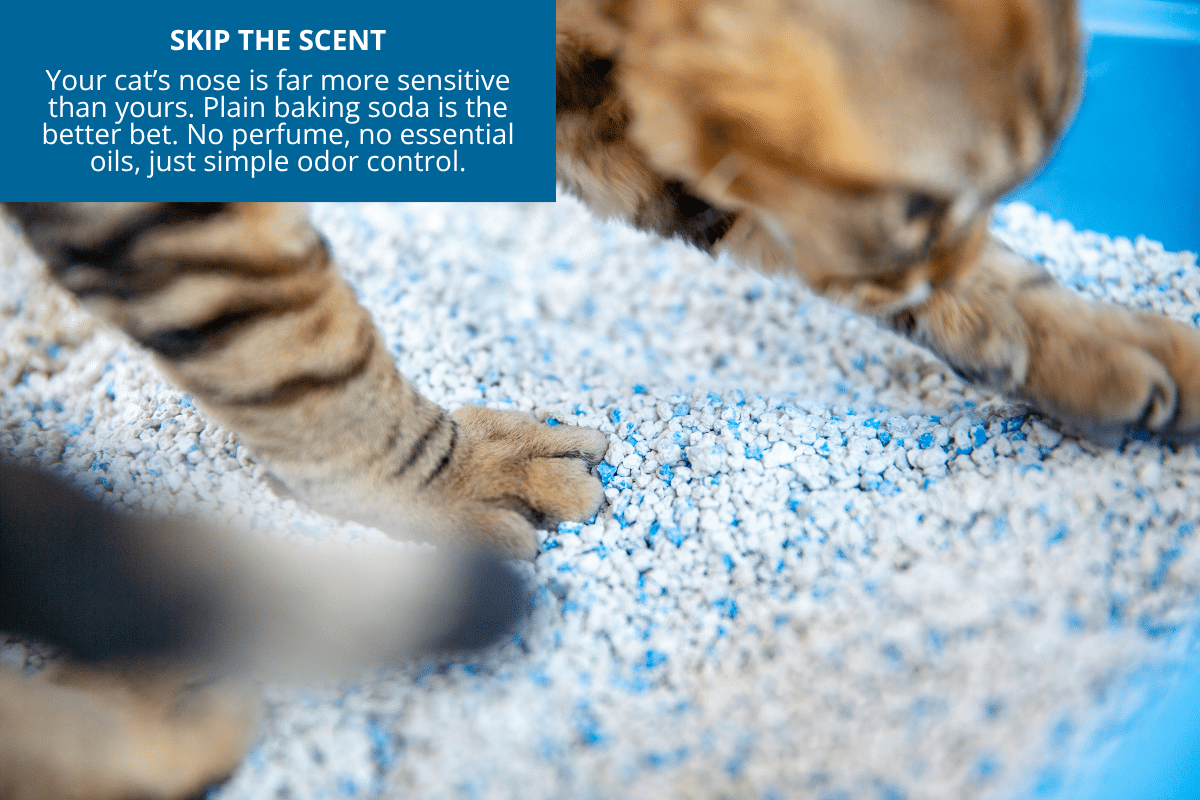
You’ll find plenty of DIY litter deodorizer recipes online that call for a few drops of lavender or tea tree oil. Skip them. I mean it. Essential oils can be toxic to cats. Concentrated oils get absorbed right through the skin or land in their system during grooming, since cats groom constantly. Strong scents can also irritate a cat’s respiratory system.
Your cat is going to walk through this stuff, dig in it and use it every single day. That’s not the place to get creative with a Pinterest recipe.
Fragrance-free isn’t just cheaper. It’s usually safer. Usually, because baking soda has its own rules, and I’d rather you know them upfront than find out the hard way.
The safety part nobody skips
Small, controlled amounts of baking soda sprinkled into litter are considered safe for cats. Large amounts are a different story. Swallow enough of it and a cat can end up with a serious electrolyte imbalance, since baking soda is an alkaline salt and their bodies aren’t built to handle much of it at once. The fine powder can also irritate the lungs, especially in a cat with asthma or another breathing issue.
None of that means skip the baking soda. It means mix it in thoroughly instead of leaving a loose layer of powder sitting on top where a cat can inhale it or lick it off a paw.
How to actually use it
Start small, and let your cat cast the deciding vote. Trust me, they will let you know if they don’t approve.
After you scoop, sprinkle a light dusting of plain baking soda over the litter and work it in thoroughly, not just a quick pass on top. You’re not frosting a cake, and you’re not leaving loose powder for a paw to kick up into the air. A little goes a long way. Dumping in more doesn’t buy you more odor control, and it does raise the amount your cat could end up ingesting.
If your cat suddenly hates the box, stops using it or just seems off about the texture change, stop the baking soda. A clean box your cat actually uses beats a perfectly deodorized box that gets ignored in favor of your rug.
The routine that makes this work
- Scoop at least once a day. Multiple cats or a heavily used box? Twice a day earns its keep.
- Add a light sprinkle of baking soda. Mix it into the existing litter instead of leaving a layer sitting on top like snowfall.
- Keep scooping. Baking soda helps with odor. It does not replace cleaning.
- Wash the box regularly. Empty it out, wash with warm water and a mild unscented soap, rinse well and let it dry fully before you refill it. The ASPCA recommends staying on top of full cleanings, and steers clear of scented cleaners and anything ammonia-based.
What baking soda is actually doing
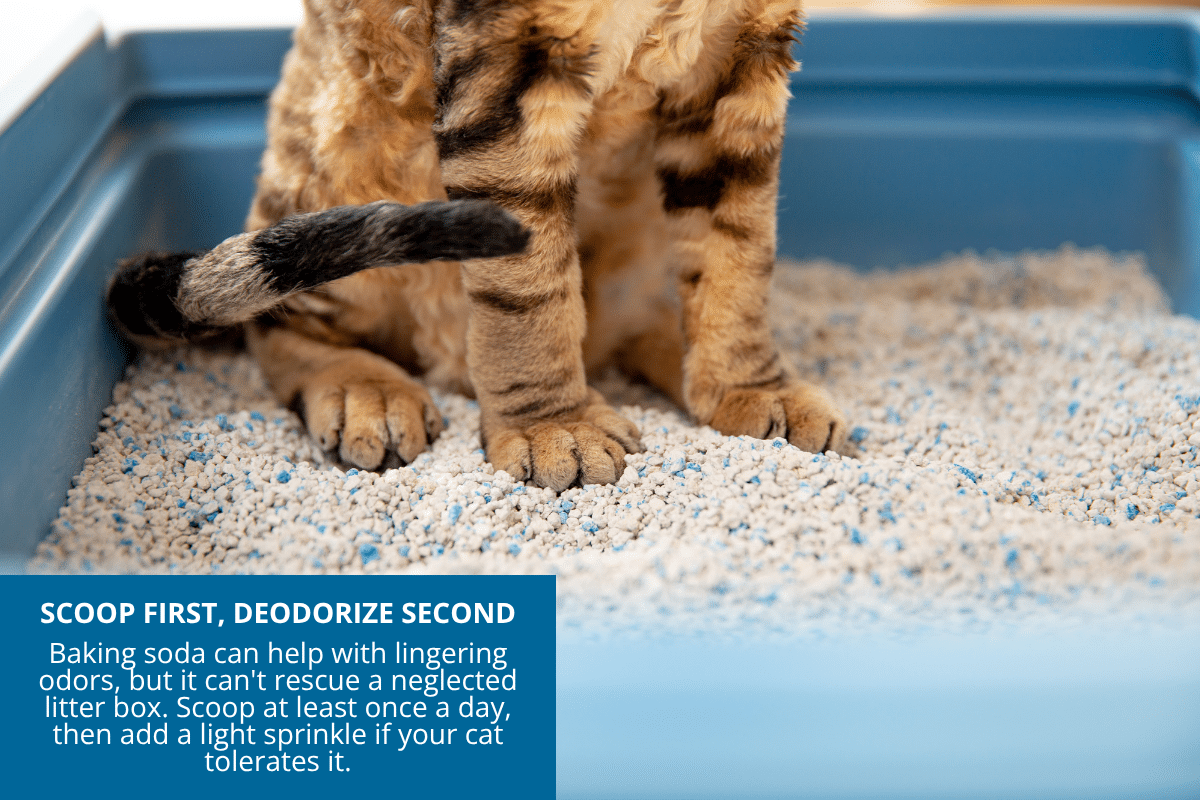
Baking soda, or sodium bicarbonate if you want to get fancy about it, is a household staple that helps neutralize odors instead of just piling another scent on top of the problem.
But let’s be honest about what it can and can’t do.
Baking soda is not a magic eraser. If the box isn’t getting scooped, the litter’s saturated or the plastic itself needs a real scrub, no amount of powder on top is going to fix that. You’re treating a symptom, not the source.
Think of baking soda as the supporting player, not the star. The real formula looks like this: scoop, clean litter, clean box, decent airflow, and a light dusting of baking soda if your cat’s on board.
Already using litter with odor control built in?
If your litter already contains baking soda or activated carbon or some other odor-fighting ingredient, you probably don’t need to add more on top. Different litters use different technology, and “more baking soda” isn’t some universal law that guarantees a fresher house.
And if your cat is already happily using an unscented litter without complaint, I wouldn’t mess with a good thing just because a new bag promises extra freshness. When it comes to cats, leave well enough alone.
The biggest odor fix costs nothing at all
If you’re really trying to get ahead of litter box smell, start here before you buy a single thing.
Scoop every day
This is the one that actually moves the needle. The ASPCA recommends scooping at least once daily, and busier households often do better with more. A quick pass in the morning and again at night can make a bigger difference than any product on the shelf.
Don’t wait for the smell to tell you something’s wrong
A stinky box is a signal that something needs attention. It’s not a cue to reach for more deodorizer. How often you need a full litter swap depends on the litter type, how many cats share the box and how consistent your scooping is. Check the manufacturer’s guidance, then adjust based on what you’re actually seeing.
Wash the box itself
When it’s time for a full change, wash the empty box with warm water and a mild, unscented soap. Rinse well. Let it dry completely before you add fresh litter. Skip the heavily scented cleaners. What smells “fresh” to you and what smells tolerable to your cat are two very different things.
More litter isn’t automatically better
Most cats prefer a shallower layer than you’d think. The ASPCA points to one to two inches as the sweet spot for many cats. Yours might feel differently. If your cat digs like it’s training for the Olympics, adjust accordingly.
Think about where the box actually lives
Put it somewhere quiet and easy to reach, but not somewhere your cat feels cornered. A dark closet behind a closed door might hide the evidence from your guests, but your cat isn’t thinking about your guests. Airflow matters too, but don’t relocate a box purely for ventilation if the new spot makes your cat nervous. A nervous cat finds other places to go.
The multi-cat math
More cats means more traffic, and the standard rule holds up: one litter box per cat, plus one extra. Two cats, three boxes. Don’t argue with the math.
And don’t line them all up in one corner like a public restroom. Spread them around the house so your cats have real options.
Yes, that’s more boxes to clean. But it also means no single box turns into the busiest bathroom in the neighborhood, which is exactly the kind of thing that pushes a cat to start looking elsewhere.
So what does this actually save you?
This is where the baking soda trick earns its keep. Skip the specialty pet-branded deodorizer and grab a plain box or the bigger bag from the baking aisle instead. It’ll cover a lot of ground for not much money.
I won’t hand you an exact number, since it depends on how many boxes you’ve got, how often you use it and what prices look like in your neck of the woods. But the principle holds: you’re using a household staple instead of paying extra just because a label slapped a cat on the front.
That’s the kind of savings I can get behind.
One important caveat
If your cat suddenly starts avoiding the litter box, don’t assume it’s the baking soda or a dirty box and call it a day. Sudden changes in litter box habits can point to something behavioral or medical, including urinary issues that cause a cat to go outside the box entirely. That’s a vet conversation, not a DIY project.
There’s also this: if a cat somehow gets into a real quantity of baking soda, not the light dusting mixed into litter but actual meaningful amounts, watch for vomiting, diarrhea, lethargy, tremors or trouble breathing. Those can show up within a few hours. If you see any of that, call your vet or a pet poison control line right away, don’t wait it out.
And if your cat just doesn’t like the baking soda, take it back out. No deodorizer on earth is worth a cat who’s decided the box isn’t for them anymore.
The bottom line
You don’t need a scented powder, essential oils or a complicated formula to keep a litter box smelling decent. Scoop daily. Keep things clean. Stick with unscented products. Give your cats enough boxes to go around. And if your cat’s willing to tolerate it, mix in a light, well-blended sprinkle of plain baking soda, never a loose layer on top.
Cheaper. Simpler. And nobody in the house has to smell like a lavender field just to use the bathroom.
Question: What’s your best litter box trick? A litter brand, a cleaning routine, a spot in the house that just works? Tell me about it in the comments.
EverydayCheapskate™ is reader-supported. We participate in the Amazon Services LLC Associates Program and other affiliate advertising programs, designed to provide a means for us to earn from qualifying purchases, at no cost to you.

More from Everyday Cheapskate
 https://www.everydaycheapskate.com/wp-content/uploads/20261019-Skeleton-with-sunglasses-in-closet.png
800
1200
Mary Hunt
https://www.everydaycheapskate.com/wp-content/uploads/EC-Logo-by-Mary-Hunt-Tagline-Trimmed.png
Mary Hunt2026-10-19 11:42:432026-10-19 11:42:4310 Easy Last-Minute Halloween Costumes From Your Closet
https://www.everydaycheapskate.com/wp-content/uploads/20261019-Skeleton-with-sunglasses-in-closet.png
800
1200
Mary Hunt
https://www.everydaycheapskate.com/wp-content/uploads/EC-Logo-by-Mary-Hunt-Tagline-Trimmed.png
Mary Hunt2026-10-19 11:42:432026-10-19 11:42:4310 Easy Last-Minute Halloween Costumes From Your Closet https://www.everydaycheapskate.com/wp-content/uploads/20261015-Sweet-pepper-and-onion-relish-in-a-white-bowl-with-crackers-and-fresh-red-bell-peppers.png
800
1200
Mary Hunt
https://www.everydaycheapskate.com/wp-content/uploads/EC-Logo-by-Mary-Hunt-Tagline-Trimmed.png
Mary Hunt2026-10-15 13:14:022026-10-15 13:14:02Sweet Pepper Onion Relish (Perfect Over Cream Cheese)
https://www.everydaycheapskate.com/wp-content/uploads/20261015-Sweet-pepper-and-onion-relish-in-a-white-bowl-with-crackers-and-fresh-red-bell-peppers.png
800
1200
Mary Hunt
https://www.everydaycheapskate.com/wp-content/uploads/EC-Logo-by-Mary-Hunt-Tagline-Trimmed.png
Mary Hunt2026-10-15 13:14:022026-10-15 13:14:02Sweet Pepper Onion Relish (Perfect Over Cream Cheese) https://www.everydaycheapskate.com/wp-content/uploads/20260917-fall-cleaning-checklist.png
800
1200
Mary Hunt
https://www.everydaycheapskate.com/wp-content/uploads/EC-Logo-by-Mary-Hunt-Tagline-Trimmed.png
Mary Hunt2026-09-17 17:11:012026-09-28 22:48:45Fall Cleaning Checklist: 15 Overlooked Spots to Clean
https://www.everydaycheapskate.com/wp-content/uploads/20260917-fall-cleaning-checklist.png
800
1200
Mary Hunt
https://www.everydaycheapskate.com/wp-content/uploads/EC-Logo-by-Mary-Hunt-Tagline-Trimmed.png
Mary Hunt2026-09-17 17:11:012026-09-28 22:48:45Fall Cleaning Checklist: 15 Overlooked Spots to Clean https://www.everydaycheapskate.com/wp-content/uploads/20260908-how-to-stop-puppy-biting-White-And-Black-Border-Collie-Puppy.png
800
1200
Mary Hunt
https://www.everydaycheapskate.com/wp-content/uploads/EC-Logo-by-Mary-Hunt-Tagline-Trimmed.png
Mary Hunt2026-09-07 12:05:572026-09-28 22:49:05How to Train a Puppy Not to Bite (Without Buying a Single Thing)
https://www.everydaycheapskate.com/wp-content/uploads/20260908-how-to-stop-puppy-biting-White-And-Black-Border-Collie-Puppy.png
800
1200
Mary Hunt
https://www.everydaycheapskate.com/wp-content/uploads/EC-Logo-by-Mary-Hunt-Tagline-Trimmed.png
Mary Hunt2026-09-07 12:05:572026-09-28 22:49:05How to Train a Puppy Not to Bite (Without Buying a Single Thing) https://www.everydaycheapskate.com/wp-content/uploads/20260902-pumpkin-spice-latte-recipe-homemade-diy.png
800
1200
Mary Hunt
https://www.everydaycheapskate.com/wp-content/uploads/EC-Logo-by-Mary-Hunt-Tagline-Trimmed.png
Mary Hunt2026-09-02 16:16:022026-09-02 16:18:35Homemade Pumpkin Spice Latte Recipe (Cheaper, Better, Faster)
https://www.everydaycheapskate.com/wp-content/uploads/20260902-pumpkin-spice-latte-recipe-homemade-diy.png
800
1200
Mary Hunt
https://www.everydaycheapskate.com/wp-content/uploads/EC-Logo-by-Mary-Hunt-Tagline-Trimmed.png
Mary Hunt2026-09-02 16:16:022026-09-02 16:18:35Homemade Pumpkin Spice Latte Recipe (Cheaper, Better, Faster) https://www.everydaycheapskate.com/wp-content/uploads/20260831-Portrait-of-a-Pitbull-on-a-yellow-background-homemade-dog-treat-recipes.png
800
1200
Mary Hunt
https://www.everydaycheapskate.com/wp-content/uploads/EC-Logo-by-Mary-Hunt-Tagline-Trimmed.png
Mary Hunt2026-08-31 13:06:072026-09-28 22:49:173 Homemade Dog Treats Recipes Your Dog Will Love Most
https://www.everydaycheapskate.com/wp-content/uploads/20260831-Portrait-of-a-Pitbull-on-a-yellow-background-homemade-dog-treat-recipes.png
800
1200
Mary Hunt
https://www.everydaycheapskate.com/wp-content/uploads/EC-Logo-by-Mary-Hunt-Tagline-Trimmed.png
Mary Hunt2026-08-31 13:06:072026-09-28 22:49:173 Homemade Dog Treats Recipes Your Dog Will Love Most https://www.everydaycheapskate.com/wp-content/uploads/20260826-DIY-cat-litter-deodorizer-kitten-looking-up-at-camera-from-box.png
800
1200
Mary Hunt
https://www.everydaycheapskate.com/wp-content/uploads/EC-Logo-by-Mary-Hunt-Tagline-Trimmed.png
Mary Hunt2026-08-25 21:17:362026-09-28 22:49:26The One-Ingredient Litter Box Trick That Costs Pennies
https://www.everydaycheapskate.com/wp-content/uploads/20260826-DIY-cat-litter-deodorizer-kitten-looking-up-at-camera-from-box.png
800
1200
Mary Hunt
https://www.everydaycheapskate.com/wp-content/uploads/EC-Logo-by-Mary-Hunt-Tagline-Trimmed.png
Mary Hunt2026-08-25 21:17:362026-09-28 22:49:26The One-Ingredient Litter Box Trick That Costs Pennies https://www.everydaycheapskate.com/wp-content/uploads/20260822-central-AC-maintenance-air-condenser-outdoors.png
800
1200
Mary Hunt
https://www.everydaycheapskate.com/wp-content/uploads/EC-Logo-by-Mary-Hunt-Tagline-Trimmed.png
Mary Hunt2026-08-22 14:19:562026-09-28 22:49:43How to Extend the Life of Your Central AC (5 Late-Summer Tune-Up Tips)
https://www.everydaycheapskate.com/wp-content/uploads/20260822-central-AC-maintenance-air-condenser-outdoors.png
800
1200
Mary Hunt
https://www.everydaycheapskate.com/wp-content/uploads/EC-Logo-by-Mary-Hunt-Tagline-Trimmed.png
Mary Hunt2026-08-22 14:19:562026-09-28 22:49:43How to Extend the Life of Your Central AC (5 Late-Summer Tune-Up Tips) https://www.everydaycheapskate.com/wp-content/uploads/20260809-how-to-get-the-smell-out-of-towels-stack-of-towels-sitting-with-candle-in-bright-natural-light.png
800
1200
Mary Hunt
https://www.everydaycheapskate.com/wp-content/uploads/EC-Logo-by-Mary-Hunt-Tagline-Trimmed.png
Mary Hunt2026-08-08 16:48:552026-08-08 16:50:57How to Get Smell Out of Towels: The 2-Wash Fix That Works
https://www.everydaycheapskate.com/wp-content/uploads/20260809-how-to-get-the-smell-out-of-towels-stack-of-towels-sitting-with-candle-in-bright-natural-light.png
800
1200
Mary Hunt
https://www.everydaycheapskate.com/wp-content/uploads/EC-Logo-by-Mary-Hunt-Tagline-Trimmed.png
Mary Hunt2026-08-08 16:48:552026-08-08 16:50:57How to Get Smell Out of Towels: The 2-Wash Fix That Works

Mary, thank you for this! I’ve lived with cats for 68 years and volunteer several times a week at a cat shelter/rescue. The biggest problem with litter boxes is people not scooping and cleaning often enough. They leave waste in the box and try to perfume it away. Honestly, that’s like a person not flushing the toilet. We need to scoop any time we think of it or become aware that someone’s used her litter box. We need to clean the litter boxes with water and soap and disinfectant regularly. As you mentioned, essential oils can be toxic to cats in any amount, and a death from liver failure is a terrible one. I agree with the baking soda choice. However, if I scoop whenever I hear someone scratching in the boxes, I don’t even have to have that. Also, I loved your info about humanely training puppies not to bite. We use those solild suggestions you made at the cat shelter, too, as far as calmly removing yourself rather than punishing, and then rewarding the desired behaviors. Merci!
I seem to remember an article on using Nok Out for the litter box. Would you mind refreshing my memory? I have a whole gallon of it and would like to put it to good use. Despite cleaning the box twice a day, the smell is getting overwhelming from my 1 cat. (and no, he doesn’t have any medical issues causing this) Thanks!
Here you go – https://www.everydaycheapskate.com/litter-box-care-and-cleaning-basics-you-should-know/
3 cats, only one large box w/ventilated cover – cleaned daily – no real issues, however, living in the country my cats are allowed inside/outside and one will let us know when he needs to go outside like a dog even in winter. Still, winter means cleaning more often as all stay in more often.
In answer to some of the questions/issues, the box is on a large boot tray so most of the tracking and “over spray” when that happens doesn’t travel through the house. btw: we have several safe areas for them outside in case of hawks or coyotes.
What we do for our pets, eh? If you’re gonna have them, take care of them — they are not just stuffed toys.
I have two indoor adult cats and three litter boxes. Using an unscented cat litter and 1/2 cup of baking soda mixed through for each, works for everyone. I scoop the boxes 3-4 times a week and use about 4 inches of litter per box. There’s a mat under each box to limit tracking. Every few months, the boxes are scrubbed out, or replaced. Spoons are cleaned after each use by soaking in hot water. Please spend a bit more and use a litter that promises low dust.
We have three cats and use a large plastic container as their litter box. The container is one of those under the bed storage bins. It works great! My husband, bless his heart, is in charge of litter box cleanup. The box is tucked in a corner of “his” bathroom.
I use newspaper to line my cats’ litter boxes. Box, newspaper, plastic liner, newspaper, baking soda, litter, soda mixed in.
The first 3 layers make it easy to get the litter out by rolling it up and putting/sliding a garbage under it. The newspaper helps absorb the oder.
Good ideas — the shelter I volunteered for uses newspaper which was totally emptied everyday. Every cat had their own box + a few scattered around the play room.
i have two cats and two litter boxes. there really are no other places to put a third one. one is in the laundry room and one is in my son’s room. there are two other bedrooms but one of the cats is not allowed in them unsupervised because he doesn’t know how to behave. he is not allowed in the one bathroom for the same reason. he can’t get to my bathroom because he’d have to be allowed in my room to get there. what we have, works for us. they each use both pans. what i’d like to know is how do i keep the litter in the box, and not all over the laundry room and kitchen floor. i go barefoot in the house and i hate the feel of litter on my feet. i do have a mat that’s supposed to take care of that but it doesn’t. the pan is deep enough that normal use shouldn’t allow that. i think the one is doing that on purpose to get even with me for not allowing him free access to my room. he does have an evil sense of humor. he knows one granddaughter is afraid of him and he plays with that.