

How to Get Smell Out of Towels: The 2-Wash Fix That Works


Pull a towel out of the dryer, bury your face in it, and get hit with mildew. Not exactly the spa moment you were going for. I hear about this one constantly, and there’s a reason it’s newer: those water-saving front-loading washers everyone loves are also really good at not rinsing detergent all the way out. Good news: you don’t need new towels.

If my inbox is any indication, smelly towels have become one of the great unsolved mysteries of modern laundry.
You don’t need new towels. You need about 45 minutes, some white vinegar, and a box of baking soda you probably already have in the fridge.
Why your towels smell (even though you just washed them)
That musty, mildewy smell isn’t your imagination and it isn’t a sign your towels are done for. It’s buildup. Detergent and fabric softener residue that never fully rinsed out, sitting there in the fibers, staying damp between showers. Damp plus residue is basically a welcome mat for bacteria. That’s your smell.
It’s also why your towels have gone stiff and scratchy instead of soft and fluffy. All that leftover soap coats the fibers, so instead of absorbing water like a towel should, it just kind of… repels it. You end up drying off with something closer to a cardboard washcloth.
More is not more here. I learned this one the hard way, back when I figured extra detergent meant extra clean. It meant extra crunchy.
Vinegar or baking soda? Do both, just not together
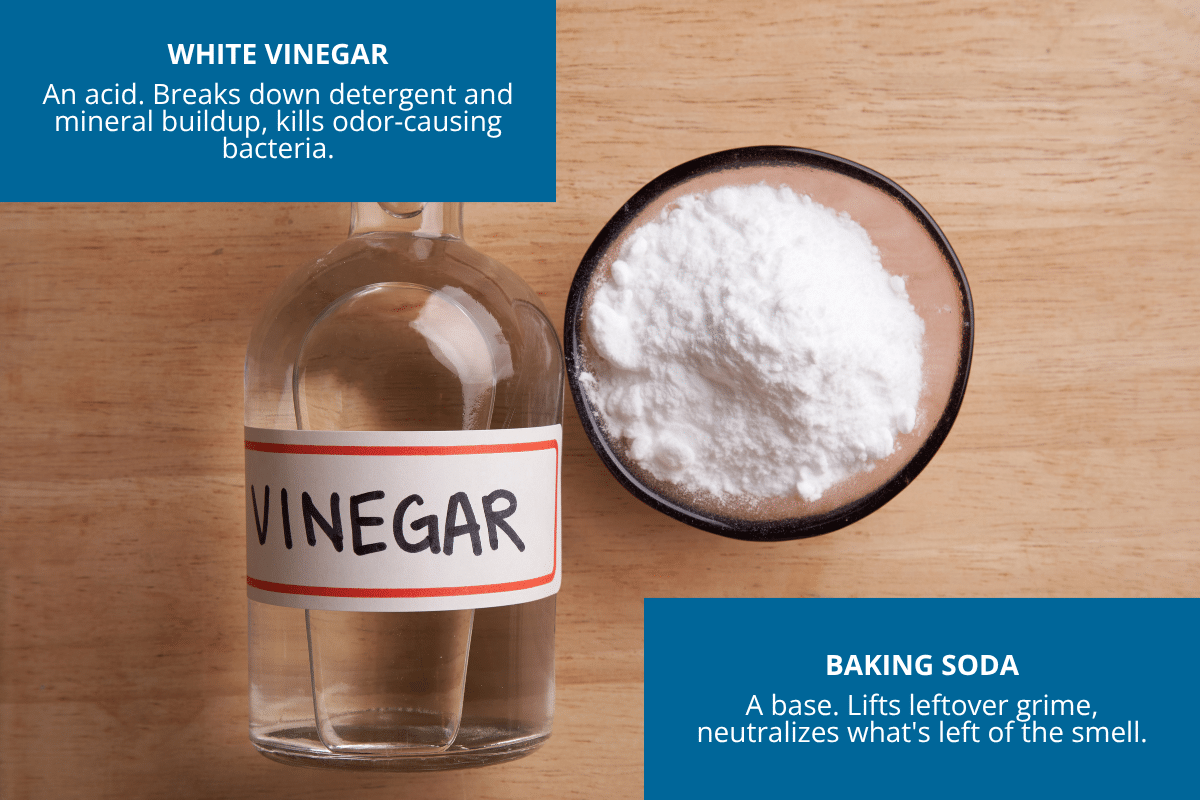
This is where people go wrong. They dump vinegar and baking soda into the same load at the same time, figuring they’re doubling up on cleaning power. Instead, the acid and the base mostly just cancel each other out and you’re left with clean-smelling, still-stinky towels.
Run them in two separate washes and each one gets to do its actual job:
- White vinegar is an acid. It breaks down the mineral and detergent buildup coating your towels and kills the bacteria causing the odor.
- Baking soda is an alkaline. It goes after leftover grime and neutralizes whatever smell is left behind.
One after the other, not mixed. Think of it as a one-two punch instead of a wasted handshake.


The towel reset: two washes, no special products
Wash one: vinegar
Load your towels loosely into the machine. Don’t cram them in; they need room to actually agitate against the water. Set the hottest water your machine offers. If your water heater can hit 140°F, use it. If it can’t, boil a pot on the stove and add it in to help the temperature along.
Pour in 2 cups of white vinegar, no detergent this round, and run a full cycle. When it’s done, leave the towels sitting in the machine instead of pulling them out right away.
Wash two: baking soda
Fill the machine with hot water again. Add 1 cup of baking soda, then run a complete cycle.
If your water heater caps out below 120°F, don’t sweat it. You can do both washes in a big bin or the bathtub instead. Boil water on the stove and add it in until you’re as close to 140°F as you can get.
Dry completely, no shortcuts
Air-dry outside if you can, or toss them in the dryer with wool dryer balls. Either way, they need to come out bone dry. Any leftover dampness is just inviting the smell right back.
Give them a sniff test once they’re dry. Still not quite right? Run both washes again. It sounds like a lot, but a stack of $40 towels is worth 90 more minutes of your time.
Keeping them fresh once you’ve fixed them
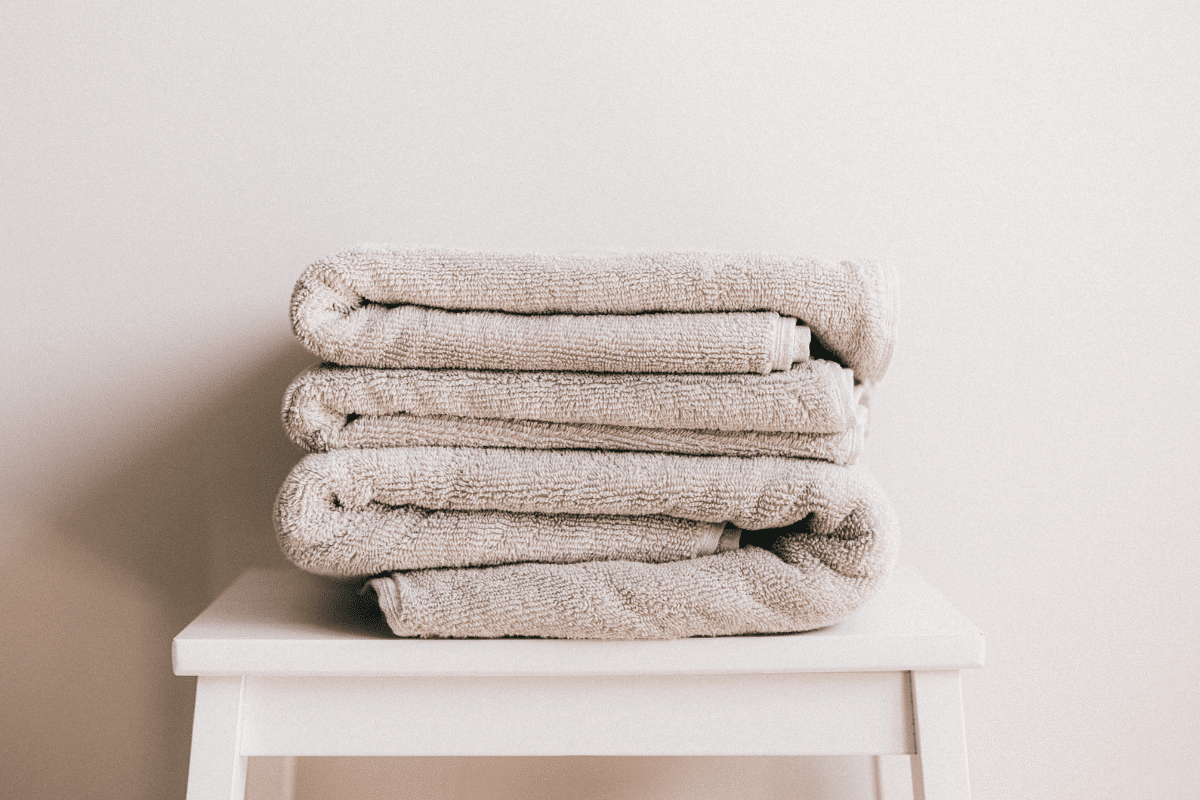
Here’s where I save you from doing this whole process again in three months.
Use less detergent than you think you need
Check your machine’s manual for the actual recommended amount, especially if you have an HE washer. Those machines use less water, so they need less soap to begin with. Overdoing it is the number one reason towels end up smelly and stiff again.
Skip the fabric softener and dryer sheets entirely on towels
I know, they smell nice. But that scent comes from a waxy coating that sits on the fibers and blocks absorbency, which is exactly what got you into this mess. A towel’s whole job is soaking up water. Don’t sabotage it.
Add a half cup of white vinegar to the rinse cycle every so often as maintenance.
It keeps residue from building back up so you’re not starting from scratch every few months.
Always dry towels completely before folding them away
A damp towel folded into a linen closet is a bacteria colony waiting to happen. If you’re not sure, give it another 20 minutes in the dryer. Better safe than smelly.
As for how long a towel should actually last you: if you’re washing and drying them properly, a good set can go two to three years before you need to think about replacing it. Smelly and stiff isn’t a sign of age. It’s a sign of buildup, and buildup is fixable.
I’d rather spend a little more on decent towels and take care of them than keep replacing cheap ones every year. That’s not a splash-out purchase, that’s just doing the math.
Question: What’s your go-to laundry fix that other people never seem to know about? Tell me in the comments. I collect these like other people collect coupons.
EverydayCheapskate™ is reader-supported. We participate in the Amazon Services LLC Associates Program and other affiliate advertising programs, designed to provide a means for us to earn from qualifying purchases, at no cost to you.

More from Everyday Cheapskate
 https://www.everydaycheapskate.com/wp-content/uploads/20260826-DIY-cat-litter-deodorizer-kitten-looking-up-at-camera-from-box.png
800
1200
Mary Hunt
https://www.everydaycheapskate.com/wp-content/uploads/EC-Logo-by-Mary-Hunt-Tagline-Trimmed.png
Mary Hunt2026-08-25 21:17:362026-09-28 22:49:26The One-Ingredient Litter Box Trick That Costs Pennies
https://www.everydaycheapskate.com/wp-content/uploads/20260826-DIY-cat-litter-deodorizer-kitten-looking-up-at-camera-from-box.png
800
1200
Mary Hunt
https://www.everydaycheapskate.com/wp-content/uploads/EC-Logo-by-Mary-Hunt-Tagline-Trimmed.png
Mary Hunt2026-08-25 21:17:362026-09-28 22:49:26The One-Ingredient Litter Box Trick That Costs Pennies https://www.everydaycheapskate.com/wp-content/uploads/20260819-dry-clean-only.png
800
1200
Mary Hunt
https://www.everydaycheapskate.com/wp-content/uploads/EC-Logo-by-Mary-Hunt-Tagline-Trimmed.png
Mary Hunt2026-08-19 23:38:122026-09-28 22:49:48The Truth About “Dry Clean Only” (And When I Actually Listen to It)
https://www.everydaycheapskate.com/wp-content/uploads/20260819-dry-clean-only.png
800
1200
Mary Hunt
https://www.everydaycheapskate.com/wp-content/uploads/EC-Logo-by-Mary-Hunt-Tagline-Trimmed.png
Mary Hunt2026-08-19 23:38:122026-09-28 22:49:48The Truth About “Dry Clean Only” (And When I Actually Listen to It) https://www.everydaycheapskate.com/wp-content/uploads/20260809-how-to-get-the-smell-out-of-towels-stack-of-towels-sitting-with-candle-in-bright-natural-light.png
800
1200
Mary Hunt
https://www.everydaycheapskate.com/wp-content/uploads/EC-Logo-by-Mary-Hunt-Tagline-Trimmed.png
Mary Hunt2026-08-08 16:48:552026-08-08 16:50:57How to Get Smell Out of Towels: The 2-Wash Fix That Works
https://www.everydaycheapskate.com/wp-content/uploads/20260809-how-to-get-the-smell-out-of-towels-stack-of-towels-sitting-with-candle-in-bright-natural-light.png
800
1200
Mary Hunt
https://www.everydaycheapskate.com/wp-content/uploads/EC-Logo-by-Mary-Hunt-Tagline-Trimmed.png
Mary Hunt2026-08-08 16:48:552026-08-08 16:50:57How to Get Smell Out of Towels: The 2-Wash Fix That Works https://www.everydaycheapskate.com/wp-content/uploads/20260729-the-problem-with-fabric-softener-sitting-on-a-washer.png
800
1200
Mary Hunt
https://www.everydaycheapskate.com/wp-content/uploads/EC-Logo-by-Mary-Hunt-Tagline-Trimmed.png
Mary Hunt2026-07-29 13:45:412026-07-29 13:47:50Fabric Softener Is Wrecking Your Laundry. Here’s What Actually Works.
https://www.everydaycheapskate.com/wp-content/uploads/20260729-the-problem-with-fabric-softener-sitting-on-a-washer.png
800
1200
Mary Hunt
https://www.everydaycheapskate.com/wp-content/uploads/EC-Logo-by-Mary-Hunt-Tagline-Trimmed.png
Mary Hunt2026-07-29 13:45:412026-07-29 13:47:50Fabric Softener Is Wrecking Your Laundry. Here’s What Actually Works. https://www.everydaycheapskate.com/wp-content/uploads/20260703-home-decor.png
800
1200
Mary Hunt
https://www.everydaycheapskate.com/wp-content/uploads/EC-Logo-by-Mary-Hunt-Tagline-Trimmed.png
Mary Hunt2026-07-03 20:46:552026-09-28 22:51:4110 Everyday Items You Never Think to Wash (But Should)
https://www.everydaycheapskate.com/wp-content/uploads/20260703-home-decor.png
800
1200
Mary Hunt
https://www.everydaycheapskate.com/wp-content/uploads/EC-Logo-by-Mary-Hunt-Tagline-Trimmed.png
Mary Hunt2026-07-03 20:46:552026-09-28 22:51:4110 Everyday Items You Never Think to Wash (But Should) https://www.everydaycheapskate.com/wp-content/uploads/20260626-homemade-stain-paste-sitting-on-wooden-countertop-in-laundry-room-with-washer-and-dryer.png
800
1200
Mary Hunt
https://www.everydaycheapskate.com/wp-content/uploads/EC-Logo-by-Mary-Hunt-Tagline-Trimmed.png
Mary Hunt2026-06-26 17:41:192026-09-28 22:52:13Homemade Laundry Stain Paste That Works for Pennies
https://www.everydaycheapskate.com/wp-content/uploads/20260626-homemade-stain-paste-sitting-on-wooden-countertop-in-laundry-room-with-washer-and-dryer.png
800
1200
Mary Hunt
https://www.everydaycheapskate.com/wp-content/uploads/EC-Logo-by-Mary-Hunt-Tagline-Trimmed.png
Mary Hunt2026-06-26 17:41:192026-09-28 22:52:13Homemade Laundry Stain Paste That Works for Pennies https://www.everydaycheapskate.com/wp-content/uploads/20260625-striped-two-piece-and-red-one-piece-bathing-suit-how-to-make-swimsuits-last-longer.png
800
1200
Mary Hunt
https://www.everydaycheapskate.com/wp-content/uploads/EC-Logo-by-Mary-Hunt-Tagline-Trimmed.png
Mary Hunt2026-06-25 22:28:472026-09-28 22:52:31How to Care for Swimsuits and Make Them Last Years
https://www.everydaycheapskate.com/wp-content/uploads/20260625-striped-two-piece-and-red-one-piece-bathing-suit-how-to-make-swimsuits-last-longer.png
800
1200
Mary Hunt
https://www.everydaycheapskate.com/wp-content/uploads/EC-Logo-by-Mary-Hunt-Tagline-Trimmed.png
Mary Hunt2026-06-25 22:28:472026-09-28 22:52:31How to Care for Swimsuits and Make Them Last Years https://www.everydaycheapskate.com/wp-content/uploads/20260624-why-does-my-ice-taste-weird-soda-tea-lemonade-juice.png
800
1200
Mary Hunt
https://www.everydaycheapskate.com/wp-content/uploads/EC-Logo-by-Mary-Hunt-Tagline-Trimmed.png
Mary Hunt2026-06-24 17:10:532026-09-28 22:52:34Why Does My Ice Taste Weird? Here’s the Answer
https://www.everydaycheapskate.com/wp-content/uploads/20260624-why-does-my-ice-taste-weird-soda-tea-lemonade-juice.png
800
1200
Mary Hunt
https://www.everydaycheapskate.com/wp-content/uploads/EC-Logo-by-Mary-Hunt-Tagline-Trimmed.png
Mary Hunt2026-06-24 17:10:532026-09-28 22:52:34Why Does My Ice Taste Weird? Here’s the Answer https://www.everydaycheapskate.com/wp-content/uploads/20260618-retriever-labrador-on-white-rug-in-bright-contemporary-living-room-pet-stains-and-odors.png
800
1200
Mary Hunt
https://www.everydaycheapskate.com/wp-content/uploads/EC-Logo-by-Mary-Hunt-Tagline-Trimmed.png
Mary Hunt2026-06-18 23:08:332026-09-28 22:54:04Homemade Pet Stain Remover That Stops Repeat Accidents
https://www.everydaycheapskate.com/wp-content/uploads/20260618-retriever-labrador-on-white-rug-in-bright-contemporary-living-room-pet-stains-and-odors.png
800
1200
Mary Hunt
https://www.everydaycheapskate.com/wp-content/uploads/EC-Logo-by-Mary-Hunt-Tagline-Trimmed.png
Mary Hunt2026-06-18 23:08:332026-09-28 22:54:04Homemade Pet Stain Remover That Stops Repeat AccidentsPlease keep your comments positive, encouraging, helpful, brief,
and on-topic in keeping with EC Commenting Guidelines
Last update on 2026-10-11 / Affiliate links / Images from Amazon Product Advertising API


Hi Mary, Thanks for all the great tips! In Florida we have weather you can wear. I hang wet towels over the tub on a adjustable closet pole. They dry faster than hanging them on the door hook.
Mary, I heard that using vinegar often in the washing machine is detrimental to the machine. I have a top loading speed queen and suffer the crunchy towel problem.
Could you research this please? Thank you.
I’ve heard this from quite a number of readers, prompting a good deal of research. I followed it back to an article that ran years ago in a popular consumer magazine. I consider it an opinion piece because it was based on heresay (“according to a plumber”) with no specific research or qualification regarding vinegar—type, quantity, etc.
I have dismissed the suggestion that vinegar is detrimental to the rubber hoses and gaskets in a washing machine for these reasons:
1) Over the decades I have owned a number of washing machines—Maytag, KitchenAid, LG, GE, Electrolux. I have used 1/2 to 1 cup of white distilled vinegar in the rinse cycle for many those years. Not once did I ever have a hose blow out or a rubber gasket fail. Other things happened like the water pump dying or a timing clock giving up the ghost.
2) I have researched owner manuals for washing machines, and I’ve not yet seen a manufacturer’s warning regarding vinegar.
3) One cup of white distilled vinegar 5% (the kind we find readily in supermarkets and use in our kitchens) is 95% water, 5% acetic acid. Here’s the math: 8 oz. of white distilled 5% acidity vinegar contains 2.4 teaspoons of acetic acid. Adding 2.4 teaspoons of acetic acid to the last rinse cycle in a washing machine dilutes it even further by the number of gallons of water in that rinse cycle.
Remarkably, that small amount of powerful acetic acid really does help to remove the last amounts of detergent from the load of clothes. But is that sufficient to ruin the machine? I’ll let you be the judge. For me? My opinion: not at all. Now if you were to dump a gallon of 100% acetic acid (that’s difficult to find by the way because undiluted acetic acid is too dangerous for any household use!), maybe you’d have a problem.
Let me quickly follow with this: Should your Speed Queen top loader (a lovely machine by the way) owner manual caution that should you use any kind of vinegar in it (even that bar mop soaked with vinegar you spilled when making a delicious vinaigrette), it will void your warranty and shorten the life of the machine, by all means don’t do it! Until then—and again, this is my opinion—you have nothing to worry about.
i’m using a 24-year old ge top load washer that is original to my house. cold water, half cup borax, and one tablespoon of mary’s diy liquid detergent. i very rarely dry them, but hang them on a drying rack in the bathroom. i have never had a problem with smelly towels or sheets this gives added humidity in the winter, when it is needed, and in the summer, gives my dehumidifier something to do. i use that water to flush the toilet, so it gets used twice.
Are we supposed to use detergent with steps one and two?
No detergent in either step, Kathy. The purpose of these steps is to extract any build-up of detergent from the past and other things like softeners that have not been properly rinsed away, and have become a breeding ground for bacteria, as evidenced by the stink. So just following the steps as written.
Thank you so much!…so guessing we are starting with a “clean” load….i never received notification that this was answered…so happy to see the answer
If we don’t have baking soda…can we use washing soda?
Hi Kathy … General Rule of Thumb: You can substitute baking soda for Washing Soda, but not the other way. For sure NEVER use washing soda in baking. Never! Back to the towels … the baking soda in this process is to tackle the odor and eliminate it. That is not washing soda’s best attribute. A better substitute would be borax, which is fabulous for treating odors. Better still: Get some baking soda!
Awesome!….cuz I didn’t have washing soda…like I thought I did…I had borax….but I just used the tiny bit of baking soda I had for the time being…will get more baking soda!
thank you so much!
I have a laundry sink right next to the washer. I use the faucet (that is on a long hose) to shoot water directly into the washer. Having the extra weight of the wet laundry vs dry laundry tricks the machine into using more water. It’s ridiculous how little water the machine tries to use to wash even a large load of dirty jeans.
Brilliant. I have the same kind of setup. Just might give this a try! Thanks
Also, if you leave your washing machine door open between loads, it helps dry it out = less moisture = less habitable environment for bacteria to grow!!
Great advice. I leave my lid open all the time to air it out. I also leave the dryer open to cool it off when we do use it. We usually dry our clothes outside on the line or on laundry racks on the deck just like our mother did. LOL
I always use a cup of vinegar in my last rinse for my towels, I don’t have any problem, but I leave the dryer balls in the dryer when they are drying, should I take the dryer balls out for towels?
I used to have the gross smelly towel problem. After showering I now put the towel in the dryer on high for 8-10 minutes. Coming out it smells fresh for the next day. Not once have I had a smelly towel since starting that. It keeps mold and whatever from getting started, and takes very little effort.
Ever since we got our front load machine (which I regret buying), I have only used vinegar as fabric softener. But our clothes, especially darks, were progressively developing a terrible smell that I could not get rid of. I only have white towels and sheets. They don’t smell because I wash them with bleach and hot water, and the vinegar rinse. To freshen the washer and get the smell out of the clothing, I poured liquid Rid-X, and Lysol Laundry Sanitizer directly into the machine (in the silver tub, not the soap dispensing drawer). I wiped the build up trapped in the rubber ring of the washer as best I could, and let the Rid-X/Lysol mixture sit in the washer for several hours. Then I put a small amount of detergent in the machine, and the Lysol Laundry Sanitizer in the bleach and softener sections of the dispenser. I washed a load of old towels in hot water. The machine smelled better, and was visibly cleaner inside. I now use the Lysol Laundry Sanitizer with every load. It has helped tremendously. The product is a bleach free solution that kills bacteria, which was clearly what the problem was with my, and probably develops in all, front load washers.
I quit using store bought detergent some years back and began making my own using a recipe a cousin gave me. About a year ago I switched to a liquid recipe the same cousin gave me. Oddly enough, it’s the same recipe that Mary posted a couple of days ago. It’s effective, easy to make and inexpensive. I haven’t used fabric softener or dryer sheets in at least three decades. I’ve used white vinegar with a couple of drops of an essential oil in the rinse cycle instead and dryer balls in the dryer. The vinegar was recommended to me by an older gentleman who had an appliance repair business many, many years ago. He said the biggest cause of problems with both washers and dryers was fabric softener residue building up inside the machines. He said if I quit using fabric softeners and switched to vinegar that it would greatly extend the life of my machines and my clothing and linens as well. I will have been married 40 years in December and am only on my second washing machine. It would appear that my older gentleman knew what he was talking about! I bought a Speed Queen washer to replace my old Whirlpool about six years ago. For anyone looking for a simple, top loading machine, I can’t recommend the Speed Queen highly enough. It’s a tank!
I love my Speed Queen too!
Hi – I have a question – I have a front loading washing machine. When I add the baking soda, do I put it in the detergent cup or straight into the washer with the towels?
Thanks
i add it right on the laundry. i also have been using vinegar for prox 25 yrs. no problems, with machines, or laundry.
I have found that ammonia in the wash really kills everything including mold and mildew. Also if you want to know how much soap is left after doing a load, just wash it a second time without adding anything and see how much soap shows up as suds.