
Fabric Softener Is Wrecking Your Laundry. Here’s What Actually Works.


You measure your coffee. You measure your medicine. So why do you eyeball fabric softener and dryer sheets, load after load, hoping for softer towels? That habit is exactly what’s leaving your laundry stiff, gray, and stinky. Here’s the science behind the buildup, and the one swap that finally fixed it for good.
Be honest. When you pour fabric softener into that little cup, do you measure? Or do you just… pour, and hope for the best?
I know. Me too, for years. We want our towels fluffy, our sheets soft, our whites bright white. So we glug in extra liquid softener. We toss in one more dryer sheet, just to be safe. And when the laundry comes out looking gray and feeling like cardboard anyway, what do we do?
We use more. More detergent. More softener. More sheets.
It’s a losing game, and I played it for longer than I’d like to admit. Turns out the softener aisle has been selling us the problem and calling it the solution.
I remember the exact moment I figured this out. I pulled a load of “clean” bath towels out of the dryer, buried my face in one the way you do, and got a whiff of sour dishrag instead of fresh laundry. I’d used extra detergent, extra softener, and a second dryer sheet, thinking I was being thorough. I was actually just adding more residue on top of residue that was already there. That towel went straight back in the hamper, and so did my faith in commercial softeners.
The Real Reason Your Towels Feel Scratchy
Here’s the part nobody tells you at the store: fabric softener and dryer sheets don’t rinse away. Every single load leaves a little more residue behind, on your clothes and inside your machine.
That residue builds. And builds. Pretty soon your whites look dingy, your colors look tired, and your towels feel stiff instead of soft, no matter how much softener you add. Towels are the worst offenders. They go sour and stinky, and re-washing them with more product only feeds the cycle. All that leftover detergent and softener gives odor-causing bacteria a cozy place to move in, which is a big reason your washing machine starts to smell, too.
If your sheets feel like sandpaper lately, this buildup is very likely why. It’s not your fabric. It’s what’s clinging to your fabric.
What’s Actually in That Bottle
I’m not big on scare tactics, but you deserve to know what you’re rubbing into your sheets every week.
WebMD reports that fragrance, found in everything from laundry products to cosmetics to cleaning sprays, is the leading cause of cosmetic contact dermatitis, the itchy, sometimes blistering reaction a lot of us just chalk up to “sensitive skin.” Laundry products land squarely in that category. A 2020 study on top-selling textile-care products backs it up with real numbers: fragrance turned up as a contact allergen in 90% of the fabric softeners tested and 75% of the dryer sheets.
Dryer sheets bring their own baggage, too. A University of Washington study that sampled emissions straight from home dryer vents found more than two dozen volatile organic compounds released during a single scented load, including acetaldehyde and benzene. Both are classified by the EPA as hazardous air pollutants with no established safe exposure level, though in fairness, the amounts detected were small next to things like car exhaust. And that “clingy” feel liquid softener leaves behind comes from quaternary ammonium compounds, which are chemically related to substances recognized as asthma triggers, worth knowing if anyone in your house wheezes easily.
So here’s the irony that took me way too long to catch: the products marketed to make our laundry soft, fresh, and healthy can quietly work against all three. The more we use, the more residue ends up against our skin, night after night.
- MORE: Laundry Stripping: The Surprising Fix for Dingy Sheets, Gray Towels, and Sad-Looking Underwear
Breaking the Habit (It’s Easier Than You Think)
Cut the commercial stuff.
No more liquid softener. No more dryer sheets. No more heavily scented anything. Your skin will thank you, and so will your wallet. Scent-free, gentle products do the actual job of cleaning your clothes without the extras you never needed in the first place.
Double up on rinses, at least for a while.
If you’ve been a fabric-softener household for years, you’ve got buildup to undo. Add a half cup to a full cup of plain white vinegar to the final rinse, depending on your load size. Pour it right into the liquid softener dispenser and it will release automatically at the right time. It strips out lingering detergent and softener residue beautifully. Just know it might take several trips through the wash before everything’s fully rinsed clean.
And no, your towels will not smell like a salad. You only catch a whiff of vinegar while the laundry is still wet. Once it’s dry, even on the line, that smell is long gone.
The One Swap that Actually Solved It: Wool Dryer Balls
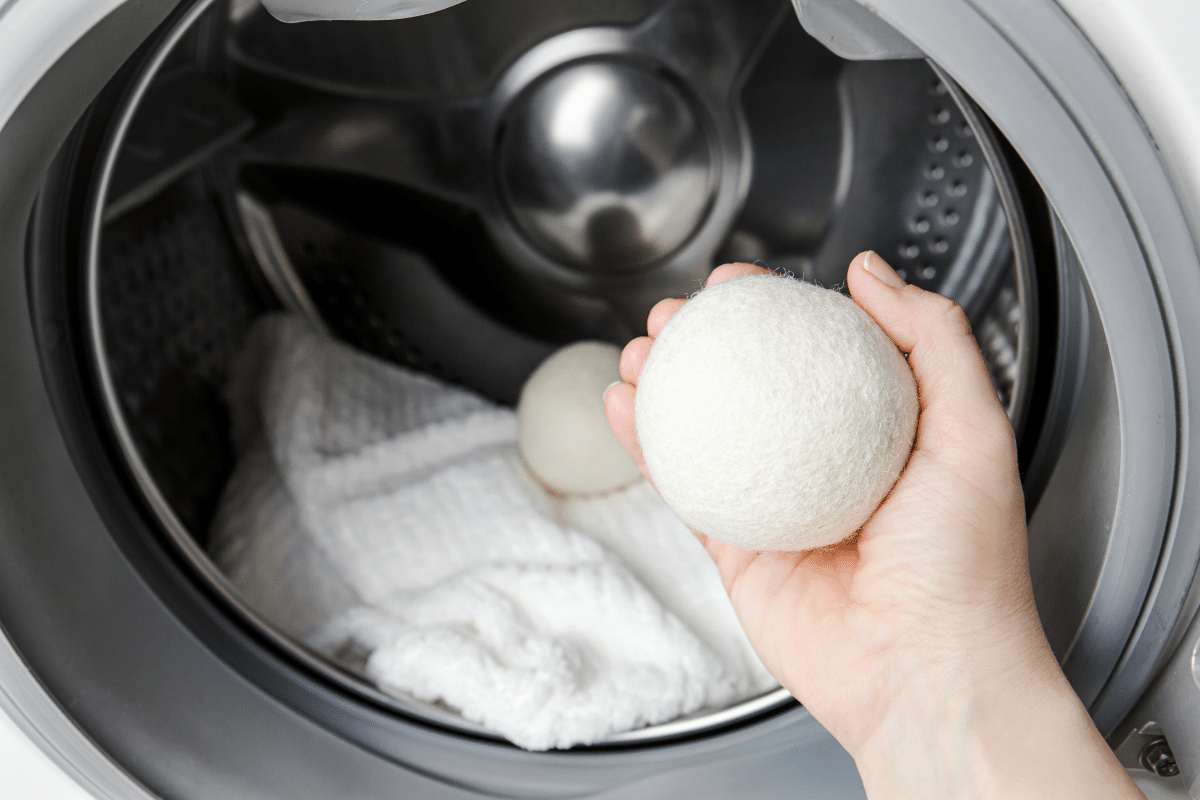
This is the part where I get a little evangelical, so bear with me. Wool dryer balls are the single best laundry change I’ve made in years, and I don’t say that about many products.
They contain no chemicals. They last for thousands of loads. They cut static, reduce wrinkles, soften your laundry, and shave real time off your drying cycles, which means real savings on your energy bill.
Here’s how they earn their keep:
They soften mechanically.
Instead of coating your fabric in chemical residue, wool dryer balls physically beat and separate the fibers as they tumble, which is what actually produces that soft feel.
They separate your load.
As they bounce around, they lift and separate clothes and linens instead of letting everything clump into one damp knot, which is half the reason overdried, wrinkled loads happen in the first place.
They hold and share heat.
Wool retains warmth and transfers it back into your laundry as it tumbles, which speeds drying and trims your energy use.
Not all dryer balls are created equal, and I’ve tried the flimsy ones so you don’t have to. My rule: buy them 100% wool, dense, and heavy. If you can squeeze one and feel it give, skip it. You want balls solid enough to outlast years of laundry without falling apart or losing their softening power.
The ones I keep in my own dryer are extra-large, about nine inches around, 100% wool, and sold in a six-pack. They’re the real deal, and they’ll outlive whatever plastic gadget is trending next.

(Disclosure: This post includes an Amazon Creator Connections product. I may earn a small commission if you purchase through the link, at no additional cost to you.)
But What About Static?
This is far and away the most common complaint I hear, and I mean thousands of emails over the years. Readers ditch the dryer sheets, love everything about wool dryer balls, and then static cling shows up and makes them want to run right back to the chemical aisle.
Don’t do it. Static almost always comes down to one thing: overdrying.
Run a dryer too long, with or without wool balls in it, and you’ll get static. Overdrying doesn’t just waste gas or electricity. It shreds your fabric fibers early, which is exactly where all that extra lint in the trap comes from. It’s also the number-one cause of static cling, especially on those bone-dry winter days when the air in your house is already thirsty.
I don’t have time to hover by the dryer watching for the perfect stopping point, so here’s my trick: I spray my wool dryer balls with water before I toss them in, or dunk them in a bowl of water so they’re good and wet. Since they’re denser than your laundry, they take longer to dry, which raises the humidity inside the dryer just enough to counter that overdrying effect. It doesn’t damage the balls, and in my experience it doesn’t add meaningful drying time, either. It just quietly fixes the static problem while everything else keeps working the way it should.
Your Questions, Answered
Are fabric softener sheets safe to use?
In small, occasional doses, probably not something to panic over. But used load after load, year after year, the chemical residue adds up on your skin, in your fabrics, and inside your washing machine. If you or anyone in the house deals with sensitive skin, asthma, or eczema, that’s your sign to switch.
What can I use instead of fabric softener sheets?
Wool dryer balls, hands down. A vinegar rinse handles the buildup already sitting in your fabrics. Between the two, you get soft, static-free laundry without a single chemical additive.
Will fabric softener ruin my washing machine?
It won’t break it overnight, but the residue buildup inside the drum and dispenser is exactly what causes that musty, sour smell so many washing machines develop over time. Switching off liquid softener is one of the easiest ways to keep your machine smelling clean.
How many wool dryer balls should I use per load?
I use four to six per load, more for bulky items like comforters or a full load of towels. They’re reusable for years, so buying one pack covers you for a very long time.
Is it okay to use fabric softener on bed sheets?
I’d skip it. Softener coats the fibers instead of cleaning them, which is exactly why so many readers tell me their sheets feel rough no matter how much they wash them. A wool dryer ball does the softening job without the coating.
Try It For a Month
You don’t have to swear off fabric softener forever to see if this works for you. Give it one laundry cycle through your whole routine: vinegar rinse to clear out the old buildup, wool dryer balls in every load after that. Watch what happens to your towels, your energy bill, and honestly, your skin.
I switched years ago and never looked back. Your washing machine will thank you, your sheets will feel like sheets again, and you’ll stop buying a product whose main job, it turns out, was making you buy more of it.
Question: Team liquid softener or team wool dryer balls: which side of the laundry room are you on? Share in the comments below. I read every one!
First published: 10-6-16; Updated and Republished 07-29-26
Everyday Cheapskate participates in the Amazon Services LLC Associates Program, an affiliate advertising program designed to provide a means for us to earn from qualifying purchases, at no cost to you.

More from Everyday Cheapskate
 https://www.everydaycheapskate.com/wp-content/uploads/20261004-reduce-healthcare-costs-with-three-habits-healthy-couple-walking-in-autumn-leaves.png
800
1200
Mary Hunt
https://www.everydaycheapskate.com/wp-content/uploads/EC-Logo-by-Mary-Hunt-Tagline-Trimmed.png
Mary Hunt2026-10-04 23:08:572026-10-04 23:09:47How to Reduce Healthcare Costs With 3 Free Daily Habits
https://www.everydaycheapskate.com/wp-content/uploads/20261004-reduce-healthcare-costs-with-three-habits-healthy-couple-walking-in-autumn-leaves.png
800
1200
Mary Hunt
https://www.everydaycheapskate.com/wp-content/uploads/EC-Logo-by-Mary-Hunt-Tagline-Trimmed.png
Mary Hunt2026-10-04 23:08:572026-10-04 23:09:47How to Reduce Healthcare Costs With 3 Free Daily Habits https://www.everydaycheapskate.com/wp-content/uploads/20260919-air-purifier-in-living-room-1.png
800
1200
Mary Hunt
https://www.everydaycheapskate.com/wp-content/uploads/EC-Logo-by-Mary-Hunt-Tagline-Trimmed.png
Mary Hunt2026-09-19 11:36:552026-09-28 22:48:42The Best Inexpensive Air Purifiers for Small Homes
https://www.everydaycheapskate.com/wp-content/uploads/20260919-air-purifier-in-living-room-1.png
800
1200
Mary Hunt
https://www.everydaycheapskate.com/wp-content/uploads/EC-Logo-by-Mary-Hunt-Tagline-Trimmed.png
Mary Hunt2026-09-19 11:36:552026-09-28 22:48:42The Best Inexpensive Air Purifiers for Small Homes https://www.everydaycheapskate.com/wp-content/uploads/20260917-fall-cleaning-checklist.png
800
1200
Mary Hunt
https://www.everydaycheapskate.com/wp-content/uploads/EC-Logo-by-Mary-Hunt-Tagline-Trimmed.png
Mary Hunt2026-09-17 17:11:012026-09-28 22:48:45Fall Cleaning Checklist: 15 Overlooked Spots to Clean
https://www.everydaycheapskate.com/wp-content/uploads/20260917-fall-cleaning-checklist.png
800
1200
Mary Hunt
https://www.everydaycheapskate.com/wp-content/uploads/EC-Logo-by-Mary-Hunt-Tagline-Trimmed.png
Mary Hunt2026-09-17 17:11:012026-09-28 22:48:45Fall Cleaning Checklist: 15 Overlooked Spots to Clean https://www.everydaycheapskate.com/wp-content/uploads/20260830-best-sound-machine-for-better-sleep-woman-hiding-under-comforter.png
800
1200
Mary Hunt
https://www.everydaycheapskate.com/wp-content/uploads/EC-Logo-by-Mary-Hunt-Tagline-Trimmed.png
Mary Hunt2026-09-10 09:51:452026-09-28 22:48:58Best Sound Machine for Better Sleep: 3 Honest Picks
https://www.everydaycheapskate.com/wp-content/uploads/20260830-best-sound-machine-for-better-sleep-woman-hiding-under-comforter.png
800
1200
Mary Hunt
https://www.everydaycheapskate.com/wp-content/uploads/EC-Logo-by-Mary-Hunt-Tagline-Trimmed.png
Mary Hunt2026-09-10 09:51:452026-09-28 22:48:58Best Sound Machine for Better Sleep: 3 Honest Picks https://www.everydaycheapskate.com/wp-content/uploads/20260826-DIY-cat-litter-deodorizer-kitten-looking-up-at-camera-from-box.png
800
1200
Mary Hunt
https://www.everydaycheapskate.com/wp-content/uploads/EC-Logo-by-Mary-Hunt-Tagline-Trimmed.png
Mary Hunt2026-08-25 21:17:362026-09-28 22:49:26The One-Ingredient Litter Box Trick That Costs Pennies
https://www.everydaycheapskate.com/wp-content/uploads/20260826-DIY-cat-litter-deodorizer-kitten-looking-up-at-camera-from-box.png
800
1200
Mary Hunt
https://www.everydaycheapskate.com/wp-content/uploads/EC-Logo-by-Mary-Hunt-Tagline-Trimmed.png
Mary Hunt2026-08-25 21:17:362026-09-28 22:49:26The One-Ingredient Litter Box Trick That Costs Pennies https://www.everydaycheapskate.com/wp-content/uploads/20260819-dry-clean-only.png
800
1200
Mary Hunt
https://www.everydaycheapskate.com/wp-content/uploads/EC-Logo-by-Mary-Hunt-Tagline-Trimmed.png
Mary Hunt2026-08-19 23:38:122026-09-28 22:49:48The Truth About “Dry Clean Only” (And When I Actually Listen to It)
https://www.everydaycheapskate.com/wp-content/uploads/20260819-dry-clean-only.png
800
1200
Mary Hunt
https://www.everydaycheapskate.com/wp-content/uploads/EC-Logo-by-Mary-Hunt-Tagline-Trimmed.png
Mary Hunt2026-08-19 23:38:122026-09-28 22:49:48The Truth About “Dry Clean Only” (And When I Actually Listen to It) https://www.everydaycheapskate.com/wp-content/uploads/20260809-how-to-get-the-smell-out-of-towels-stack-of-towels-sitting-with-candle-in-bright-natural-light.png
800
1200
Mary Hunt
https://www.everydaycheapskate.com/wp-content/uploads/EC-Logo-by-Mary-Hunt-Tagline-Trimmed.png
Mary Hunt2026-08-08 16:48:552026-08-08 16:50:57How to Get Smell Out of Towels: The 2-Wash Fix That Works
https://www.everydaycheapskate.com/wp-content/uploads/20260809-how-to-get-the-smell-out-of-towels-stack-of-towels-sitting-with-candle-in-bright-natural-light.png
800
1200
Mary Hunt
https://www.everydaycheapskate.com/wp-content/uploads/EC-Logo-by-Mary-Hunt-Tagline-Trimmed.png
Mary Hunt2026-08-08 16:48:552026-08-08 16:50:57How to Get Smell Out of Towels: The 2-Wash Fix That Works https://www.everydaycheapskate.com/wp-content/uploads/20260729-the-problem-with-fabric-softener-sitting-on-a-washer.png
800
1200
Mary Hunt
https://www.everydaycheapskate.com/wp-content/uploads/EC-Logo-by-Mary-Hunt-Tagline-Trimmed.png
Mary Hunt2026-07-29 13:45:412026-07-29 13:47:50Fabric Softener Is Wrecking Your Laundry. Here’s What Actually Works.
https://www.everydaycheapskate.com/wp-content/uploads/20260729-the-problem-with-fabric-softener-sitting-on-a-washer.png
800
1200
Mary Hunt
https://www.everydaycheapskate.com/wp-content/uploads/EC-Logo-by-Mary-Hunt-Tagline-Trimmed.png
Mary Hunt2026-07-29 13:45:412026-07-29 13:47:50Fabric Softener Is Wrecking Your Laundry. Here’s What Actually Works. https://www.everydaycheapskate.com/wp-content/uploads/20260706-negotiate-medical-bills-female-nurse-with-calculator-and-ipad-negotiating-a-bill.png
800
1200
Mary Hunt
https://www.everydaycheapskate.com/wp-content/uploads/EC-Logo-by-Mary-Hunt-Tagline-Trimmed.png
Mary Hunt2026-07-06 21:19:252026-09-28 22:51:26How to Negotiate Medical Bills and Cut Costs 30-50%
https://www.everydaycheapskate.com/wp-content/uploads/20260706-negotiate-medical-bills-female-nurse-with-calculator-and-ipad-negotiating-a-bill.png
800
1200
Mary Hunt
https://www.everydaycheapskate.com/wp-content/uploads/EC-Logo-by-Mary-Hunt-Tagline-Trimmed.png
Mary Hunt2026-07-06 21:19:252026-09-28 22:51:26How to Negotiate Medical Bills and Cut Costs 30-50%Please keep your comments positive, encouraging, helpful, brief,
and on-topic in keeping with EC Commenting Guidelines
Last update on 2026-10-18 / Affiliate links / Images from Amazon Product Advertising API


I’m team dryer balls!!! I’ve been using them for years and yes, use good ones, they are not all created equally.
Barb
I have been using white distilled vinegar in the rinse cycle for years, along with wool dryer balls. To get rid of static cling I add a ball of tin foil to the dryer. I haven’t had a sock stuck to my sheets or other clothes once since doing that. I have also given up on bottles of liquid detergent and use small sheets of detergent. i am very allergic to detergent residue in clothes. Since using this process, I haven’t had any skin issues. To make a foil dryer ball: take 6 feet of tin foil and compress it into a ball a little larger than a baseball. The tighter you compress it the better. With each load in the dryer, the ball will compress further. About the time it gets to a golf ball size it will start crumbling. When you see tin foil bits in the lint screen, toss the ball in the recycle bin and make another.
And yes I too have been using wool dryer balls and vinegar for the rinse in my load! Thanks to Mary!!
The appliance repair guy told me to stop using vinegar in the rinse because I have a stainless tub in my Speed Queen washer. Said it will corrode. Have used dryer balls for years!!!
Good tips – our towels turned very scratchy last year and I am suspecting a well water problem. I have only used dryer sheets sparingly up until now and then I did all of the towel stripping hacks to no avail. I use dryer balls but my towels are ruined no matter how much baking soda, vinegar or citric acid I throw at them in different cycles. Time to give up on them I guess! Funny I gave up on Consumer Reports and their policies a few years ago. I have never even seen good reviews on their recommendations either, lol.
I’ve been team wool dryer balls for years now. Left fabric softener behind and never missed it. By the way, Mary, it was your email that convinced me to try them in the first place, so thanks for that!
I agree with Mary about Consumer Reports. It has an ‘attitude problem’ — the reports are vague and written with such disdain. The writing is authoritative and the website is lopsided….never mind trying to get an unbiased and free review. Their website paywall begins when you get to their home page. I applaud the reports on white vinegar (buy the least expensive you find….like bleach….it’s the same formula). 5% acidity which is readily available will do a splendid job, whether marinating cucumbers or softening laundry. For hardcore cleaning, use the ‘cleaning vinegar’–check acidity on label–commonly found in hardware stores. More expensive but worth it. Thanks again, Mary!
I have always wondered if using those scent additives is as bad as using fabric softener in your washer? I have followed your advice and made my own laundry soap from the Everyday Cheapskate recipe and am using vinegar in my rinse dispenser, but I think (maybe unneccesarily) that I need a little added scent…just in case? I don’t use as much as the product calls for, just a heaping tablespoon.
Am I undoing all the other good things?
Scent additives are just cosmetic and they can cause skin irritation. You for sure don’t NEED them if you are laundering your fabrics correctly. Go without for a few months, I bet you won’t miss it.
Mary, just wanted to let you know that I appreciate the little bits of wisdom you include with your tips and tricks for keeping us healthy and saving money. They add a lift to my day – thank you!
I really, really want to do this. But I have read at Consumer Reports that it can damage seals and hoses in washing machines. I went to my manufacturer’s site (Whirlpool) and didn’t find any info regarding the safety of vinegar in their machines. Have the machine manufacturers indicated their take on this to you? Thanks!
This is my personal opinion: I wouldn’t trust Consumer Reports as far as I could throw the entire organization. I have found so many flaws in their reviews, articles. Case in point—uggesting (no, make that alerting, warning) that adding 1 cup of vinegar to the rinse cycle in a washing machine is going to destroy the hoses and gaskets. They state this as fact, which has no basis in fact. But now I get 100s of msgs from argumentative CR fans. So to answer your question, I suggest you look to the owner manual. I have been using Washing Soda, Vinegar, Borax in my washing machines for decades. I have never had one hose melt down, not one gasket fail; have not had a single service call wherein any of those items were found to have failed. I have had one washing machine service call in 52 years, and that was to replace a water pump. OK, I’ll get off my soapbox now. (You can probably tell that CR is one of my pet peeves.)
Thank you, Mary! I appreciate the response. I just did my first load with vinegar. I added a few drops of essential oil and it is wonderful! I didn’t find any info in my owners manual. But o do trust your experience. Thank you again.
Thank you, Mary for your post about your feelings on the vinegar in the rinse cycle and what Consumer Reports has to say about it. I have been reading that you shouldn’t put vinegar in your rinse cycle for the same reasons that the other poster said.I continued to use my wool balls. I continue to use my vinegar, cause I’m not going back to chemicals in my laundry so thank you thank you thank you for posting that you think it’s a bunch of baloney. I feel better.
I stopped using fabric softener years ago and I definitely haven’t missed it! Occasionally I’ll use the wool dryer balls but my laundry seems to be fine with just a few tablespoons of regular laundry detergent and not the capfuls that the bottles recommend. Now I can definitely smell someone who uses the full amount of detergent and fabric softener! It is quite overwhelming.
The way to stop static is to take an old bath towel put two or three safety pins and pin them to the towel and leave it in your dryer along with the wool balls. The towel will help to dry your clothes faster and the pins will stop static.
I’ve used a very dense ball of aluminum foil added to the dryer to neutralize static.
The worst outcome has been when the ball falls out of the dryer and one of the cats sees and gets that shiny ball of foil before I do.
OMG!! That is so funny!! I had cats for years and yes if that happened to me my cats would play with them too!! LOL