
Hands Down the Best Way to Kill Weeds (And It’s Not Roundup)


Roundup who? If you’ve got vinegar, salt, and a squirt of dish soap in your kitchen right now, you already own one of the best weed killers on the planet. It’s cheap. It’s natural. And it’s mean enough to make a dandelion beg for mercy. Whether you’re clearing the cracks in your driveway or getting a flower bed ready for new blooms, this homemade weed killer gets the job done without a single scary chemical.
Skeptical that something you mixed up in your kitchen could go toe-to-toe with the commercial stuff? I get it. I was too. Stick with me, because this one surprised me. But first, a little backstory.
How We Ended Up Spraying Our Lawns with a Chemical Named Roundup
Back in 1970, a Monsanto chemist named John Franz discovered glyphosate, a compound that could wipe out nearly any plant it touched. Monsanto bottled it, called it Roundup, and farmers went wild for it. Finally, a fast way to clear weeds on a massive scale.
There was just one hitch: Roundup didn’t know the difference between a weed and a crop. It killed both. So Monsanto went back to the lab and engineered “Roundup Ready” crops, genetically modified to survive being doused in glyphosate. Now farmers could spray the whole field and only the weeds would die.
That was decades ago, and glyphosate has been a fight ever since.
Where Things Stand with Roundup Right Now
I’d be doing you a disservice if I didn’t mention what’s happening with Roundup in the news, since this is a post about replacing it. The short version: it’s complicated, and it’s still not settled.
The Supreme Court recently ruled that because the EPA doesn’t require a cancer warning on Roundup’s label, people can’t sue Bayer (Monsanto’s parent company) under state “failure to warn” laws. That decision blocks a lot of the lawsuits that were working their way through the courts. At the same time, a $7.25 billion class-action settlement covering people exposed to Roundup before February 2026 is still moving forward, with a court hearing scheduled for August. Bayer has already pulled glyphosate out of the Roundup sold for home lawns and gardens in the U.S., for what that’s worth.
I’m not a scientist, and I’m not going to pretend I know whether glyphosate causes cancer. Smart people disagree, and this fight isn’t over. What I do know is that even setting the health debate aside completely, Roundup has never made sense to me for one very Cheapskate reason: it’s expensive. And I’ve got something that works just as well sitting in my pantry for pennies.
Why Homemade Weed Killer Beats Roundup
Here’s my honest bias. Even if someone proved to me tomorrow that Roundup was as harmless as tap water, I still wouldn’t buy it. Why would I pay top dollar for a weed killer when I can make one from stuff I already have on hand?
That’s really what this comes down to for me. Not fear. Just math.
What You’ll Need

Chances are good you already have all three of these in your house right now.
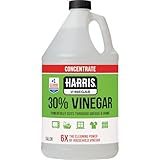
White vinegar. Plain distilled white vinegar with 5% acidity handles most weed jobs just fine. If you happen to find a higher-acidity vinegar, up around 30%, it’ll work faster. Either way, it gets there.
Table salt. Skip the sea salt, the rock salt, and the fancy stuff sitting next to your good olive oil. You want plain old sodium chloride, iodized or not, the cheapest bag on the shelf. It’s the salt doing the work here, not the price tag.
Dish soap. A few drops of any brand. The soap breaks the surface tension on the vinegar so it clings to the leaves instead of beading up and rolling off, which means it actually has time to work.
For Weeds in Spots Where You’ll Plant Again Later

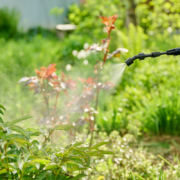
Fill a garden sprayer with plain white vinegar. Add about a teaspoon of dish soap, screw on the top, and that’s the whole recipe. No measuring spoons lined up like a science fair project.
Pick a hot, sunny day and soak the weeds thoroughly. You’ll see them wilting within a few hours. Just watch your aim. Vinegar doesn’t care if it’s a weed or your prized tomato plant, and it won’t travel down into the soil, so once the weeds are gone, you’re free to replant right on top.
For Places You Never Want a Weed Again

This is the one for driveways, sidewalk cracks, and gravel paths, anywhere green is not invited back.
Mix 1 cup of table salt into 1 gallon of white vinegar in a container roomier than a gallon, because you’ll need space to shake it. Seal it up and shake until the salt mostly dissolves. It won’t all the way, and that’s fine.
Stir in a teaspoon of dish soap, pour it into your sprayer, and apply generously on a dry, sunny day.
The salt is what makes this stick around. It works its way into the soil and keeps new growth from taking root, sometimes for a full season or longer. You might need a second pass on the stubborn spots. Just know what you’re signing up for: once you salt an area, don’t expect anything to grow there again anytime soon.
- MORE: Laundry Stripping: The Surprising Fix for Dingy Sheets, Gray Towels, and Sad-Looking Underwear
Why This Actually Works (and It’s Not Just an Old Wives’ Tale)
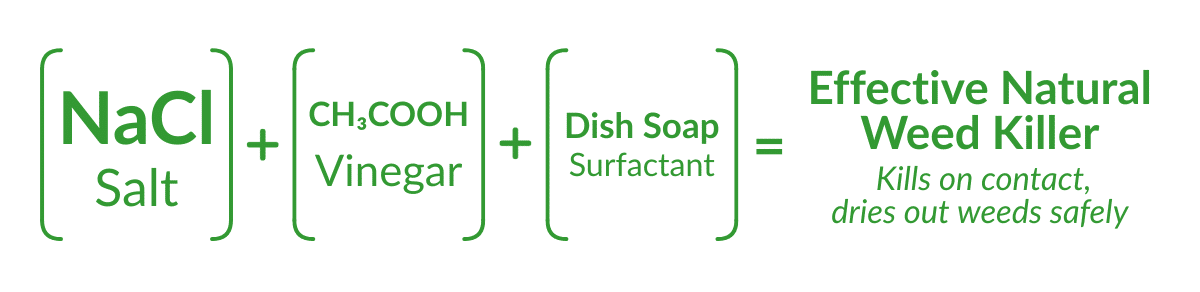
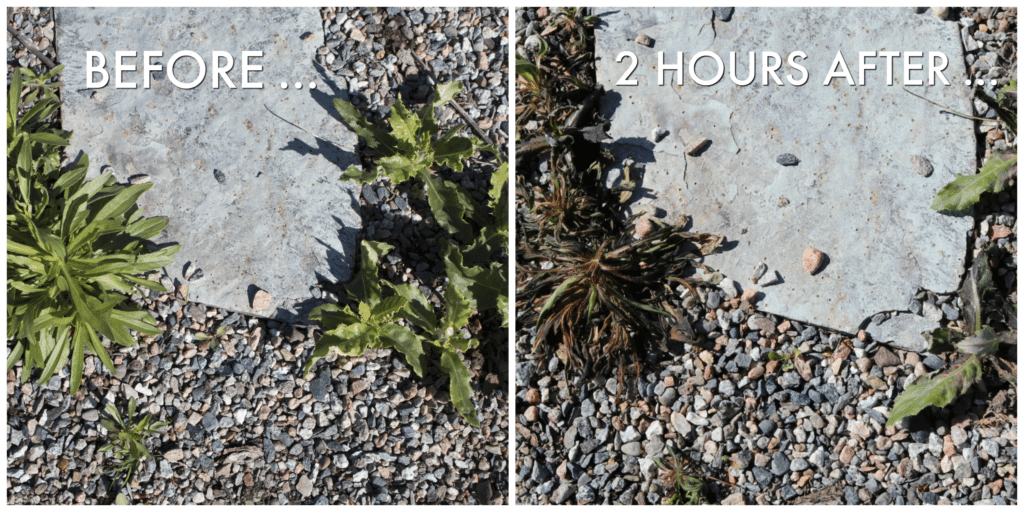
Vinegar is what’s called a contact herbicide. It kills what it touches, but it doesn’t travel down into the roots. On contact, it ruptures the plant’s cells and the leaves dry out fast. In USDA trials, even Canada thistle, a weed known for laughing off most home remedies, wilted under a 5% vinegar solution. Stronger concentrations knocked out pigweed and foxtail in a matter of hours.
Salt works differently. It interferes with a plant’s ability to pull water up from the soil, so it dries out from the roots up. That’s the long game, and it’s exactly why salt is the ingredient that makes a spot stay bare.
And the dish soap? It’s just there to help the vinegar stick instead of sliding off, especially on waxy or fuzzy leaves that normally shrug off liquid.
The best part: you’ll see results within hours, and young weeds go down the fastest. Catch them early and you’ll save yourself a lot of bending over later.
Safe for the Kids, the Dog, and Your Wallet
None of these ingredients are toxic to people or pets, which is more than I can say for most things under my kitchen sink. Dish soap isn’t something I’d recommend tasting, but vinegar and salt? You could technically make a salad dressing with the same two ingredients (please don’t use the same bottle).
Shop the Ingredients
If you’re missing anything, or just want to compare options, I’ve pulled together an Amazon list with everything you need.



Homemade Weed Killer (Vinegar, Salt & Dish Soap)
Materials
- 1 gallon white vinegar 5% acidity
- 1 cup table salt
- 1 teaspoon liquid dish soap
Instructions
- Pour the vinegar into a container larger than a gallon, so you've got room to shake.
- Add the salt, seal the lid, and shake until it mostly dissolves. It won't all the way, and that's fine.
- Stir in the dish soap.
- Pour the mixture into your garden sprayer.
- On a dry, sunny day, soak the weeds thoroughly, avoiding anything you want to keep.
- Let it sit. You'll see wilting within a few hours.
Notes
Question: Your turn. What’s your go-to for keeping weeds under control? DIY magic, or do you still reach for the store-bought stuff? Tell me in the comments. I want to know I’m not the only one out here spraying my driveway with salad dressing ingredients.
EverydayCheapskate™ is reader-supported. We participate in the Amazon Services LLC Associates Program and other affiliate advertising programs, designed to provide a means for us to earn from qualifying purchases, at no cost to you.

More from Everyday Cheapskate
 https://www.everydaycheapskate.com/wp-content/uploads/20260831-Portrait-of-a-Pitbull-on-a-yellow-background-homemade-dog-treat-recipes.png
800
1200
Mary Hunt
https://www.everydaycheapskate.com/wp-content/uploads/EC-Logo-by-Mary-Hunt-Tagline-Trimmed.png
Mary Hunt2026-08-31 13:06:072026-08-31 13:06:073 Homemade Dog Treats Recipes Your Dog Will Love Most
https://www.everydaycheapskate.com/wp-content/uploads/20260831-Portrait-of-a-Pitbull-on-a-yellow-background-homemade-dog-treat-recipes.png
800
1200
Mary Hunt
https://www.everydaycheapskate.com/wp-content/uploads/EC-Logo-by-Mary-Hunt-Tagline-Trimmed.png
Mary Hunt2026-08-31 13:06:072026-08-31 13:06:073 Homemade Dog Treats Recipes Your Dog Will Love Most https://www.everydaycheapskate.com/wp-content/uploads/20260829-fall-yard-projects-to-tackle-before-the-first-frost-foilage-front-yard-home.png
800
1200
Mary Hunt
https://www.everydaycheapskate.com/wp-content/uploads/EC-Logo-by-Mary-Hunt-Tagline-Trimmed.png
Mary Hunt2026-08-29 17:25:422026-08-29 17:25:4210 Fall Yard Tasks to Complete Before First Frost Hits
https://www.everydaycheapskate.com/wp-content/uploads/20260829-fall-yard-projects-to-tackle-before-the-first-frost-foilage-front-yard-home.png
800
1200
Mary Hunt
https://www.everydaycheapskate.com/wp-content/uploads/EC-Logo-by-Mary-Hunt-Tagline-Trimmed.png
Mary Hunt2026-08-29 17:25:422026-08-29 17:25:4210 Fall Yard Tasks to Complete Before First Frost Hits https://www.everydaycheapskate.com/wp-content/uploads/20260826-DIY-cat-litter-deodorizer-kitten-looking-up-at-camera-from-box.png
800
1200
Mary Hunt
https://www.everydaycheapskate.com/wp-content/uploads/EC-Logo-by-Mary-Hunt-Tagline-Trimmed.png
Mary Hunt2026-08-25 21:17:362026-08-25 21:17:36The One-Ingredient Litter Box Trick That Costs Pennies
https://www.everydaycheapskate.com/wp-content/uploads/20260826-DIY-cat-litter-deodorizer-kitten-looking-up-at-camera-from-box.png
800
1200
Mary Hunt
https://www.everydaycheapskate.com/wp-content/uploads/EC-Logo-by-Mary-Hunt-Tagline-Trimmed.png
Mary Hunt2026-08-25 21:17:362026-08-25 21:17:36The One-Ingredient Litter Box Trick That Costs Pennies https://www.everydaycheapskate.com/wp-content/uploads/20260822-central-AC-maintenance-air-condenser-outdoors.png
800
1200
Mary Hunt
https://www.everydaycheapskate.com/wp-content/uploads/EC-Logo-by-Mary-Hunt-Tagline-Trimmed.png
Mary Hunt2026-08-22 14:19:562026-08-22 14:19:59How to Extend the Life of Your Central AC (5 Late-Summer Tune-Up Tips)
https://www.everydaycheapskate.com/wp-content/uploads/20260822-central-AC-maintenance-air-condenser-outdoors.png
800
1200
Mary Hunt
https://www.everydaycheapskate.com/wp-content/uploads/EC-Logo-by-Mary-Hunt-Tagline-Trimmed.png
Mary Hunt2026-08-22 14:19:562026-08-22 14:19:59How to Extend the Life of Your Central AC (5 Late-Summer Tune-Up Tips) https://www.everydaycheapskate.com/wp-content/uploads/20260820-how-to-keep-ants-away-after-youve-killed-the-ant-hill.png
800
1200
Mary Hunt
https://www.everydaycheapskate.com/wp-content/uploads/EC-Logo-by-Mary-Hunt-Tagline-Trimmed.png
Mary Hunt2026-08-20 14:17:552026-08-20 14:17:57How to Keep Ants Away After You Treat the Ant Hill
https://www.everydaycheapskate.com/wp-content/uploads/20260820-how-to-keep-ants-away-after-youve-killed-the-ant-hill.png
800
1200
Mary Hunt
https://www.everydaycheapskate.com/wp-content/uploads/EC-Logo-by-Mary-Hunt-Tagline-Trimmed.png
Mary Hunt2026-08-20 14:17:552026-08-20 14:17:57How to Keep Ants Away After You Treat the Ant Hill https://www.everydaycheapskate.com/wp-content/uploads/20260815-how-to-water-your-lawn-without-wasting-money.png
800
1200
Mary Hunt
https://www.everydaycheapskate.com/wp-content/uploads/EC-Logo-by-Mary-Hunt-Tagline-Trimmed.png
Mary Hunt2026-08-15 12:45:022026-08-15 12:45:02How to Water Your Lawn Without Wasting Money This Summer
https://www.everydaycheapskate.com/wp-content/uploads/20260815-how-to-water-your-lawn-without-wasting-money.png
800
1200
Mary Hunt
https://www.everydaycheapskate.com/wp-content/uploads/EC-Logo-by-Mary-Hunt-Tagline-Trimmed.png
Mary Hunt2026-08-15 12:45:022026-08-15 12:45:02How to Water Your Lawn Without Wasting Money This Summer https://www.everydaycheapskate.com/wp-content/uploads/20260812-zucchini-overload-what-to-do-with-a-bunch-of-zucchini.png
800
1200
Mary Hunt
https://www.everydaycheapskate.com/wp-content/uploads/EC-Logo-by-Mary-Hunt-Tagline-Trimmed.png
Mary Hunt2026-08-12 17:48:312026-08-12 17:48:31Zucchini Overload? 10 Ways to Use Up Your Garden Surplus
https://www.everydaycheapskate.com/wp-content/uploads/20260812-zucchini-overload-what-to-do-with-a-bunch-of-zucchini.png
800
1200
Mary Hunt
https://www.everydaycheapskate.com/wp-content/uploads/EC-Logo-by-Mary-Hunt-Tagline-Trimmed.png
Mary Hunt2026-08-12 17:48:312026-08-12 17:48:31Zucchini Overload? 10 Ways to Use Up Your Garden Surplus https://www.everydaycheapskate.com/wp-content/uploads/20260724-ratatouille-recipe-served-over-white-rice.png
800
1200
Mary Hunt
https://www.everydaycheapskate.com/wp-content/uploads/EC-Logo-by-Mary-Hunt-Tagline-Trimmed.png
Mary Hunt2026-07-25 12:24:422026-07-25 12:24:42End-of-Summer Ratatouille (Uses Everything From the Garden)
https://www.everydaycheapskate.com/wp-content/uploads/20260724-ratatouille-recipe-served-over-white-rice.png
800
1200
Mary Hunt
https://www.everydaycheapskate.com/wp-content/uploads/EC-Logo-by-Mary-Hunt-Tagline-Trimmed.png
Mary Hunt2026-07-25 12:24:422026-07-25 12:24:42End-of-Summer Ratatouille (Uses Everything From the Garden) https://www.everydaycheapskate.com/wp-content/uploads/20260722-easy-home-repairs-slow-sink-drain-squeaky-hinges-sticky-drawer.png
800
1200
Mary Hunt
https://www.everydaycheapskate.com/wp-content/uploads/EC-Logo-by-Mary-Hunt-Tagline-Trimmed.png
Mary Hunt2026-07-22 13:04:022026-07-22 13:04:0210 Small Home Annoyances You Can Fix in Under 15 Minutes Each
https://www.everydaycheapskate.com/wp-content/uploads/20260722-easy-home-repairs-slow-sink-drain-squeaky-hinges-sticky-drawer.png
800
1200
Mary Hunt
https://www.everydaycheapskate.com/wp-content/uploads/EC-Logo-by-Mary-Hunt-Tagline-Trimmed.png
Mary Hunt2026-07-22 13:04:022026-07-22 13:04:0210 Small Home Annoyances You Can Fix in Under 15 Minutes EachPlease keep your comments positive, encouraging, helpful, brief,
and on-topic in keeping with EC Commenting Guidelines
Last update on 2026-09-28 / Affiliate links / Images from Amazon Product Advertising API


This web page is really a walk-by for all the info you needed about this and didn’t know who to ask. Glimpse here, and you’ll undoubtedly discover it.
I know this isn’t going to thrill environmentalists but old anti freeze in a spray bottle is about as safe as round up. Just secure the area treated fir a week or two afterwards to keep animals safe. Some things just can’t be done using modern day products. Weed killing and roach killing are both big business. Make sure that what you buy off that store shelf says 100% guaranteed. You can find both weed and roach killer labeled this way. Neither work but both are usually the best products available at the time. Take them home. Use them. Return them. Keep doing this and maybe they’ll put something in the stores that works.
I want to get rid of fungus knats and any other tiny things that fly up when I walk around in my yard. I have large yard so I need to make enough of the solution.
Can I use 30% vinegar I can get at Home Depot with table salt and dish soap and apply in a spray bottle?
Yes! It will work even faster as 30% has a greater acidity content. However, I wouldn’t necessarily pay more to get 30% (it is more expensive). But if you have it, absolutely you can do this. And if you want to make it go farther and still retain its effectiveness or weedkiller, dilute with water about 3 parts water to 1 part 30 acidity vinegar.
Just to put It out there, salt, when used in reasonable amounts, will not kill asparagus. So if asparagus is your thing u can use salt in this(preferably isolated) bed and control weeds in this way. Asparagus is resistant to the effects of salt but dont cover the ground and make it look like its snowing and expect everything to be ok. Also not good for under 1
Yr shoots
The vinegar, salt and dishwashing liquid weed killer can I make it in bulk and use whenever I need it or do I have to make it as I need it?
thanks
Glyphosate is essentially a really strong solution of Potassium Chloride (potash, KCl), a salt that forms in the same formation as Sodium Chloride (table salt, NaCl), a metal salt that is slightly heavier atomically than food salt, it forms in layers, KCl on the bottom of the salt formation, NaCl on the top layer.
This “hack” works because you are making something very similar chemically to Glyphosate or Round Up. Domestic round-up is now being marketed with a new version that contains the special ingredient Acetic Acid, which is just vinegar, so when you make this solution to kill weeds, or unwanted grass, a non-selective herbicide, you are essentially making round-up.
The myths around Round-Up that you address early in the article are just that, myths, and yes, even water in excessive amounts is toxic to the human body, round-up is not toxic because of what it contains, it is toxic when excessive amounts are ingested, no different than with table salt, vinegar, or even Dihydrogen Monoxide….
I still strongly support making home-brew non-selective herbicide, not because Glyphosate is bad, but because Monsanto is a predatory company with business practices I abhor, they treat farmers terribly, and they charge too damn much for their products for what they actually are…
Lawn weeds like dandelions are a joy to eliminate. It’s done with coffee beans, barley and sometimes hops. Here’s how…
Buy yourself a Fiskar weed gun. You know, the post with a tube or claw you stomp in over Mr. Weed and pry him out. With just a little practice, you can do it with 1 hand. If it is before 11AM, the other hand holds a coffee while meandering around your lawn. After 11, a beer is quite acceptable. Just do this every couple of days. It’s quite relaxing, almost theraputic, even zenish. In a couple of weeks, no more weeds and your lawn is airated as well.
Your welcome.
The solution used in the Northeast is different than Salt..regardless, Salt is 100% natural and Organic..it really doesn’t poison the soil and bugs will relocate from the treated area! After 35 yrs of trial and error, the solution mentioned in this post is by Far the best idea..and it works very well! Salt itself will not stay in topsoil very long..Fertilizers do add other ingredients that will enhance Salt properties..but in No way does Salt hurt the soil,..or the Bugs!
Unfortunately Monsanto is an enemy of the people, putting GMO’s and other crap in our food. It is a fact that Monsanto is working hand in hand with Bill Gates to reduce the population. That means, roundup causes cancer and probably a host of other things. Their goal is to eliminate you, that is a fact, so if I were you I would NEVER buy ROUNDUP again. The FDA has the same agenda, population control. I mean come on, it’s poison and they love for you to use it around your home, family, crops, and animals. Perfect.Buy more. NOT!!!
?? Monsanto is no Monster..!! Does the roundup spray itself? Whew…when will ppl take personal responsibility for the actions They take??!! Roundup works Great..as does the solution aforementioned on this post..its up to the Individual to make the Choice..
I love to experiment and have been using vinegar/salt
solution for years, since discovering Roundup must
be used every year (under fence around garden). And yes, it is not good for the soil — worms, other living soil microbes we need. Where my birds eat.
So, first year a large dandelion grew by the back step. I sprayed it good and kept an eye on the spot.
Several years, never another dandelion, just grass which I did not kill (I use cardboard to protect around
where I am spraying. Crabgrass in the old sidewalks
with long established roots under the sidewalk — I do spray every year, on a sunny dry day. Always works, but not always permanent. Front sidewalk all disappeared to never return.
I decided since stronger vinegar works so they say,
I boil a gallon 5% down to half or 1/3 on my stove,
add salt (usually about a cup), and few drops of dish
soap. Works very well for me. But I don’t use it in the lawn — dandelions are not a bother. Sorry my
grandchildren will never experience the fun we had
with them growing up. And I grab some flowers now
and then, pop them in my mouth. Kinda tasteless, but very edible.
I scanned through all these comments and pretty much decided not to bother trying to kill my weeds! I’ve been digging them out of areas where I want to plant flowers and veggies. Otherwise, I’m letting them do their natural thing. That gave me a surprise field of wild daisies in my backyard, which I love! I noticed one comment about putting down black plastic. I will NEVER do that again. After putting down contractor bags a few years ago, I had a total mess. Weeds grew right through the bags and made them very difficult to remove. Same goes for landscaping fabric. I even found a 5 x 7 rug buried in my yard. Weeds had grown through it completely, so I really don’t think anything can stop them. From now on, if I want to get rid of weeds, I’ll dig them up and put pine needs on the ground. As the weeds come through, I’ll pull or snip them.
We haven’t found anything that works, homemade or store bought. An employee of our electricity company gave us a small sample of the formula they use to keep the power lines free of trees and brush, trying it this weekend, hope it works.
Ever wonder why cattlefarms are full of mud, cows man…cows. Fence off the the area,, put in a couple cows, they will eat it all and tromp down to mud the rest. It will take years to recover. You either move cows to another area or take them to slaughterhouse and get your fresh beef. Its a no brainer. No salt, vinegar, herbicides, pesticides needed. Only a roller to smooth out land after its been tromped to death……
Smaller areas or hillsides try a few goats. Been being done for years. Sell your lawnmower, buy a boat and go get some fish while the animals eat the green. Then come home and look out and enjoy your beef and fish on the grill………….ah….did you want frys with that….
I have my wife talk to the weeds. Since she’s killed all my hopes, dreams, and ambitions, I figure she can knock off a few weeds too!
If you are thinking that Roundup is the only effective method, then this article will break that myth for you. They give you two killer recipes for killing weeds and both use ingredients readily available in every household. They are easy to make, cost-effective and also quite effective in getting rid of the weeds.
The hubby and I want to kill off all our old “grass” (it’s mostly weeds) and start absolutely fresh with fresh soil and grass seed…curious if I can use the salt/vinegar/dish soap to kill off all the under stuff—will that effect the new soil that we spread on top later? Probably hey—but I just thought I’d check. If that won’t work then what is your suggestion for the best way to go about that? We can either put on sod or fresh soil and grass seed—we just don’t want all the old weeds pushing back through. Thanks in advance.
There are two “recipes” … one with salt, one without. Depending on how much salt you use and how often you repeat, you run the risk of “sterilizing” the soil which in the extreme, nothing will grow there. From what you describe, I do not think this DIY weed killer will not produce the results you are looking for. You want a weed killer that says it kills for something like 30 days, after which you can replant without fear of harm for your seeds, seedlings, etc. Hope that helps!
Awesome thank you so much!!
Thanks for explaining that the soap is just to break the surface tension on the plants because I like to know how things work. I have tons of weeds in my yard. It’s insane how tall they’ve gotten. After weed whacking them, I want a way to make sure they don’t come back. https://armedforcepest.com/calistoga
I know a 22 year old boy who took a job on a farm and he was the “Roundup” guy. After a couple of years being the roundup sprayer he is in the hospital dying of cancer. I’ll take the vinegar, salt and dish soap over cancer any day.
Great To Read
https://topweedkiller.com/
Before coming across the information given here, I used Roundup to keep my driveway and walkway clear of plants. Let me say that I will never use it again because of the high costs and potential harm to my health. I can now get rid of weeds in a non-toxic and cheap way by only using house ingredients.
https://bit.ly/2YRoT52
I used vinegar & dish wash detergent too and it appeared to work just fine.
I read somewhere it can be diluted, so mixed mine +-50% with water. Sure, the weeds browned & appeared dead, BUT not all died. The bigger, fatter broadleaves just looked the same. Then light rain came & approx. 60% of the weeds are forming new leaves and pushing up new flowers again (dandelions). A friend recommended pool acid: at even way less than 10% dilution, he says it’s quite effective.
You don’t think the reason your use of the homemade weed killer might have been because you did – not – follow – the – recipe??? By diluting it with 50% water, of course it doesn’t work! To blame the original ‘recipe’ when you didn’t use the original ‘recipe’ is ludicrous!
Just wanted to say thank you
I made up the vinegar, dishwashing liquid recipe and it works like a charm!!
So grateful that you shared 🙂
I would like to kill all the vegetation in my garden area, put a top cover o er it and cover that with bark. My question is, how many times should I have to spray before I can cover and how will my tree fare, which is in the center of the small plot?
Thank you for your tip to use white vinegar, table salt, and dishwashing soap to kill weeds. Now that it is fall, it is time to do some weed control. I’ve noticed that I have a lot of weeds growing in my garden and my lawn and I need to get them sprayed. In my case, I’ll need a professional to come and take care of that job for me. https://forevergreenlawnandpest.com/services/lawn-services/
Thank you for sharing, this really works! I live in AZ and weeds seem to be extra tough here – actually Roundup does nothing to kill some types of weeds we have. Yesterday I sprayed a solution of Heinz Cleaning Vinegar with Dawn detergent. This morning when I checked, ALL the weeds I sprayed were dead, even the extra tough ones.
THE ROMANS plowed salt in the farmers fields of enemies too reverse the non -Roman agenda
Take it easy you mup mup, not everyone needs your tales of bigotry
Godson you don’t get invited to too many parties, do you?
It’s called history and those who won’t learn it are condemned to repeat it.
Im sneaking into godsons lawn tonight with a thatcher and container of Mortons.
Looking for a way to kill weeds and grass; then I will start planting… Any suggestions??
Yea roundup is the cheapest most effective lowest toxicity systemic herbicide that exist
Correct. RoundUp hysteria is a lawyer’s $$$ machine
A lot of commenters concerned about the salt. Did you guys even bother to ready the article?? Omit the salt and use the vinegar and soap only in areas where future planting is desired. Driveways, cracks and seams along the curb, etc salt is a great alternative to not worrying about it in the future.
What about using plain table salt to kill weeds permanently?
Any form of salt will kill plants. The author was just making a point of – to use an inexpensive one (I think).
Salt is not good for the soil or other plants or next plants. perhaps Baking soda a better idea.
Yes! Please mix baking soda with your vinegar. Please have a friend video it for us all.
If I use salt in the recipe would that seep over to my plants that are two feet away? That’s my concern. I don’t know where that salt will go.
Lots of Monsanto bot/trolls in the comments.
Salt is a great way to ruin your soil for years to come!
And that’s why the author made that point clear.
I tried the same method of vinegar, table salt and Dove soap. I have a long, badly heaved interlocking driveway so I don’t find the pump sprayers very effective. Even if you hit every nook and cranny the amount of spray is not that much. So I tried a paint roller. I sopped up a good amount and just rolled it on. Way faster and highly effective
Thanks for your method and the telling of your results. I was planning to use a paintbrush in areas where I do not want vegetation to grow ever. Your idea of the roller on the driveway is even a greater solution!!! .
I have flowers and ground cover next to the weedy driveway, if I use the salt solution on the drive will it leach to the ground beside it and kill my iris, etc as well?
Actually, salt is very toxic to animals if they ingest too much.
Use the vinegar solution if you want, but if you’re really a “cheapskate” (and not hung up on all the scare stories about Roundup) then use glyphosate purchased at a farm supply outlet. A 2 1/2 gallon jug of glyphosate (the active ingredient in Roundup) mixed at a rate of 2 oz per gallon of water will make 160 gallons of weed killer for about $40. That’s 25 cents a gallon and it kills all the way down including the roots.
Seeds will sprout eventually and most areas will need regular respraying, however, like with the vinegar without salt added. It won’t sterilize the soil like the salt does.
Certainly white vinegar isn’t cheap at around $2/gallon. How well does it work? Glyphosate applied at the proper rate is cheap and works with no build up..
Round up may be cheap to make/apply, but how much is the potential to contract non-Hodgkin lymphoma add to the cost?
Tony, unless you’re planning to bathe in Roundup concentrate the cancer scare is 100% bs. Science is > than lawyers scare tactics
This year a I sprayed our gravel with roundup 365 and I mix it extra strong because the premix is a joke well I will never waste my money again I’m done with roundup and I’ll find something else to use it’s just unbelievable never had this happen before maybe they have changed something in the chemicals
But the weeds return in short order……if they were even killed………more likely sedated.
I am attempting to kill dewberry vines and wild grape vines along my pasture fence lines PERMANENTLY!! Has anyone here used the vinegar/ salt/ soap recipe on these aggressive vines with success? I just want them GONE. TIA
I cannot believe I am sitting here reading all these responses about weeds. Fascinating. I think I’m buying a condo. Who wants to have to mess around constantly with this thing that never knows when to go away.
I THOUGHT THIS WAS ABOUT KILLING WEEDS, NOT THE GRASS TOO.
if I use the salt method, how far must I stay away from an area that I do want plants to grow in. I want to spray around the concreat in my yard but not kill the plants that grow further in the back of the yard.
Another great alternative is a propane torch. They’ll run you $20-$30 at places like Harbor Freight or Northern Tool. Make sure you get the kind with a hose that hooks up to a propane tank like you use on a grill. The ones that use the small camp stove canisters are junk. It kills everything without ruining the ground and yard work has never been so much fun. I’ve burned a fence line clear or ivy and other weeds in the rain with it.
This is popular “internets BS.” Science, not folklore or social media, is the way to address issues of chemicals and treatments regarding our living plants. Virtually all state and county ag. extenstions point out that the “vinegar and epsom salts (dish soap) magic recipe does not work, and can be also dangerous and the unproven allegations against glysophate (Roundup). The “internets” and it’s social media are FILLED with home remedies on virtually everything from cleaning your home to quick fixes in the home or auto to garden herbicides. This one is one of the most popular, and while there is a marginal measure of success, it’s no where near the effectiveness of herbicides and glysophate. 5% vinegar won’t do the job, and moving to dangerous 20% “horticulture level” vinegar is so dangerous, protective gear is required, not recommended. Added to this is this will kill the above ground plant, but it won’t kill the roots as glysophate does, and the weed will eventually return. To your research, and don’t go to social media or sites like this. Use government or actual education (university) sites that use science, not folklore.
glysophate has to be done over and over. more weed seeds come and more weeds grow. it is NOT a cure-all
Unproven allegations? Seriously? https://www.greenmedinfo.com/toxic-ingredient/glyphosate
UNPROVEN ALLEGATIONS? Last I checked, the chemical companies were shelling out BILLIONS of dollars in claims. With a “B”. I’m guessing that was due to proof, not a good gesture.
Roundup causes cancer. It is airborne in high quantities all year long due to incessant over-spraying by cheap businesses and municiplaities. You can fee your mouth and tongue burn/tingle when its inhaled and you know someone is spraying somewhere. You can wake up and spit blood if it’s really nearby. It’s a cash cow for chem companies who don’t care about people’s kidneys or life expectancy. Salt works great for areas you want to kill weeds and a spade and a bucket works well for gardens. Phosphonates (Roundup) don’t break down the C-P bond easy which is why they are so toxic. The body has to flush it out via the kidneys. and Roundup acts as an antibiotic killing good mouth & gut bacteria because gram positive bacteria absorb so much of it.
All the astroturfers trying to dissuade people from natural and safe methods of weed control have a spot reserved for them in one of the rings of hell.
Do you really believe the government or universities to tell the truth? Whoever pays the most money in grants or contributions will get the results that they want.
This does not kill the roots though… Vinegar and salt does the trick for a few weeks… cheap yes, forever… NO!
I need help, I am using – 1 Quart Spray Bottle, How much Vinegar do I use? How much Salt? How much Dish Soap?
Help me please, How much Vinegar, salt and dish soap for a Quart Bottle? This is my First Time, Please Help ME
In a one quart bottle: fill the bottle 3/4 full of vinegar. Add 1/3 cup table salt. Shake until it is dissolved. Add 1/2 teaspoon of dish soap. Voila.
Don’t believe a word that the world health organization says these guys are blowhards global warming hacks they wouldn’t no science if it bit them in the butt
sounds like somebody is drinking the cool aid?
The best ground clearing stuff is antifreeze…cheaper too…30 years in exterior construction…
I want to kill a haka plant that is coming into my yard and is pointy and has got my dogs eye how to do it
The vinegar doesn’t work – PERIOD. Every year we go thru easily 20 to 30 GALLONS of this recipe and every year the crap keeps growing. Yes, it kills it but it seems for only a matter of weeks. This much of any acid can;t be any good for ground water sources. Sorry…don’t like Roundup either bu at least it worked for a couple months anyway
I’ve had the same experience, it doesn’t kill the roots… & only a little browning with some of the tougher weeds like the “thistles”.
We are just beginning to know what collusion exits between government and a host of companies like Monsanto. It is also true of all of big Pharma and take a look at the Boeing Situation. I don’t understand how our medical system has become under control of the organizations. The internet will soon be controlled also if we don’t stop these fascists.
Spot on! The collusion is real and they want to silence truth everywhere. The big banker money controls speech and corporate interests as well as municipal, state and federal government!
I have been using table salt, white vinegar and dawn dish soap. They work wonders on killing my weeds. The problem is that the sprayers I am using seem to get all gunked up with the salt. They stop spraying after like one bottle full of the mixture. Any advice on what type of sprayers to use? I’m tired of buying cheap sprayers.
Harden sprayer? Is that one tou hook up to a hose and mix with water?
Chapin has a vinegar sprayer that I bought this year. used 3 times no problems. Roundup they come back and 3 years, 3 times salt and vinegar they come back.
Vinegar doesn’t kill weeds unless it’s 30%+ acid. Table salt ruins your soil.
Sorry Mack … yes 5% acidity vinegar will kill vegetation; 30% will just do it faster. And you’re right on salt as well. That’s why salt is only in the recipe for areas you want nothing to ever grow again. Note: It takes multiple applications of salt for that to happen. Thanks for stopping by!
I spray my tomato plants with a mixture of water and dawn dishwashing soap it didnt kill anything around it or my plants so I dont think this will kill weeds or grass
Hi Ken! It’s the vinegar + salt that does the job on weeds. The dishwashing liquid is a surfactant, which means it breaks the surface tension of the liquid, allowing it to stick to the plant/leaves. You’re right. Soap won’t kill tomatoes! I wouldn’t suggest you perform this same test with vinegar and salt, however!
Works but doesn’t kill them dead as stated
Is there anything that will kill creeping Jenny permanently and still be able to grow veggies and grass?
I agree, roundup didn’t kill the ivy out back at all. I sprayed it on about 30x on hot days and got fed up with the work, now it just creeps over the fence again…
Ivy has a waxy coating on it.use a crop oil on to work better
Using to week of mixture makes weeks glyphosate tolerant you put 5oz per gallon in two weeks everything is dead,
Add my ingredient and say good bye to all foliage
What’s your ingredient? I tried what is said in this post, vinegar with a heap load of salt and a spritz of soap. The corners of the ivy are a bit dark now but it’s holding strong after 5 applications in full sun.
Had success with ivy, took one initial application, then subsequent spot applications.
Actually kills dandelion and blackberry briars very well.
Only if you mix it with petrol and set fire to it…
All of you! Think of your animals walking around your yard when you use this stuff! Even after it’s long dried and the plants are gone, the stuff is still on t he surface of the ground. IT NEVER GOES AWAY BUT YOUR PETS WILL!
I remember DDT. I inspected the basement of a 100 year old house in 1998 and there were no insects! At all! We found that DDT had been applied (don’t know when) and it was still at work! However, Roundup goes inert in the soil 30 minutes after application. That’s why the EPA allows it to be be sold anywhere. Fortunately, it is “idiot proof”.
Ann, we had a very close call with one of our cats and weed killer.. now using the vinegar/soap.. Im so sorry about your cat… thank you as well for your post.
I read this article by Robert Pavlis who says NaCl doesn’t break down in the soil, whereas glyphosate does. He sounds like a Monsanto hack but I’d appreciate if anyone could verify or refute any of this. I’m just a simple caveman trying to kill the weeds on my patio without ruining the planet. http://www.gardenmyths.com/homemade-weed-killer-roundup-vs-vinegar-vs-salt/
Pavlis is one of the most impressive gardeners I have ever read. He is intelligent, experienced, does his research *and* his own experiments, and explains everything in practical detail. In contrast to 90% of such bloggers. “Mosanto hack??” You have a serious perception problem.
Tried the vinegar/soap and it was a complete fail. Maybe some minor wilting but nothing was even close to being killed, nothing. A whole gallon of 5% acetic acid in my pressurized sprayer – my patio smelled like a vinegar factory! I’ll try the salt now I guess. Anyone else failing?
Yeah, this failed once before for me as well. I made a super concentrated mix in a 5 gallon bucket for my home in Colorado and added to much salt. It killed my entire lawn at that time and the yard filled up with weeds the next spring. I have to try it in NM hence why I asked about the tall Fescue issue. Be careful about the salt! I’m beginning to think resodding may be the cheaper overall solution.
Will this method work on Tall Fescue in my yard? I just moved into a new house and noticed my Bermuda Grass garden beginning to have patches of Fescue. I verified that it is indeed Tall Fescue and not Crabgrass by research and a calling a local gardener.
If you mow your lawn shorter than two inches, the fescue will be at a big disadvantage and the bermuda should overwhelm it in time. If you just want to burn it down, I would suggest using a roofing torch to cook the fescue and then reseed with a good bermuda blend.
I can’t imagine that two cups of salt sprayed on any area would be enough to keep the rain from leaching it away in a single season in a rainy region like Western Oregon/Washington. This must be a recipe for the Central Valley of California.
Actually, by far the best is something you shouldn’t use anymore . . . But I used to live out in the country where they used old motor oil from the county trucks on dirt roads. That’s the stuff . . . oil (and a little gas mixed in) will kill a spot for YEARS! Of course I personally never tried it, I just HEARD about it . . . yeah, that’s it. I just heard about it.
I love RoundUPP… !! It’s my goat’s name.
Round-up is a DNA disruptor. Does it really matter how much a little vinegar costs by comparison?
It actually is not a DNA disruptor. Where on earth do people get these ideas?
It’s on the web. Lawsuits are won by lawyers$$$$. It must be true!
Science? Who needs science when we have madeup bs.
Roundup, when used as directed, is safe and works no matter what the fear people say.
BTW, it does NOT kill ivy, star jasmine, vinca major and a few other waxy leaved plants.
This is interesting i have also seen something similar here http://diysomo.com/index.php/2017/06/27/get-rid-of-garden-weed-organically/
I agree with the people who advise against using common table salt (sodium chloride) as a weed killer. From personal experience, it killed the weeds in my sidewalk cracks, but it also adversely affected any of the plants which had roots in the area, including several large specimen trees. It seemed to have been a very poor decision, and it did, in my case, leave the otherwise fertile soil unusable. Just stating my experience; people who like talking snarky-tough about tree-huggers can save their comments for someone who cares.
I also agree with the people who suggest that a lot can be gained (and a lot of work avoided) by reassessing what you regard as a weed or not. It’s especially puzzling when people “pull a weed”, even if they don’t know what it is. It might be more interesting or valuable than the plant you’re trying to grow. Or it might attract pollinators or parasitic wasps to benefit the other plants. Best (and more thoughtful) to identify the plant first, before killing it.
There are numerous definitions of a weed, including: a plant out of place and not intentionally sown; a plant growing where it is not wanted.
From the company that brought you Agent Orange, “Round UP”
Facts, please. Dow Chemical, Not Monsanto, developed Agent Orange.
Well… Technically the formula was developed by a team at the U of Chicago, but the supplier/manufacturer for the US Army was Dow
Yes facts please indeed, Dow Chemical did not develop agent orange, the US army did. Dow, Monsanto and others were contracted to mass produce it and had to give that contract priority in virtue of the Defense Production act of 1950
Dow Chemical and Monsanto were the two largest producers of Agent Orange for the U.S. military, and were named in the suit, along with the dozens of other companies (Diamond Shamrock, Uniroyal, Thompson Chemicals, Hercules, etc.).
Is this a UK gallon, or a USA gallon please?
It’s an Asian gallon.
Through all of this discussion, nobody ever gave the proportions of the landscape vinegar (I bought 30%) to water, salt, dish detergent. I would guess that strong vinegar should be cut with water????
Everyone is so negative about everything. What has happened to common sense. Too much round, too much salt or too much vinegar. The thing is about round up a very little with deiscretion and common sense goes a long way and is more effective than any other trick or old wives recepies out there. Just use it very carefully.
i have used concentrated round -up..followed the directions, even added a lil extra per gallon.kills them for a bit ,but keep coming back.now i just lay down dark rubber tarps where i want vegetation killed….nothing survives without light and water
Great tip, Jeff. Thanks for sharing it!
Works very well on dandelions and bindweed and whitetops.
Yep, Roundup works on most everything but can’t use in the lawn unless extremely careful and precise.
I use Roundup and / or vinegar. For bindweed Quinclorac.
So far, Roundup has been my only effective solution for bindweed and whitetops. I do not wish to saturate the soil with salt, making all growth impossible forever. I just want to kill the weed and its roots, and be able to replant. Roundup is the only thing that works for that. Roundup Ready Crops? No thank you!!
No worries about that salt will not make growth impossible forever. I used a bag of pool salt on my yard trying to kill everything growing . Worked for about 6 months. how ever it did not kill the Kudzu.
Kudzu – the plant that ate the South. 🙂
Kudzu, LOL. that’s stuff is a plague. My father told me the only way to kill that stuff is to pour gasoline on it and light a match.
The whole point of using natural substances is to avoid products like Roundup to begin with. The toxicity level alone should scare you.
Seven points on this discussion.
(1) Salt is not exclusively sodium chloride. There are many salts. A salt is the reaction product of an acid with a base. Sodium chloride (table salt) is the product of hydrochloric acid and sodium hydroxide. Epsom salt (magnesium sulfate, MgSO4) is a true salt, the product of sulfuric acid and magnesium hydroxide.
(2) Sodium chloride (NaCl) does not poison the soil. All soils have varying quantities of sodium in them. Sodium does cause soils to become impervious to water by locking onto clay micelles and displacing calcium (Ca), causing the soil to become like concrete. However, the condition is not permanent unless you keep adding sodium every year. Even then you can cause a sodic soil to recover by adding gypsum (calcium sulfate, CaSO4), another salt, or sulfuric acid (H2SO4), which reacts with soil calcium to create gypsum, which displaces sodium. The sodium is released, becomes soluble and leaches away with either irrigation water or rain.
(3) When a salt is mixed with vinegar (acetic acid, CH3COOH), it dissociates into cations and anions. In the acid solution in vinegar (approx 5% to 6 % acetic acid) its reaction with plant tissues is a combination of an acid burn and a salt burn. The acid disrupts cell membranes. The salt causes cells to lose water. The combination is a rapid burn and dry down of treated foliage. You can use a lot of different salts to get this effect. The alkali metal salts (lithium [Li], sodium [Na], potassium [K], rubidium [Rb], cesium [Cs]) are the most toxic, followed by the alkaline earth metals (beryllium [Be], magnesium [Mg], calcium [Ca], strontium [Sr], barium [Ba]). Their salts increase in toxicity with molecular weight, i.e. sodium chloride (NaCl) is more toxic to plants than lithium chloride (LiCl), and potassium chloride (KCl) is more toxic than sodium chloride. Furthermore, their halide salts, particularly with fluorine (F) or chlorine (Cl) are the most toxic. Sulfate salts (SO4) are less toxic.
(4) Finally, if you want a really hot “salt & vinegar” weed killer, try vinegar and potassium chloride. Potassium chloride is found in “Light Table Salt” (not salt substitute) and is more expensive than ordinary table salt. However, fertilizer grade potassium chloride (murate of potash, 0-0-60 fertilizer) is cheaper than table salt. It is not as pure as table salt because there are insoluble components. But if you mix the murate of potash (KCl) with vinegar at the rate of 1 or 2 cups to a gallon of vinegar, you will get a very hot weed killer.
(5) With 0-0-60 murate of potash, there is a mineral component that is not readily soluble in water or even dilute acetic acid (vinegar). Therefore, when you mix the murate of potash with the vinegar stir vigorously until most of it is dissolved. Let is stand until the insoluble mineral component settles out. Then transfer the clear solution to your sprayer. Then add liquid detergent, and do not stir to avoid foaming.
(6) The effect on soil is negligible because unlike sodium, potassium is more reactive and does not cause the soil to become alkaline. Potassium is a plant nutrient, and once in the soil, it provides additional nutrients. If you check your garden fertilizer label, you will find that it contains potash (potassium) usually in the form of murate of potash (potassium chloride, KCl). Potassium, like nitrogen in fertilizer is quite water soluble and will readily leach out of the root zone of plants. So it must be replaced periodically.
(7) My experience with potassium chloride fertilizer showed me how toxic it can be. About 35 years ago, I was an agricultural consultant with a large, multi-state farmers cooperative association. An orchard owner in Washington, Utah, asked for a fertilizer recommendation after a soil test showed a potassium deficiency. I recommended about a quarter pound per tree applied in the drip zone of the trees. The “drip zone” of a tree is the area under the tree just where the branches of a tree end. It is the area where the maximum number of feeder roots exist closest to the soil surface.
The orchard owner, however, was a city guy who had never farmed anything before. He had moved to the rural area of Washington County to become a gentleman farmer, while he continued to commute by air to his office in Los Angeles. He had no idea where a tree’s drip zone was, so he placed the murate of potash against the trunks of his trees. A few months later, he called to say that his trees were all dead and had been killed by the fertilizer. When I investigated, I found that the murate of potash, still in crystalline form, in direct contact with the tree trunks. It had destroyed the bark, cambium and water conductive outer xylem of the trees. I explained where the drip zone was and that his lack of understanding had caused him to kill his own trees. We saved most of them by bridge grafting, and about half survived. But this demonstrated how phytotoxic concentrated potassium chloride is.
that weed killer doesn’t work on garlic mustard. Back to roundup for me.
I have poison ivy and other weeds growing on and around my fruit trees. If I use the second recipe would it kill my trees too?
How much vinegar do I use for the week killer? You gave the amounts for salt and soap but not the vinager. Thank you
That was the idea. Kill everything so that nothing will come back. I want to clear a patch of land to put a greenhouse on it. Weeds are now gone, but will come back. I want everything dead. Extinct. Gone. Never to return…
Try salt on your mouth.
According to my calculations, comparing cost of a gallon of white vinegar vs what it would cost for 4 tablespoons of RoundUp per gallon, RoundUp is CHEAPER. That being said, I refuse to use RoundUp because of what I perceive as dangers, to myself and family, future food crops, etc. And I just don’t like Monsanto.
A gallon of vinegar is about $3. An ounce of dish soap about $.25. How do you figure that compares?
We used to use RoundUp from time to time (before we knew better), and mixed it 3 oz per gallon. Walmart sells 64 oz of concentrate for 38.92. That makes it $1.82 / gal. For stubborn weeds we mixed it closer to 6 oz per gallon, which costs $3.65 per gallon. So the vinegar is in the ballpark, between those two extremes.
The only issue I have had with the vinegar mix is that I have to repeat the spraying often. It burns the foliage, and that does not guarantee that the root dies as well. For large areas, heavy black plastic in the hot sun works wonders!
I buy roundup for $10 gl.
It’s hard to compare the cost of Roundup with Roundup because it comes in many different concentrations. It is sold diluted ready to use (very expensive) and in different concentrations. If you buy at Wally World it will be more expensive than if you go to a farm supply store that sells to farmers.
p.s. …and the 20% acid vinegar is about $25 per gallon on Amazon
p.s. you don’t have to use 20%.
We used to use RoundUp from time to time (before we knew better), and
mixed it 3 oz per gallon. Walmart sells 64 oz of concentrate for 38.92.
That makes it $1.82 / gal. For stubborn weeds we mixed it closer to 6
oz per gallon, which costs $3.65 per gallon. So the vinegar is in the
ballpark, between those two extremes.
thanks
at least 20% if you want it to work.
I used RoundUp in my back yard and it made my dogs sick. I may use it in other areas of my yard, but never again around my pets. They eat the grass. I used this homemade version and it works and does not make my dogs sick.
DON’T EVER USE IT. PROVEN TO CAUSE CANCER
Yeah, but the FDA won’t tell us that, just like the artificial sweetener aspertane the FDA says is safe to consume, BS! (spelling on aspertane?)
Cause the FDA is loaded with the same ppl who own the companies that make all the poisons, including big pharma and big chem. More of the deep state swamp that Pres Trump is working to destroy.
Roundup is utter rubbish. Dandelions laugh at it. Brambles ignore it. Comfrey and borage their snoots at it…, spray it by accident on your bloody tomato plants though…
At least it works on something…
Works really well on your lungs and your children’s lungs too. Works a treat on pets!
Yep – causes cancer and digestive system damages. The 2nd is how it kills the bees. They are starting to be sued for huge amounts of money and ppl are winning.
I’ve had success every time against kudzu (scourge of the south) in Georgia. I found that mixing it per instruction necessary. Too weak, the plant doesn’t die thoroughly. Too strong, you kill the top only and the plant survives.
I have clover running wild around the base of a tree. Do you think the tree would be hurt if got sprayed when I the clover?
Dont kill the clover……….you should be rolling in it not killing it !
Mix? I’ve never mixed it with anything… just spray it on leaves.. 😀
There is another reason to not use RoundUp. My father got Roundup on his hands in April 2015. He broke out in an all body rash which persisted until July. Then his platelets dropped to single digits. The docs did blood transfusions and finally a bone marrow test. He had what they call a “blast crisis” leukemia condition and the prognosis was that he would not survive. He was dead a month later. There are class action suits against Monsanto about several different diseases users have contracted. But there is no effort around “wrongful death.” I urge anyone using RoundUp to stop; get rid of it. It’s poison and it will kill you.
I have seen something on television about a law firm that was advertising that it would represent people who became ill over using Roundup. I have used it for years; thank you for sharing your sad story about your father. It could save countless lives. God bless.
Sorry about your father, but far and away the most people who get this sort of bone marrow disease have no contact with Roundup. And millions of people get Roundup on their skin with no ill effects. Cause and effect can be very hard to establish.
Roundup literally says to use gloves. Literally.
And these jokers who say it doesn’t work….laughable. Utterly laughable.
There are instructions for safe use, follow them.
I call BS on this one sorry
I too am sorry to hear about your farther but I am sure that the instructions tell you to wear gloves when handling this product.
BS
This is all not true.
The class action suits are for people that developed conditions after using roundup for many years at great frequency.
Roundup on your fathers hands did not cause his illness. Glyphosate does not penetrate skin well at all. It also works on a protein pathway that does not affect humans. Glyphosate is extremely safe and has never been shown to cause any ill effects even for those of us who use it every day. It is sad that your father got sick, but spreading misinformation can also cost lives. Without the use of safe herbicides like Roundup, people in other countries will starve and die of undernourishment.
Gee. You know this for sure, do you? Read my post at the top about my cat. All her doctors agreed there was no way (young, spayed) she could have gotten the cancer other than by toxic agents. How about the man’s father having small cuts or open areas in his hands as entry points? How about just the pores in his skin? And how about people in other countries? How many of them sickened and died because of Roundup? You know this too? Don’t think so.
Anecdotal evidence is not actually evidence.
Vets have zero qualifications on safety/dangers of glyphosate. Fear and ignorance go hand in hand however
I have been spraying round up for 32 years for california public works. I have gotten round up splashed on me and even in my eyes a couple of times and have no health related problems caused by it. However I do believed its use should be limited and has caused many enviromental problems.
Will the salt leave a white residue? I have 150 year old cobble stones I don’t want white stains on!!
A residue of foolishness, certainly — if you’re speaking about using sodium salt on soil.
It does not stain. If it recrystallizes into a white film, wash it off.
I tried this weed killer but can’t get the salt to dissolve any ideas on how to do this.
warm water.
One question please. I plan to use this formula but am wondering if it will kill the grass as well. I am seeding a new area but would like to spray first. Will it have a negative effect on new seeds? thanks
As for all you yahoos yelling about salt . . it’s MY land. Not borrowed. I’m not a tenant. I OWN it. If I want to put salt in the soil and sterilize it, then I will. If you don’t like it, find another planet to live on you tree hugging a-holes.
Geez… Take it easy.
nobody said you couldnt ruin your ground with salt, dude….. get ahold of yourself! you must be from Texass.
People like you destroy not only their own land and supplies, but all those around them because the stuff runs off. People like you really do need to find another planet to live on. We may own a piece of earth, but if we destroy it, it never belonged to us. And if you ever want something out of the land, including selling it in the future, would you not want a valuable piece of land? Although many folks could care less, and you may very well be one of those.
In the north, we put tons and tons and tons of salt on the roads every winter, everything is fine. Where do you get your information?
Road salt… is actually calcium chloride not sodium chloride.
I stand corrected. I was unsure there was a difference. Thank you, now I know.
Actually that will depend on the area. Many areas use good ‘ol NaCl.
You are wrong. Sodium chloride, magnesium chloride, and calcium chloride are all commonly used as road salts. Sodium chloride is most common because it’s cheapest. All of them should be outlawed for clearing roads. Not just for polluting our waterways, but for the billions in damage to vehicles, roads, and bridges. Plow and sand. If that’s not good enough, stay home.
I grew up in the Midwest where salt was used all the time. It was corrosive over the long term, particularly to the undersides of cars. But it works, so there’s that.
Have you seen Dr. Strangelove? I think your twin rode the bomb.
Oh, grow up. Nobody cares what you do. Have at it nasty little boy throwing a tantrum.
Solizarization with plastic would kill seeds and sterilize the ground
…sterilize the ground down an inch. If the roots are deeper than that…
I’m glad someone mentioned this. This is a great method that is very useful!!
Thank you for telling me about Epsom salt. I have read of it being used as a soil supplement. I have seen a recipe for weed killer calling for epsom salt, but it didn’t work for us. I know that in the Bible it mentions where salt was sowed in the fields of the enemy.
Judges 9:45 And Abimelech fought against the city all that day; and he took the city, and slew the people that was therein, and beat down the city, and sowed it with salt.
Salt is an extremely bad idea for general use as a weed killer. It ruins soil tilth and accumulates to toxic levels because plants do not use the salt. Over time salt will render your planter beds or garden areas completely fruitless.
I’m an all phase landscape contractor with over 30 years on the ground and over 20 years running my own business. Roundup is the best that science has to offer, the active ingredients are all used by plants. The only thing you really should concern yourself with is runoff or working near any watershed or river. I refuse to spray near these places. This irresponsible rhetoric about Roundup causing cancer, or that “you should use salt” are lies spread by organic food growers who are trying to push their vastly overpriced products. In doing so they are damaging the earth, it’s really that simple. If you’re smart, and I think that you are… then you wont use salt to kill weeds.
I’ve noticed several new ‘recipes’ online that suggest using Epsom salt instead of table salt. Please note Epsom ‘salt’ is NOT in any sense of the word actually salt. It will do nothing except possibly help the weeds revive. Epsom ‘salt’ is not true Salt; true salt is Sodium. Sodium/Salt acts as a drying agent, which is why Sodium Chloride, aka table salt kills plants. Epsom ‘salt’ is actually a pure mineral compound of magnesium and sulfate in crystal form. It looks like salt crystals so it’s labeled ‘salt’, but it has no sodium chloride. In fact Epsom salt is used as a FERTILIZER or plant booster for many plants including roses and tomatoes. The vinegar alone will do a much better job, probably, although the vinegar will only kill the parts above ground and not a root. Sodium chloride or true salt will kill the entire plant, leaves stem, & root, BUT it will also sterilize the soil and nothing else will ever grow in that spot where true salt has been put. Epsom ‘salt’ will not harm the plant nor the soil.
Actually, salt is a general term and magnesium sulfate, or Epsom salt, is a salt. A salt is any compound formed from the reaction of an acid with a base. But you are correct that it will typically aid plant growth because both magnesium and sulfur are necessary for plants to grow. Sodium chloride works well for this use because not only does the salt absorb large amounts of the water, keeping it from the plants, but the chlorine will separate from the sodium molecule and be absorbed by the roots. The resulting toxicity builds up quickly, killing the affected plants.
to reinforce comments by edward keating…..
epsom salt aka magnesium sulfate is, without any doubt whatsoever, a salt.
sodium chloride aka table salt is but only one of many many many many many salts, and all are “true salt” using your term. “salt is an ionic compound that results from the neutralization reaction of an acid and a base”.
salt can be categorised in different ways eg component ions can be inorganic or organic, and can be monatomic or polyatomic, and there are varieties of salts dissolved in water eg salts that hydrolyze to produce hydroxide ions are basic salts, whilst those that hydrolyze to produce hydronium ions are acidic salts, and neutral salts are those that are neither acid nor basic salts.
many fertilisers used in agricultural are salts and/or derived from salts eg potassium sulphate, potassium nitrate, potassium chloride, monocalcium phosphate aka single superphosphate, monoammonium phosphate. micronutrients like molybdenum, zinc, and copper are provided as water-soluble salts. these are all salts, or as you put it “true salts”.
salt can absorb water that would otherwise be available to the roots and effectively dehydrate them causing plant stress, which can kill the plant.
but sodium chloride aka table salt is toxic because it is made up of sodium and chloride and both are toxic to plants when present in high concentration. sodium ions in the salt
replace other nutrients in the soil that plants need eg potassium calcium and magnesium, so these nutrients become unavailable to the plant. roots absorb the chloride ions and transport them to the leaves, where they accumulate and interfere with chlorophyll
production and photosynthesis.
although i did an agricultural degree, it was a long time ago and i have forgotten a lot of what i learnt, so i had to do some reading to be able to write this response, and i might not have explained it perfectly compared to a soil and/or plant specialist, or someone willing to do more reading than i did, it is more or less accurate and based on science, rather than uninformed and inaccurate opinion.
Holy shiest! What an amazing science lesson! Probably learned more right here than I did in my last science class.
Although Epsom salts are used as a fertilizer I have used it with vinegar and the results were very good. I wondered how Epsom salts could help but it did. So maybe there is something about the combination of the two.
Salt poisons the soil. It makes it barren for generations. In the past, when a conquering nation wanted to destroy a land/people, they would sow the water and soil with salt. (The Bible has examples.) Not all pollutants are new inventions.
PLEASE stick to vinegar and dish soap, etc. Even if you never want ANYTHING to grow in that spot EVER again, what if you sell the house? What about future generations?
Remember, we do not own the world. We merely borrow it from our children.
This is not a criticism of anyone. Just please understand that the consequences of salting the earth last a very long time.
Christ – what a load of drama queens. rain water will eventually leach salt out of the soil just as it leaches out everything else. Here in the UK, that would take about a week in March…
It’s not “queen” anything. Salinization of soil is a huge global farming problem. Intentionally adding sodium salt to soil is stupid. In fact, it’s my opinion that sodium salt should be illegal for use as an ice melt. Calcium chloride works better (twice the number of ions per gram and effective at lower temps) and is safe for plants.
“Soil salinization is a serious and difficult to reverse form of soil degradation. Topsoil salts can greatly reduce agricultural productivity, erode infrastructure, and impose long-term limitations on land productivity.”
You can also till the soil and add water and it fixes the issue.
Tilling soil releases more carbon and nitrogen which is bad for both the soil and environment
I found the same thing. I used salt and vinegar in driveway cracks but the rainwater washed it away. Still growing weeds in the cracks..
Who wants weeds to ever grow again in their gravel driveway?
Gatorade might be the answer. In the movie, “Idiocracy”, the government ordered all farmers to irrigate their fields with it instead of water on the count that Gatorade was more nutritious, lol. Ms Lillian, while I respect your intent, I don’t think everyone is bent on sowing their entire yards with salt. What little is suggested here is far from the Biblical proportions you’re referring to.
Anyone ever find an effective solution to be used over a large area using an Ortho sprayer, (thru a garden hose)?
I have killed weeds in my backyard that grow around my pool area, by using the salt/vinegar method. However, the soil composition has changed, and now there are ant colonies throughout the whole area. To get rid of the ants, I pour boiling water on them, but it is a large area, and not a permanent solution. Any advice?
Hi Dee, have you tired the ‘Borax solution’ we had a problem with ants once and I tried all the ant sand, ant powder, commercial insecticides etc and the ants just kept coming back! I found the borax recipe in one my Dad’s old gardening books, so I mixed it up and used it around the ants, after a few days it works wonders. I couldn’t find the book but I did find the recipe for you on the internet: ”Mix one cup warm water with ½ cup sugar and 3 tablespoons borax. Soak it up with cotton balls and place them in shallow dishes near ant trails” I found it best to place the balls near where the ants nest. It doesn’t kill straight away as they carry it back (the solution, not the cotton ball!) to the nest. Try not to disturb or kill any ants you see as you want them to keep coming for the solution.
I bought the Borax from the supermarket in the laundry section. Hope this works for you.
Seth.
Another way is to use Borax powder mixed with icing sugar in equal parts, the ants love sugar and will transport both the icing sugar and borax deep into the nest for all to enjoy. If you can’t find any Borax, use baking soda mixed with the icing sugar instead. Ants have no way to expel gas from their body generated by the baking soda once they eat it with the icing sugar. They will swell up and rupture causing death.
Cool!!!
I have a pile of dirt that keeps growing weeds and so far this process is taking along time, I have hit it like 3 times now and a lot of it is still green.
Sure fell in love with the ‘natural’ home remedy herbicide…Until I read about the toxicity of each and not to mention the permanent soil sterilization that salt does. As to price – Still not a winner. White Vinegar is between $2.50 to $3.50 a gallon, disregard the price of an oz of dishwashing liquid and skip the salt and you are going to use that straight no dilution. Eliminator (A glyphosate only weed killer is currently $34.99/gallon) in a gallon container using at the strongest recommended concentration is going to cost you just under $.70/gallon that’s bout 25% the price of just white vinegar and with white vinegar you get a top only kill of everything and with glyphosate you get a systemic kill. BOTH break down in the soil – that is unless you add salt to the ‘home remedy’ mix and then the price goes some more and you render that soil sterile for a lengthy period of time. And lest we forget, that salt will leach into the surrounding soil with affects determined by how high that concentration rises over time.
I’m not pro-roundup or any other chemical. BUT given that the EPA still has not found a reason to ban or provide any cancer-causing connection to glyphosate. Further at least one other report gives salt and acetic acid (the active ingredient in white vinegar) a higher toxicity rating to humans than glyphosate. I have to say – I’ll save my money and stay with Roundup or other glyphosate containing products.
One last point – in ancient times the conquering armies that wanted to infllict the most long lasting damage on their enemies – would salt their fields to prevent any crops from growing for years. Once dissolved into the soil the soil was rendered useless for crops.
I have concrete blocks with pansies growing in them along the edge of our patio. If I spray the permanent killer on the lawn side of them, will it effect the pansies?
If it leaches through the porous concrete blocks – bingo death to the pansies. I assume you are talking about the salt because it’s the permanent killer, Roundup / glyphosate break down in the soil and it’s unlikely to leach through the concrete before it breaks down.
glyphosate (roundup) is banned in many countries because it is highly cancerous and causes birth defects.
It doesn’t just disappear! regardless of what Monsanto would have you believe.
And you know this how? One of the make-money-on-misinformation hysteria clickbait websites? Or a peer-reviewed study?
I have used a teakettle of boiling water for most areas. I don’t concern myself much with lawn weeds. Works like a charm.
But wouldn’t you rather poison the soil by adding sodium salt?
For one thing, salt has a much longer effect. Also, in my case I’m trying to get rid of weeds in my gravel driveway. Soil doesn’t belong there.
Whenever we have pasta, I use the leftover water while still hot to hit selected weeds. It works pretty well unless the plant has a really large root. Some plants need a second dose. Too bad it doesn’t go further and hit more weeds. The advantages are that you can hit a specific weed without killing wanted plants and the dissolved nutrients in the water help neighboring plants.
As an alternative to ridding your property of every possible unsightly weed: consider consuming the dandelion greens and picking the yellow flower heads before they blow out. You might want to find out what kind of ‘weeds’ you have and act accordingly. After many years of DDE (Daily Dandelion Elimination) every spring we had it with that method and made peace with the greens and just pulled the tops. Our Fiskars weed popper was great then. We have thistle, spotted knapweed, oxeye daisy and several other noxious and invasive weeds that we work on eliminating every year. Hand pulling is the most successful we’ve found.
There is a website, urbanfoodgarden.org, that may be of interest to those who don’t have to live with manicured lawns.
I don’t think most gardeners who would use this method are worried about every possible unsightly weed. I would like to see it used on the weeds that have invaded you yard that are on the state’s noxious weed list, e.g. old man beard clematis, english ivy, etc. We are after lots of other weeds as well (cat’s ear, potato weed, and lots of others that overtake the vegetable garden.
Our lawn has several non-grass plants. I love the yarrow; it looks a lot like grass and the occasional white flower is attractive.
This comment stream is very helpful! Thank you for the tips & pointers!
try SpeedZone, kills all broad leaf weeds and does not bother grass – with just one application. have been using it every year with amazing success…no weeds. it is a mirical spray.
Jack:
I have 2 large beds where many years ago I had a wild flower mix that contained Black Eyed Susan’s. They took over the beds. I pulled them out for years…thought I had been successful so I planted the beds with a perennial wild flower mix last fall and this year I have beds full of Black Eyed Susan’s. If I spray Speed zone will it kill this Broad leaf forever.
I do have ornamental grasses in there as well. Will the perennials which never bloomed come back next year?
A lot of questions, huh?
We tried this concoction this Spring on our front yard. We used Epsom salt instead of table salt from a recipe I found on Facebook. We sprayed it on dandelions in the front yard and it killed the leaves and the grass around the plant. However the dandelions quickly went to seed and the seeds blew away. I don’t recommend this method.
This is not an appropriate, research-based solution! You won’t see this recommended by trained personnel – it is not an ecologically sound sustainable gardening practice. (The University Extension Service trained Master Gardeners around the country are not paid or supported in any way by the chemical companies.) Keep in mind that just because something is “natural” or edible by humans that it is harmless. (For example, chocolate is great for humans, but a couple of ounces can kill your dog.) You are altering the chemical makeup of the soil with vinegar & salt. Vinegar must be used repeatedly to be effective (doesn’t kill the roots outright.) So you re adding acid to your soil, upsetting the natural balance, and perhaps killing or stunting beneficial bugs and bacteria that live there. Salt, as noted above, is a KILLER. In South Texas, the ground water already contains too much dissolved salt from fertilizers and salt water infiltration. This limits its use to a few salt-tolerant crops. If you live up North, look at what winter road salt does to the ditches & boulevards – only salt-tolerant plants will grow there, and many of those are weeds. Don’t assume because you don’t want anything to grow there, that the next tenant or homeowner will feel the same way.
So, before you embrace this as a weed control, look at the full ramifications. And maybe, just maybe, spend some time pulling those weeds – it’s great exercise.
haha, you’re welcome to come hand-pull the weeds on my 1/2 mile long driveway! 🙂
Any other suggestions besides pulling them?
Says the person that’s not handicapped. By the way, the grass is always greener on the sides of the road and in the ditches. The deer just seem to love that grass best (because of the salt content). Hand pulling is great for those who have the time. Now let’s get to the change the environment crap. Vinegar and salt will not leach the soil nor harm the environment. The general public is going to use man made chemicals so wouldn’t it be better if some started using natural stuff God made vs man made?
@ Sue in MN
You need a life.
You must be up all night panicking over things .
Geez.
Great informative article… thank you
The solution used in the Northeast is different than Salt..regardless, Salt is 100% natural and Organic..it really doesn’t poison the soil and bugs will relocate from the treated area! After 35 yrs of trial and error, the solution mentioned in this post is by Far the best idea..and it works very well! Salt itself will not stay in topsoil very long..Fertilizers do add other ingredients that will enhance Salt properties..but in No way does Salt hurt the soil,..or the Bugs!
The solution used in the Northeast is different than Salt..regardless, Salt is 100% natural and Organic..it really doesn’t poison the soil and bugs will relocate from the treated area! After 35 yrs of trial and error, the solution mentioned in this post is by Far the best idea..and it works very well! Salt itself will not stay in topsoil very long..Fertilizers do add other ingredients that will enhance Salt properties..but in No way does Salt hurt the soil,..or the Bugs!
ROFLOL – 115 acres- sure I’ll get right on it. I couldn’t pull an acre before I’d have to start all over again!
Applying salt is NOT a permanent solution. We all know that sodium chloride readily dissolves in water. Eventually the rain will wash the salt away. Just like in Jurassic Park, “Nature finds a way”. Believe me, I’d LOVE to find an easy solution for nothing to grow in an area for forever, or at least a decade. No such thing exists, and it certainly isn’t salt!
The world is a series of tradeoffs. Some of us would rather pick salt, which is cheap and safe for humans over nuking stuff with Roundup or pulling weeds. There’s no perfect solutions.
The reason it didn’t work for you is most likely because you used Epsom salt instead of table salt. Epsom ‘salt’ is not true Salt; true salt is Sodium. Sodium/Salt acts as a drying agent, which is why Sodium Chloride, aka table salt kills plants. Epsom ‘salt’ is actually a pure mineral compound of magnesium and sulfate in crystal form. It looks like salt crystals so it’s labeled ‘salt’, but it has no sodium chloride. In fact Epsom salt is used as a fertilizer or plant booster for many plants including roses and tomatoes. The vinegar alone would have done a much better job, probably, although they say vinegar will only kill the leaves or parts above ground and not a root. Sodium chloride or true salt will kill the entire plant, leaves stem, & root, BUT it will also sterilize the soil and nothing else will ever grow in that spot where true salt has been put.
Most everything Kathy said here is true except for the statement that Epsom salt is not a true salt. Here is the definition of a ‘salt’.
“any chemical compound formed from the reaction of an acid with a base, with all or part of the hydrogen of the acid replaced by a metal or other cation.” Magnesium sulfate is a salt; just not the kind that is effective at killing weeds.
I have a hill that I want it to be free of weeds so I have pulled them and used salt twice already and then suddenly tons of weeds popped up so I am definitely not convinced that salt kills all weeds and prevents anything else from coming up
Cant substitute epsom salt. Not the same in any way.
You must use salt.
Happy Thursday!!!
I have been singing the praises of the formula since March 3rd of this year & telling all of my friends!!! I finally got in my backyard to tackle the weeds growing in the alley alongside my fence. My husband doesn’t like for me to go into the alley, so I used the formula from my side of the fence. All of those weeds died & are still gone!!! The city if LA is extremely lousy on taking care of the alleys. I plan on giving the city councilman in my area the formula so that whatever city dept handles alleys in the city can use this formula to control the weed growth. My mind tells me this attempt will be futile, but I am going to do this anyway. I will continue to use this formula & tell people about it. I have a lot more to do my the backyard, but nothing pleases me more than to do this process myself. I also take time to dig up the roots of weeds then apply the solution. That has been effective for me. My husband still is NOT a believer in this process although he has seen spectacular results! I believe what I believe! N- joy HIS day!!
Andrea W – – you say: “praises of the formula” which one do you use please? I’d like to know what you mix & how many parts to water, etc.
Hello Andrea… You put a very long comment here about a formula that works and you want to tell everyone but then I don’t see anywhere in your comment give him the formula!… Are you going to share and if you did share here I don’t see it because there are unlimited comments so could you share it again and reply to my comment?
In Europe they have used salt to kill grass in the sidewalks. I remember my mother pouring salt in all the cracks where grass was growing. When the ground was wet we used to pull up the weeds and then put salt down. Worked every time.
Not a good idea- It will destroy the concrete.
Salt is a mild acid and lowers the pH in the concrete. The acidic reaction attacks
the concrete paste and aggregate, weakening the structure and strength of the
concrete. It also increases the pore size, allowing additional water and chemicals
into the concrete, which can exacerbate freeze/thaw cycle damage.
Thank you for letting me know that.
Back to Chemistry 101A. Salt is not acidic.
Table salt, which is sodium chloride (NaCl), is not an acid nor a base, but is a salt, as it is formed by the replacement of the H+ ion in Hydrochloric acid by a sodium ion.
The reason that salt damages concrete is that it is hygroscopic (it attracts and retains moisture). The excess moisture, accumulating wherever the salt solution penetrated, swells and cracks the concrete over time.
Glad I read the comments.
Nice cut and paste. Google University I see
i know right, how dare he use simple resources at hand
I’m in SE Texas. I’ve never found household vinegar to be effective in killing weeds! But I’ve sworn off Roundup. The higher percentage agricultural type vinegar seems to work….it’s an ongoing battle….had a Chinese Tallow tree removed but not the stump. It’s grown back over 6 feet now. /sigh/
Pound a copper nail into the trunk and watch it wither
& die
I’m gonna try it. Thanks.
Those things are the devil! I got one and can’t afford a tree chopper. SMH Dadgummit! Who thought them things were a good idea?
We had a black walnut stump that insisted on sending up shoots after being cut down. For several years. Sprayed with RoundUp. Knocked it back a bit, but always came back. What worked was a cup full of houseplant fertilizer (blue crystals) dumped in the dead center of the stump. Killed it! I think it over stimulates the plant or tree, and it dies from exhaustion 🙂
Yes!! We had the exact same scenario! Worked perfectly!
A cottonwood tree that was cut down continued to grow back in spite of spraying with various poisons, cutting again and again, and burning. I suggested that my client cut it back again and then build a compost pile over and around it. The diameter for the trunk was at least 4′. She put some inexpensive wire fencing around the trunk and filled it with leaves plus some vegetable and fruit peelings. The trunk began to decompose and never grew back again.
yes, those are trees from heaven (hell). I am out picking seedlings every day. Ignore the copper nail…nothing kills this crap except poison.
Take a drill and drill holes in the top of the salt. Fill the holes with agriculture grade vinegar and table salt. Should be dead within 6 months
I have used cornmeal with great success. This is a great site on how to use cornmeal effectively as a natural weed killer; http://www.gardeningknowhow.com/special/organic/cornmeal-in-the-garden.htm
Probably a good thing for my overspray mistakes.
Cornmeal doesn’t kill weeds, it is supposed to stop seeds from sprouting. Sort of an organic preen.
Cornmeal is also recommended on grass as an organic fertilizer.
Worms love to eat cornmeal.
I wonder why farmers do not use the vinegar-and-dish soap method?
I’m thinking because it’s much easier to just spray the entire area with Roundup, that’s the whole point of the GMOs, the Roundup won’t kill the crop, just the weeds….
and everything else. Glyphosate is very effective at killing. Do we really need it in the food chain? I would rather use gasoline or diesel to control weeds.
Diesel is the lesser of the two evils.
Using gasoline/diesel is one of the worst possible things you could use as a herbicide. I know it is standard practice in many places and is even recommended by agricultural “experts”, but come on! You are pouring refined hydrocarbon oils, napthalene, toluene and alkylbenzenes onto your soil. Not to mention that gasoline has benzene in it which is utterly carcinogenic. Diesel is very persistent in the soil and can also move into the water table. I am not a huge fan of glyphosphate, but please use it and not gasolene/diesel.
Oh and one more thing, don’t ever use salt as a herbicide. That is just as wrong headed as using hydrocarbons.
Because vinegar isn’t very effective, and salt is VERY bad for the soil.
Research online brings up what most internet advice about using vinegar on weeds fails to say: “acetic acid in the vinegar works to kill the leaves on the plant but not the root”. So repeated applications are necessary if using vinegar. It’s not a once-and-done thing.
Probably a good thing for my overspray mistakes.
The article mentions that it takes several applications for the salt to penetrate into the soil. That should kill the roots.
Or you could pour salt directly onto the vegetation then water Same results only faster
Re read the article. That was clearly stated.
Round-up isn’t a permanent solution either, and it costs a shitload more
I can buy Roundup for less than a dollar per gallon and a generic version for even less. If you go to a farm store and not the big box stores. It’s not premixed. I have an acre of yard with lots of uncultivated areas where weeds like to go. If I used your vinegar mixture, it would break me. I mix it up in 15 gal batches and it takes about two batches to spray all that I need to spray and it has to be 3 or 4 times as weed seeds can lie dormant for years before sprouting.
Not nearly as much as a blood cancer will break you.
A little Utube test of Roundup VS Vinegar. https://www.youtube.com/watch?v=Y5rPC45ut9E
If you buy the vinegar at higher percentages in a non-grocery store you can have the equivalent savings by deleting it to 5%. It most likely is also less expensive to start with.
i sure would like to know where you can get Roundup for a $1.00 or less
per gal
I buy the concentrate at a local farm store in 2 1/2 gal containers. I mix it 1 oz to the gal of water. It kills most weeds and makes all of them sick. Some weeds have a resistance and need to be sprayed a second time. Weeds will come back from seed so once and done doesn’t work for any herbicide. Using a preemergent, like Preem, will help but it also needs to be repeated
I believe Roundup works good but what is used to kill the weeds is like high dose of fertilizer so if you don’t keep using it weeds grow back more than when you first sprayed…Just like spraying for mosquito poison kills the weak and leaving the strong to breed… There natural ways to take care of all just need to do your homework
Lol. No where. Too funny
Roger, check the cancer stats in your area. Yes, “everyone” uses it, but should they? If everyone was using heroin, would you too?
I would
yes and that chemical goes right into your ground water and into the drinking water. Round-up is a toxic soup of poison for people and the environment.Stuff is just bad. stop using it.
Just sharing information, Roundup goes inert in the ground 30 minutes after contact. The amounts that are applied to plants are harmless to animal and humans. It has to be a much greater dose (like drinking concentrate out of the bottle) to be toxic. Right with you on deterring ground water pollution, I’ve experienced the effect of bad well water. Roundup is not a source to worry about. Think about it: it’s available to ANYONE. Therefore, must not be much of a worry, as far as the EPA is concerned.
That’s exactly opposite of what I read. The article I read said it never degraded. Please link your source.
Every little bit is extremely toxic dont let them or anyone tell you any diffrent why do you think 1 million dogs a yr get cancer
And so many people have cancer..???
HELLO CHEMICALS!!! everyone needs to stay away from pesticides and herbicides.
Roundup does not “Go inert” in 30 minutes. It is detectable in the milk of most mother’s in the US. It is BANNED in the EU and many other countries. Industry owns the EPA and Congress.
It’s now being banned in parts of the US – Los Angeles County has done it and forced all stores to remove it from their shelves. The stuff is poison, causes cancer and digestive damages. The 2nd one is how it kills bees.
Round up is not banned in the EU. I’m from the EU and it’s widely used
At 0.01 PPB it causes disruption to the endocrine system and has been proven. I went with a group of scientists and advocates to DC in June of 2016. We have proven time and time again it is not healthy at all. Even at 0.01 PPB it is not healthy. It is contaminated in everything now. Air, water, soil, clothing,medication, vaccines, supplements and food. We must stop using it. BTW, children with autism and people with autoimmune disease always have unacceptable levels of n phosphonomethyl glyicne/Roundup (a synthetic glycine that replaces your amino acid glycine) in their systems when tested. I encourage you before using it again read all of this research and then go into what we showed to the EPA and what we presented in our Congressional Briefing at this link. https://people.csail.mit.edu/seneff/
Usually, when someone promotes Roundup it’s a sponsored post, I’ve seen very convincing posts/videos/lectures claiming Roundup as safe, convincing enough that you would almost believe them and purchase the product.To have an attitude that is available to everyone and therefore safe is completely wrong.
I once took a job in a factory where the welders were having a problem with the steel arching due to its manufacturing process which left oils and other lubricants on the steel, so they got a general labor girl to dip the steel (once it was cut to length) in vats(totes) to clean the oils off. She was reaching in past her elbows to retrieve the pieces. I was out in the back lot one day and asked her what she was doing and told me she was dipping the steel in acetone to remove the oils. I said to her you can’t put your arms in there without protection, and her answer and attitude was ooh its fine it’s been on the market for years, its nail polish remover, to which I told her they are trying to remove it from the market it’s bad for you and get absorbed thru your skin, well it didn’t matter to her one bit she already knew all the facts, and to her nail polish is safe.
to top that off, after that project was done the tote sat out in the back lot just sitting there, and guess what during break time that’s where employees took their break, drinking sodas and smoking cigarettes, I noticed and said do you know what in that tote, and explained it to them, and not one person was concerned about the flammability of the Acetone. the entire workforce was dumb as rocks!
I had enough, (oh if only OSHA knew what was going on at this place) I only stayed 6 weeks and quit.
IF YOU’VE EVER SMOKED A FILTERED CIGARETTE, YOU’VE MOST LIKELY BREATHED SOME ACETONE. ACETONE DOPE, CONSISTING OF ACETONE AND CELLULOSE, ARE THE BASIS OF FILTER CIGARETTES.
should have reported this incident
Who told you this rubbish? The Bayer, Monsanto, Pharmacia, Solutia rep?
30 mins,INERT !? WRONG WRONG,WRONG
Yea, right. Inert.
I REALLY DO NOT TRUST ANY PART OF OUR FEDERAL GOVERNMENT.
Then I guess we will all die someday. Some sooner than others.
I agree. It made my dogs sick so I stopped using it. The vinegar solution works.
I have been using the vinegar trick 3 summers in a row… nothing, doesn’t work! weeds grow up to 3 feet tall still. Had a pool on the land for 7 years, took it down, weeds grew back in less than a year. short of using a back hoe and digging deeper what other tricks are there?
Use cardboard or black plastic over the area- blocking the sun will kill the weeds- it’s a bit unsightly but it works. You can even use stones or pavers over the top to camouflage the barrier- it needs to sit long enough to kill the root systems completely. Vinegar method will not penetrate the roots- only new growth. If you want grass to grow in that area be very careful about using salt- salt will make the land essentially barren- kills both undesired and desired plants. Honestly, if you hand pull the large weeds or use a weed removing tool- it will be the most effective method if your root systems are that strong. Any major hardware store should have the “shotgun” style which is very easy to use and kind of fun.
Hi Ron: you actually have to add salt to the vinegar to make it work. I tried plain vinegar too and it didn’t work for me. Next time I did it with the salt in the vinegar. That is supposedly supposed to kill everything with a residual effect. The first year I did it, yes it was residual. Next year it was not. But it still killed everything. 1 gal white vinegar, 2 cups of salt and 1 tsp of dishwashing liquid.
I bet you could make this mix for less than $1 per gallon too if you bought the ingredients in bulk instead of 1 gallon at a time. I mean.. Come on. Use some common sense. You’re comparing the price of buying Roundup in bulk to buying the ingredients for this mix 1 gallon at a time.
Go on amazon and price 20% vinegar. You can’t compare by price. For a small yard/sidewalk vinegar is fine but I need about 60 gal of herbicide for one round of spraying and usually to it at least twice. My house is surrounded by corn grown for silage to feed dairy cows and they use roundup ready seed and spray with roundup. I’m not sure where the milk goes if it’s milk, butter, ice cream or cheese. I guess we are all going to die.
Monsanto’s RoundUp Poison 125 Times More Dangerous …
naturalsociety.com/monsantos-roundup-poison-125-times-dangerous…
Monsanto’s RoundUp Poison 125 Times More Dangerous than … and determines that RoundUp – and its combined chemical … principal’ which is poisoning us, …
Can I use the vinegar solution to control both crabgrass and weeds growing in fescue? If not what does work without harming the good grass?
Typically what people think of as crabgrass is actually a thick bladed fescue. The answer is that you have to dig it up. Leave the other grass longer. People generally cut fescue too short. Leave it at the highest setting on your mower, which will encourage the health of the thinner bladed grass and allow it to spread more rapidly while crowding out that nasty thick bladed stuff that grows in short grass. I am not an expert, just a guy who grew a fescue lawn from seed and learned a lot of stuff this summer. Hope it helps.
Roger’s entire argument revolves around the notion that everyone’s life is exactly like his, if he does things a certain way, then everyone else should do it just like him, and if he needs 300+ gallons of RoundUp, then so does everyone else. It might help to leave your county (or god forbid, visit a foreign country) every once in a while and meet people different than you. Might give you some perspective.
Sad waste of a nutritious dandelion!
Dandelions would be a cinch. It is the “trees from Heaven” which are invasive, bindweed which spread from my neighbors yard and it is killing everything, henbit etc.