

How to Read a Grocery Store Sale Cycle (And Stop Overpaying)

Most people shop the grocery store like the prices are fixed. They aren’t. The same box of cereal, the same bag of frozen vegetables, the same roast… every single one runs through a predictable rise-and-fall sale pattern that the store has been quietly using for decades. Once you know how the cycle works, you stop paying full price for almost anything. No coupons, no apps, no extreme couponing. Just timing. Here’s how the cycle actually works, and how to start using it this week.

The Store Isn’t Doing You Any Favors
Grocery stores aren’t trying to give you a deal. They’re trying to predict your behavior. Sales exist because data tells the store that running a particular item at a particular price, in a particular week, will move more total dollars through the register than holding the price steady. The whole system runs on cycles and those cycles are remarkably consistent if you know what to look for.
The short version: most non-perishable grocery items go on real sale roughly every six to twelve weeks. The trick is knowing when each category cycles, learning what your “stock-up price” actually is, and buying enough to last until the next sale instead of paying full price in the meantime.
The Basic 6 to 12 Week Cycle
Walk through any major grocery store and you’ll notice the sale flyer rotates through categories. Cereal is the deal one week. Pasta sauce the next. Frozen vegetables the next. Meat the next. Cleaning supplies the next.
This isn’t random. Most large grocery chains operate on a six to twelve week sale rotation for non-perishables, meaning a given item will be at its lowest price of the cycle roughly every two to three months. If you stock up at the bottom of the cycle and buy enough to last until the next one, you almost never pay full price.
The cycle gets compressed during major holidays. Items associated with a holiday hit their lowest price the week before or of the holiday itself. Baking supplies before Thanksgiving and Christmas. Hot dogs and buns before the Fourth of July. Ground beef and condiments around Memorial Day.
Step One: Track Your “Stock-Up Prices”
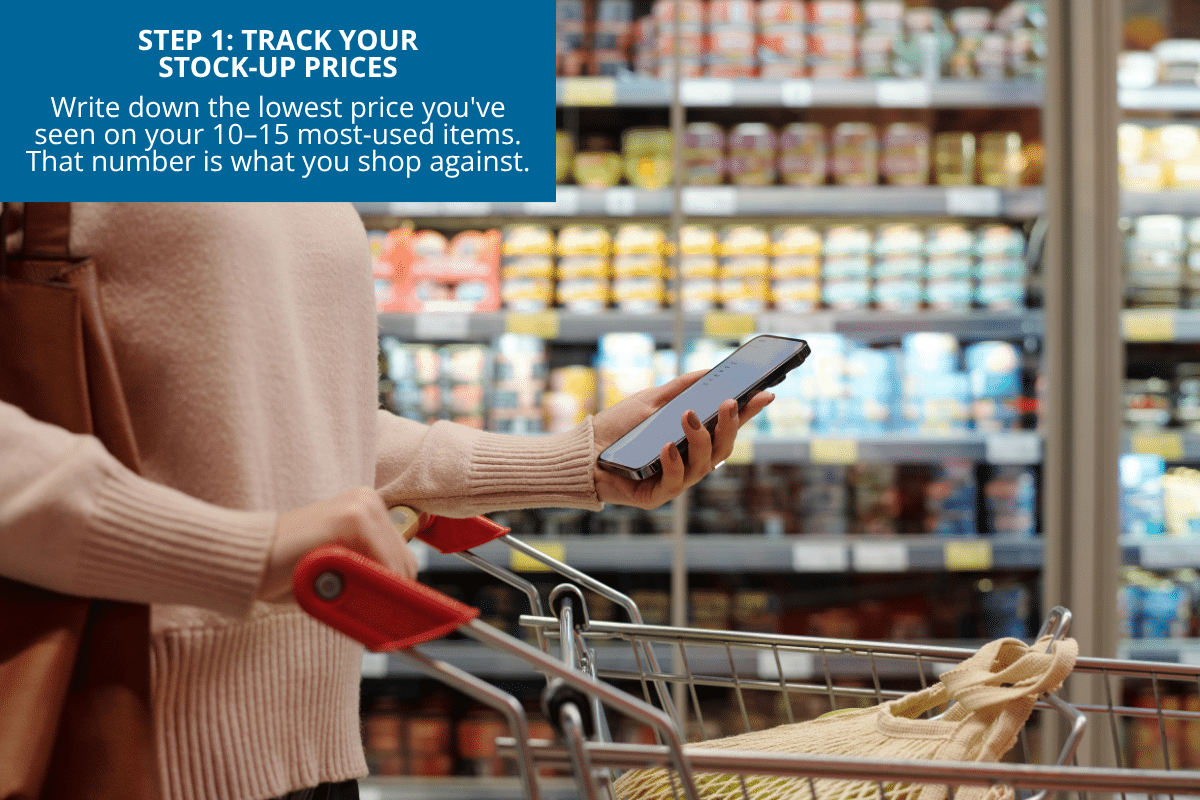
This is the single most useful habit a thoughtful grocery shopper develops. A stock-up price is the lowest price a given item reliably hits during its sale cycle. Not the regular price. Not a sort-of-sale price. The bottom-of-the-cycle price.
To find yours, keep a small notebook (or notes app) and write down the lowest price you’ve seen on the 10 to 15 items you buy most often. Update it whenever you see a new low. Within a couple of months you’ll know exactly what your local store’s bottom price is for chicken thighs, ground beef, pasta, cereal, cheese, and so on.
Once you know your stock-up prices, your grocery shopping fundamentally changes. You stop comparing this week’s price to last week’s. You compare it to the cycle low. And you only buy if it’s at or near that number.
Step Two: Spot the Real Sale vs. the Fake Sale
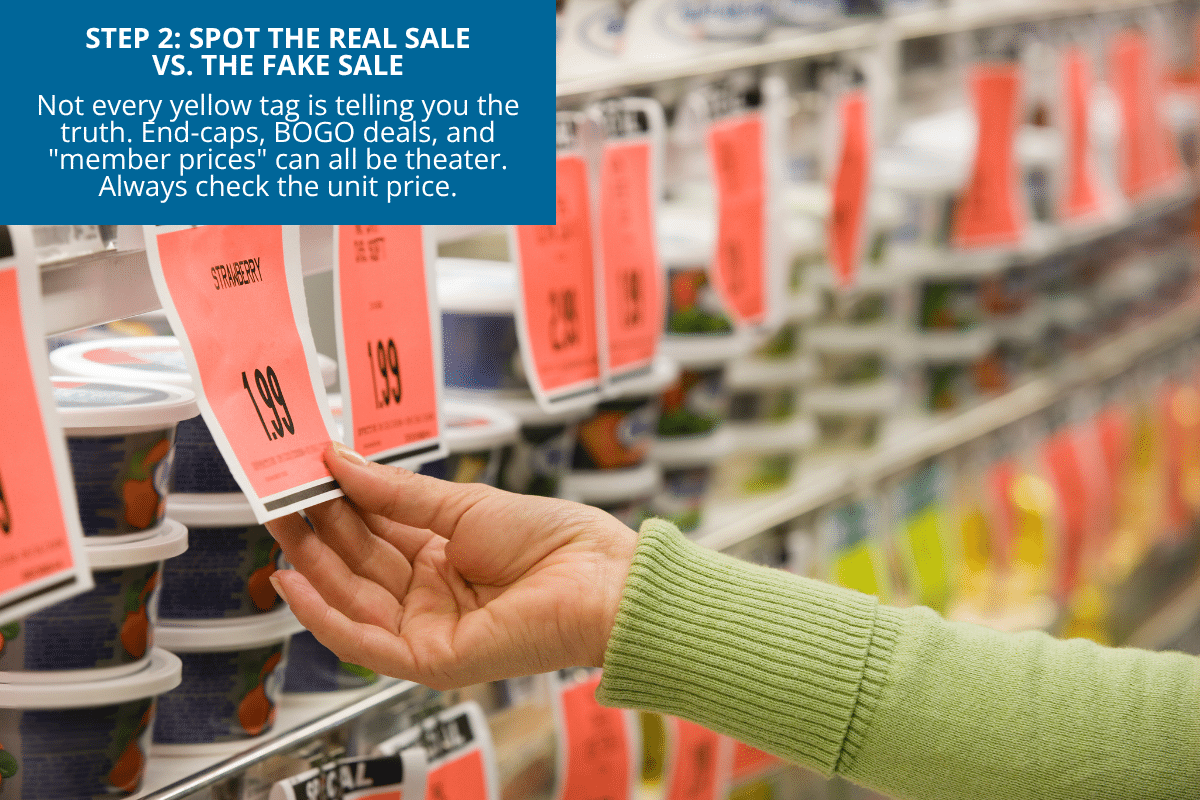
Not every yellow tag is a sale. Stores use a handful of pricing tricks designed to look like a deal without actually being one.
- “10 for $10” promotions. Almost never require you to buy 10. Most of the time, each one is $1, and you can buy just one. Worth knowing.
- “Buy one, get one 50% off.” The same as 25% off two. Not bad, but not as exciting as it sounds.
- “Save $1.00” signs that don’t show the original price. Always check the unit price on the shelf tag. A “savings” sign is meaningless without the actual price.
- End-cap displays. Items on end-caps are often there because the manufacturer paid for the placement, not because they’re on sale. Always check the price.
- Loyalty card “member prices.” Sometimes these are real sales. Sometimes the “regular” price was inflated last week. Compare to your stock-up notes.
Step Three: Use Loss Leaders to Your Advantage
Every weekly flyer has a few “loss leader” items. These are products the store is selling at or below their own cost to get you in the door. These are usually on the front page of the flyer, in big bold print, and tied to a “limit of two” or “limit of four” per customer.
These are the deals worth driving for. Build your week’s meal plan around the loss leaders. If chicken breasts are $1.79 a pound this week (your stock-up price might be $1.99), buy as many as your freezer will hold. If ground beef is the loss leader next week, do the same.
The store is betting that once you’re inside, you’ll buy other items at regular price to make up for the loss. The savvy shopper buys the loss leader, sticks to the list for everything else, and walks out.
Step Four: Build a Small Reserve
The hardest part of this system isn’t tracking prices. It’s having enough cash and pantry space to stock up when something is at its low.
Start small. Pick three or four items you buy regularly. Watch their prices for a month. When one hits its stock-up price, buy six to twelve weeks’ worth at once. Then don’t buy that item again until the next sale.
Within three or four months, you’ll have built a small reserve that covers the items you use most. Your weekly bill drops because you’re only buying perishables and the occasional fill-in. The grocery cycle is working for you instead of against you.
Seasonal Patterns Worth Memorizing
Knowing when each category hits its annual low is worth more than any coupon. Here’s a cheat sheet:
- Meat: Memorial Day, Fourth of July, and Labor Day for grilling cuts; Thanksgiving season for turkey and ham
- Baking supplies (flour, sugar, butter, chocolate chips): November and December, hands down
- Pasta and sauce: Back-to-school (September) and before major holiday and football weekends
- Frozen vegetables and dinners: January post-holiday clearance and back-to-school
- Condiments, dressings, and BBQ sauce: Memorial Day through Labor Day
- Canned goods: February (National Canned Food Month) and major holidays
- Beverages: Summer holiday weekends
Screenshot it. Stick it on the fridge. You’ll thank yourself in November.
What This Actually Looks Like
You walk into the store on a Wednesday. You glance at the flyer at the entrance and notice that boneless chicken thighs are at your stock-up price, and so is pasta sauce. You buy enough chicken thighs to fill the freezer space you have, and six jars of pasta sauce. You pick up the milk and bread you actually came for.
Total bill: lower than last week, even though you “bought more.” Next week, you only buy what you need. The chicken and pasta sauce are handled for two months.
That’s the cycle working for you. No apps. No couponing. Just paying attention.
Question: What’s the one item where you’ve nailed the stock-up price down cold? Mine is boneless skinless chicken thighs. I know to within ten cents what my floor is. Share yours in the comments below.
EverydayCheapskate™ is reader-supported. We participate in the Amazon Services LLC Associates Program and other affiliate advertising programs, designed to provide a means for us to earn from qualifying purchases, at no cost to you.

More from Everyday Cheapskate
 https://www.everydaycheapskate.com/wp-content/uploads/20261006-prime-big-deal-days-have-landed.png
800
1200
Mary Hunt
https://www.everydaycheapskate.com/wp-content/uploads/EC-Logo-by-Mary-Hunt-Tagline-Trimmed.png
Mary Hunt2026-10-05 11:01:432026-10-07 09:02:53EC’s Top Picks from Amazon Prime Big Deal Days 2026
https://www.everydaycheapskate.com/wp-content/uploads/20261006-prime-big-deal-days-have-landed.png
800
1200
Mary Hunt
https://www.everydaycheapskate.com/wp-content/uploads/EC-Logo-by-Mary-Hunt-Tagline-Trimmed.png
Mary Hunt2026-10-05 11:01:432026-10-07 09:02:53EC’s Top Picks from Amazon Prime Big Deal Days 2026 https://www.everydaycheapskate.com/wp-content/uploads/20261004-reduce-healthcare-costs-with-three-habits-healthy-couple-walking-in-autumn-leaves.png
800
1200
Mary Hunt
https://www.everydaycheapskate.com/wp-content/uploads/EC-Logo-by-Mary-Hunt-Tagline-Trimmed.png
Mary Hunt2026-10-04 23:08:572026-10-04 23:09:47How to Reduce Healthcare Costs With 3 Free Daily Habits
https://www.everydaycheapskate.com/wp-content/uploads/20261004-reduce-healthcare-costs-with-three-habits-healthy-couple-walking-in-autumn-leaves.png
800
1200
Mary Hunt
https://www.everydaycheapskate.com/wp-content/uploads/EC-Logo-by-Mary-Hunt-Tagline-Trimmed.png
Mary Hunt2026-10-04 23:08:572026-10-04 23:09:47How to Reduce Healthcare Costs With 3 Free Daily Habits https://www.everydaycheapskate.com/wp-content/uploads/20261004-woman-dreaming-about-her-financial-and-life-goals.png
800
1200
Mary Hunt
https://www.everydaycheapskate.com/wp-content/uploads/EC-Logo-by-Mary-Hunt-Tagline-Trimmed.png
Mary Hunt2026-10-04 12:50:422026-10-04 12:50:42She Lived in a Basement for $100 a Month. Here’s Why.
https://www.everydaycheapskate.com/wp-content/uploads/20261004-woman-dreaming-about-her-financial-and-life-goals.png
800
1200
Mary Hunt
https://www.everydaycheapskate.com/wp-content/uploads/EC-Logo-by-Mary-Hunt-Tagline-Trimmed.png
Mary Hunt2026-10-04 12:50:422026-10-04 12:50:42She Lived in a Basement for $100 a Month. Here’s Why. https://www.everydaycheapskate.com/wp-content/uploads/20241004-news-you-can-use-october-everyday-cheapskate-top-news-articles.png
800
1200
Mary Hunt
https://www.everydaycheapskate.com/wp-content/uploads/EC-Logo-by-Mary-Hunt-Tagline-Trimmed.png
Mary Hunt2026-10-04 01:04:052026-10-11 14:34:17News You Can Use • October 2026
https://www.everydaycheapskate.com/wp-content/uploads/20241004-news-you-can-use-october-everyday-cheapskate-top-news-articles.png
800
1200
Mary Hunt
https://www.everydaycheapskate.com/wp-content/uploads/EC-Logo-by-Mary-Hunt-Tagline-Trimmed.png
Mary Hunt2026-10-04 01:04:052026-10-11 14:34:17News You Can Use • October 2026 https://www.everydaycheapskate.com/wp-content/uploads/20261003-woman-hugging-elderly-mother-sandwich-generation-caring-for-aging-parents.png
800
1200
Mary Hunt
https://www.everydaycheapskate.com/wp-content/uploads/EC-Logo-by-Mary-Hunt-Tagline-Trimmed.png
Mary Hunt2026-10-03 10:47:222026-10-03 10:47:25Sandwiched Between Aging Parents and Adult Children
https://www.everydaycheapskate.com/wp-content/uploads/20261003-woman-hugging-elderly-mother-sandwich-generation-caring-for-aging-parents.png
800
1200
Mary Hunt
https://www.everydaycheapskate.com/wp-content/uploads/EC-Logo-by-Mary-Hunt-Tagline-Trimmed.png
Mary Hunt2026-10-03 10:47:222026-10-03 10:47:25Sandwiched Between Aging Parents and Adult Children https://www.everydaycheapskate.com/wp-content/uploads/20261002-cake-mix-chocolate-chip-cookies.png
800
1200
Mary Hunt
https://www.everydaycheapskate.com/wp-content/uploads/EC-Logo-by-Mary-Hunt-Tagline-Trimmed.png
Mary Hunt2026-10-02 19:44:302026-10-02 19:44:30Cake Mix Chocolate Chip Cookies That Taste Homemade
https://www.everydaycheapskate.com/wp-content/uploads/20261002-cake-mix-chocolate-chip-cookies.png
800
1200
Mary Hunt
https://www.everydaycheapskate.com/wp-content/uploads/EC-Logo-by-Mary-Hunt-Tagline-Trimmed.png
Mary Hunt2026-10-02 19:44:302026-10-02 19:44:30Cake Mix Chocolate Chip Cookies That Taste Homemade https://www.everydaycheapskate.com/wp-content/uploads/20260930-cheap-Halloween-party-snacks-for-kids-punch-bowl-mummy-dogs-ghost-bananas.png
800
1200
Mary Hunt
https://www.everydaycheapskate.com/wp-content/uploads/EC-Logo-by-Mary-Hunt-Tagline-Trimmed.png
Mary Hunt2026-10-01 11:08:582026-10-01 11:08:59These Cheap Halloween Snacks Are Almost Too Easy to Make
https://www.everydaycheapskate.com/wp-content/uploads/20260930-cheap-Halloween-party-snacks-for-kids-punch-bowl-mummy-dogs-ghost-bananas.png
800
1200
Mary Hunt
https://www.everydaycheapskate.com/wp-content/uploads/EC-Logo-by-Mary-Hunt-Tagline-Trimmed.png
Mary Hunt2026-10-01 11:08:582026-10-01 11:08:59These Cheap Halloween Snacks Are Almost Too Easy to Make https://www.everydaycheapskate.com/wp-content/uploads/20261001-prime-big-deal-days-are-coming.png
800
1200
Mary Hunt
https://www.everydaycheapskate.com/wp-content/uploads/EC-Logo-by-Mary-Hunt-Tagline-Trimmed.png
Mary Hunt2026-10-01 09:25:072026-10-01 11:45:25Prime Big Deal Days 2026: Your Cheapskate Game Plan
https://www.everydaycheapskate.com/wp-content/uploads/20261001-prime-big-deal-days-are-coming.png
800
1200
Mary Hunt
https://www.everydaycheapskate.com/wp-content/uploads/EC-Logo-by-Mary-Hunt-Tagline-Trimmed.png
Mary Hunt2026-10-01 09:25:072026-10-01 11:45:25Prime Big Deal Days 2026: Your Cheapskate Game Plan https://www.everydaycheapskate.com/wp-content/uploads/20260927-impossible-lasagna-pie-recipe-with-wooden-serving-spoon-in-white-casserole-dish.png
800
1200
Mary Hunt
https://www.everydaycheapskate.com/wp-content/uploads/EC-Logo-by-Mary-Hunt-Tagline-Trimmed.png
Mary Hunt2026-09-28 09:38:592026-09-28 22:48:34Impossible Lasagna Pie: All the Flavor, None of the Noodles
https://www.everydaycheapskate.com/wp-content/uploads/20260927-impossible-lasagna-pie-recipe-with-wooden-serving-spoon-in-white-casserole-dish.png
800
1200
Mary Hunt
https://www.everydaycheapskate.com/wp-content/uploads/EC-Logo-by-Mary-Hunt-Tagline-Trimmed.png
Mary Hunt2026-09-28 09:38:592026-09-28 22:48:34Impossible Lasagna Pie: All the Flavor, None of the Noodles

I consider myself a pretty savvy cheap shopper but you’ve given me more great ideas. Living on a fixed income is more of a challenge these days. I shops the Meat Dept manager’s specials always to see if there’s anything that works for us. It works great at 50% off the “members price”. I split my shipping amongst at the grocery discount stores like Grocery Outlet, Trader Joe’s, etc. even switching up brands we generally use if I can find another that is cheaper. Thank you for giving your helpful plan to add to my tool kit. I LOVE this plan!
boneless, skinless chicken breast. This week the “special” is $2.49/lb. NEXT week it will probably be an unadvertised special for less than $2.
My rule of thumb for ANY meat is $3/lb or less. I usually have a stocked freezer!! I also regularly shop the markdown meat section, where I get my best bargains.
Hi Mary,
As you know, I follow your tips on saving and love them. Thank-you. But sometimes I feel like I’m Really poor; running too tight, missing out on what I could have. Any help would be appreciated.
Thanks,
Barbara
Thank you for this, and for being honest about the hard part. That feeling isn’t in your head, running this tight is draining, and it’s okay to grieve what you’re going without. Saving was never meant to be a punishment, and when there’s no slack at all, the usual advice to “treat yourself” can feel like a slap.
So let me say something different: small dignity counts. A good cup of coffee made the way you like it, a library book, a free walk somewhere beautiful, one inexpensive thing each week that’s yours. These aren’t failures of discipline. They’re what keeps you going, and they belong in the budget right alongside the bills.
And cut yourself the same slack you’d give a friend. You’re doing a hard thing well. Being stretched thin isn’t a sign you’re bad with money, it’s a sign you don’t have enough of it yet, and that’s not a character flaw. Keep going. I’m glad you’re here.
What kind and useful information. Thank you!
Butter- during the holidays when butter is so low, especially at one store I shop, There is usually a limit of 6. I buy the limit every week when I go and stick it in the freezer. The butter I buy lasts the whole year. When butter was $4 a pound, I was still using $2.99 butter. $1.01 x 52=$52.52! It adds up.
Thanks to you Mary, even old dogs like me can learn new tricks.
Ive not seen a sales add in years except for the smaller chains or grocery stores.
I used to go to Sam’s or Costco for stocking up but interested in this.
With newspapers quitting delivery, it’s hard to find a sales flyer
I have taught myself to use my phone to look up the websites of my three grocery stores and search for weekly ad on their website websites.
And this is how I shop these days I know exactly what’s on sale at each store in town
Many stores post their weekly ads online, and some allow you to submit your email address, and they’ll email them to you.