

Why Your Home Feels Sticky and How to Fix It Fast


Humidity can make or break how your home feels. One day everything’s fine, and the next? The air feels heavy, your windows are sweating, and that faint musty smell starts creeping in. It’s not just uncomfortable. It can quietly damage your home and your health if you ignore it too long. If you’ve ever wondered whether a dehumidifier is worth it (or which one actually makes sense for your space), you’re in the right place. Let’s walk through what they do, how to know if you need one, and how to choose a solid, budget-friendly option that gets the job done without overcomplicating your life.

Humidity, or the lack of it, has been front and center around here lately. Where I live in northern Colorado, we’re sitting at about 24% humidity today, and it’s not unusual for that number to dip into the teens by afternoon. In other words, dry. Very dry. We run a humidifier almost nonstop just to stay comfortable.
But lately, my inbox has been telling a completely different story.
Reader after reader is dealing with the opposite problem: air that feels heavy, sticky, and exhausting. If you’ve ever walked into your home and felt like you needed a towel instead of a thermostat adjustment, you know exactly what I’m talking about.
That’s where a dehumidifier comes in. It’s not a luxury gadget. It’s a practical fix for a problem that affects how your home feels, smells, and even holds up over time.
What Is a Dehumidifier (and What Does It Actually Do)?
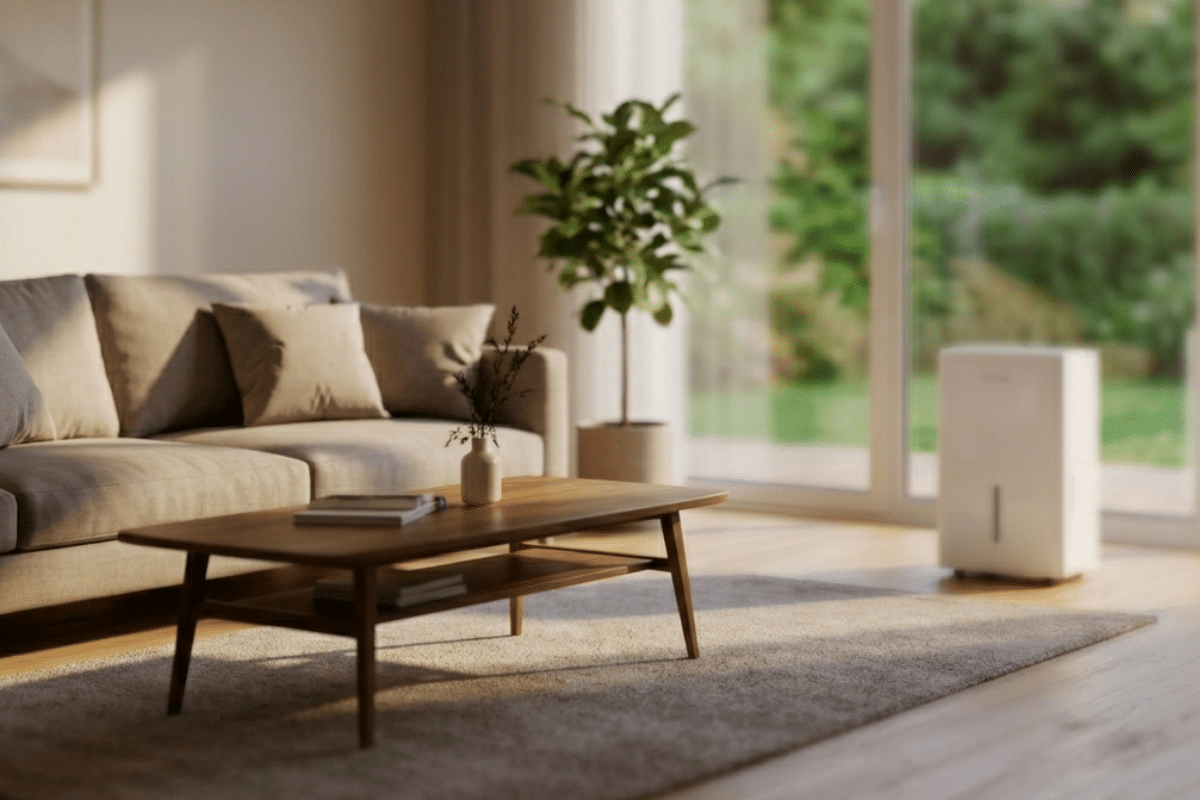
Think of a dehumidifier as a cross between a vacuum and a sponge for the air.
It pulls in damp air, removes the moisture, and sends dry air right back into the room. That moisture doesn’t disappear. It collects as water in a tank you’ll empty or drains out through a hose if you’ve set it up that way.
Behind the scenes, it’s pretty simple:
- A fan pulls humid air into the unit
- Cold coils turn that moisture into water
- The dry air is warmed slightly and pushed back out
The result is air that feels lighter, cleaner, and a whole lot more comfortable.
Most units also let you set your ideal humidity level, so you’re not guessing. Aim for that sweet spot between 30% and 50%, low enough to discourage mold and dust mites, but comfortable enough that your home doesn’t feel dry.
Some people use a dehumidifier alongside their air conditioner to take the pressure off during hot, sticky weather. Others rely on it in spaces where AC just doesn’t cut it, like basements or closed-off rooms.
Why Humidity Matters More Than You Think
High humidity isn’t just about comfort. Sure, that sticky, can’t-get-comfortable feeling is annoying. But what’s happening behind the scenes matters even more.
Too much moisture in the air can:
- Warp wood floors and furniture
- Damage paint and drywall
- Invite mold and mildew to move in
- Trigger allergies and breathing issues
- Make your AC work overtime (and run up your energy bill)
And here’s the part most people don’t realize: all of that can be happening before you see obvious signs.
On the flip side, when your humidity is in balance, your home feels lighter, cleaner, and easier to live in. Your air conditioner doesn’t have to work as hard, things dry faster, and that “something feels off” feeling disappears.
Not Sure What Your Humidity Level Is?

(Disclosure: This post includes an Amazon Creator Connections product. I may earn a small commission if you purchase through the link, at no additional cost to you.)
Signs You Might Need a Dehumidifier

You feel sticky… all the time.
That heavy, damp feeling that doesn’t go away, even with the AC running, is a classic sign. Your body is trying to cool you down, but the moisture in the air won’t let it do its job. So instead of feeling refreshed, you just feel… damp.
Your windows are wet on the inside.
If your windows are wet on the outside, it’s probably the weather. But if they’re dripping on the inside? That’s excess humidity settling in where it doesn’t belong.
You notice musty smells.
That “something smells off” scent, especially in basements, closets, or closed-up rooms, is often humidity at work. Even if you don’t see moisture, your nose usually knows.
You see stains or peeling paint.
You’ve ruled out leaks, but those water spots keep showing up anyway. Moisture can build up inside walls and ceilings, leading to stains, bubbling paint, and eventually damage that’s much more expensive to fix.
Mold or mildew shows up.
If something’s growing, humidity is feeding it. Mold and mildew thrive in damp environments, and once they settle in, they don’t leave quietly. They can also trigger allergy symptoms like congestion, sneezing, and irritated eyes, another reason to deal with the moisture, not just the mess.
Laundry takes forever to dry.
If towels stay damp and clothes take longer than usual to dry, the air is holding onto too much moisture. It’s a small annoyance that often points to a bigger issue.
If you’re nodding along to any of these, the next question is simple: Where is this happening in your home? Because humidity rarely shows up everywhere equally. It tends to settle into certain spaces and once you know where to look, it becomes much easier to fix.
Some spaces need extra help more than others:
- Basements & crawl spaces: naturally damp and poorly ventilated
- Bathrooms & laundry rooms: frequent moisture spikes
- Bedrooms: especially if they feel stuffy at night
- Garages & workshops: protect tools and stored items
- Closets: prevent musty odors on clothes
If a room smells off or feels damp, it’s a good candidate.
How to Choose the Right Size
Dehumidifiers are sized by how much moisture they can pull out of the air in 24 hours (measured in pints). Here’s an easy way to think about it:
- Up to 30 pints → small spaces like closets, offices, or bathrooms
- 30–50 pints → bedrooms, living rooms, and everyday spaces
- 50–70 pints → basements, large rooms, or homes that always feel a little too humid
You don’t need to overanalyze square footage or get out a calculator. Just match the unit to the general size and “feel” of the space. And when in doubt, go slightly bigger. A unit that doesn’t have to work as hard will run more efficiently and last longer.
Features That Actually Matter (and What You Can Skip)
It’s easy to get distracted by bells and whistles, but most people only need a handful of features to make a dehumidifier truly useful.
Worth it:
- Auto shut-off (prevents overflow… no surprise puddles)
- Continuous drain option (skip the daily emptying)
- Built-in humidistat (lets you set it and forget it)
- Washable filter (saves money and keeps things running smoothly)
Nice, but optional:
- Smart app controls
- Voice assistant compatibility
If you enjoy the tech side of things, those extras can be fun. If not, don’t give them a second thought. A simple unit will do the job just as well.
Drainage: The One Thing People Forget
Here’s the part nobody thinks about until they’re carrying a sloshing tank across the room. Every dehumidifier pulls moisture from the air, and that water has to go somewhere.
You’ve got two options:
- Tank collection: empty it when it fills up (simple, but hands-on)
- Continuous drain hose: attach a hose and let gravity do the work
If the unit is going in a basement, this is where you’ll thank yourself later. A drain hose turns it into a “set it and mostly forget it” situation.
Best Inexpensive Dehumidifiers
When it comes to affordable and reliable, the hOmeLabs line keeps things simple without cutting corners. These units quietly remove excess moisture, run efficiently, and fit into just about any space, from a small office to a big basement.
Here’s why they’re a smart choice:
- Simple to use: intuitive controls, with some models offering Wi-Fi for remote monitoring.
- Quiet operation: most run at whisper-quiet levels, so they won’t disrupt sleep, work, or TV time.
- Energy-efficient: designed to keep humidity in check without driving up your electric bill.
- Multiple sizes: from compact units for bedrooms and closets to larger models for basements and living spaces.
- Built to last: features like auto shut-off and washable filters make long-term use easy and low-maintenance.
Most importantly, these dehumidifiers focus on the basics: removing moisture effectively and quietly, without unnecessary extras. If you like a little tech, the Wi-Fi models let you check humidity, set targets, or control the unit from an app, perfect for keeping your home comfortable even when you’re not there.
Pick a size that matches your space, and consider a built-in pump if you’d rather never think about emptying a tank. From bedrooms and laundry rooms to garages and basements, there’s a hOmeLabs unit designed to fit seamlessly into your home life.


(Disclosure: This post includes an Amazon Creator Connections product. I may earn a small commission if you purchase through the link, at no additional cost to you.)
Quick Maintenance & Why It Matters
A little upkeep goes a long way and it only takes about 10 minutes:
- Rinse or replace the filter every few weeks
- Wipe down the water tank to prevent buildup
- Check the drain hose for clogs
That’s it. Simple steps like these keep your dehumidifier running efficiently and quietly for years.
Dehumidifiers aren’t flashy, but they’re one of those behind-the-scenes upgrades that make a real difference. They protect your home, improve comfort, and quietly save you money by preventing bigger headaches down the road.
Once your humidity is under control, you’ll notice it immediately, especially on those heavy, sticky days when the air just won’t quit holding onto moisture.
Dehumidifier FAQ: Everything You’re Curious About
Simply put, it pulls excess moisture from the air. That keeps your indoor humidity in the 30–50% sweet spot, making your home feel more comfortable and less prone to musty smells, condensation, and lingering dampness.
Classic signs include: slow-drying laundry, condensation on windows, musty odors, visible mold or mildew, and that “sticky air” that never seems to let your AC do its job. As one reader in Georgia put it, “I originally had a small unit for 260 sq ft and it never dropped below 50%—go bigger, you won’t regret it!”
Open windows let in new moisture, which can make the unit work harder or feel like it’s barely doing anything. For best results, keep windows closed in the room where your dehumidifier is running. Think of it like trying to bail water from a bathtub while the tap’s still running.
Often, yes. They use less energy and help your home feel cooler, which means your AC doesn’t have to work overtime. A couple of readers noted that even energy-efficient machines can bump up your bill if run nonstop, so pairing with timers or running during off-peak hours helps.
Anywhere damp air lingers: basements, bathrooms, laundry rooms, garages, or even bedrooms that feel stuffy at night. One reader in a studio apartment raved that proper placement gave them “total peace of mind.”
Only if you’re not using a continuous drain hose. If you do empty it manually, don’t toss the water. Many readers use it to water houseplants. Just remember, it’s essentially distilled water, so a bit of fertilizer can help.
Not necessarily. Wi-Fi-enabled units like some hOmeLabs models let you monitor and control humidity from your phone or via voice assistant, but you don’t need tech skills to run them. Plug in, set your desired humidity, and let it do the rest. One reader was relieved to find a smart model that didn’t require “calling the Geek Squad just to operate it.”
Most modern units are whisper-quiet. For bedrooms or basements under living spaces, look for units rated around 38–45 dB. Several readers confirmed that a quiet dehumidifier is worth the small price difference for uninterrupted sleep. What does a dehumidifier do?
How do I know if I need one?
Will a dehumidifier still work if windows are open?
Is a dehumidifier cheaper than air conditioning?
Where should I place a dehumidifier?
Do I need to empty the water tank?
Are smart dehumidifiers hard to use?
What about noise?
Question: Ever walked into a room and felt like you were swimming in the air? How do you tackle indoor humidity at home? Share your tips in the comments below.
EverydayCheapskate™ is reader-supported. We participate in the Amazon Services LLC Associates Program and other affiliate advertising programs, designed to provide a means for us to earn from qualifying purchases, at no cost to you.

More from Everyday Cheapskate
 https://www.everydaycheapskate.com/wp-content/uploads/20260925-best-inexpensive-coffee-grinders-burr-manual-and-electric.png
800
1200
Mary Hunt
https://www.everydaycheapskate.com/wp-content/uploads/EC-Logo-by-Mary-Hunt-Tagline-Trimmed.png
Mary Hunt2026-09-25 11:06:342026-09-28 22:48:36The Coffee Grinder Upgrade That’s Actually Worth It
https://www.everydaycheapskate.com/wp-content/uploads/20260925-best-inexpensive-coffee-grinders-burr-manual-and-electric.png
800
1200
Mary Hunt
https://www.everydaycheapskate.com/wp-content/uploads/EC-Logo-by-Mary-Hunt-Tagline-Trimmed.png
Mary Hunt2026-09-25 11:06:342026-09-28 22:48:36The Coffee Grinder Upgrade That’s Actually Worth It https://www.everydaycheapskate.com/wp-content/uploads/20260919-air-purifier-in-living-room-1.png
800
1200
Mary Hunt
https://www.everydaycheapskate.com/wp-content/uploads/EC-Logo-by-Mary-Hunt-Tagline-Trimmed.png
Mary Hunt2026-09-19 11:36:552026-09-28 22:48:42The Best Inexpensive Air Purifiers for Small Homes
https://www.everydaycheapskate.com/wp-content/uploads/20260919-air-purifier-in-living-room-1.png
800
1200
Mary Hunt
https://www.everydaycheapskate.com/wp-content/uploads/EC-Logo-by-Mary-Hunt-Tagline-Trimmed.png
Mary Hunt2026-09-19 11:36:552026-09-28 22:48:42The Best Inexpensive Air Purifiers for Small Homes https://www.everydaycheapskate.com/wp-content/uploads/20260918-man-and-woman-signing-an-extended-warranty-in-a-car-dealership.png
800
1200
Mary Hunt
https://www.everydaycheapskate.com/wp-content/uploads/EC-Logo-by-Mary-Hunt-Tagline-Trimmed.png
Mary Hunt2026-09-18 15:23:432026-09-18 15:25:43Is an Extended Warranty Ever Worth It? The Truth for 2026
https://www.everydaycheapskate.com/wp-content/uploads/20260918-man-and-woman-signing-an-extended-warranty-in-a-car-dealership.png
800
1200
Mary Hunt
https://www.everydaycheapskate.com/wp-content/uploads/EC-Logo-by-Mary-Hunt-Tagline-Trimmed.png
Mary Hunt2026-09-18 15:23:432026-09-18 15:25:43Is an Extended Warranty Ever Worth It? The Truth for 2026 https://www.everydaycheapskate.com/wp-content/uploads/20260917-fall-cleaning-checklist.png
800
1200
Mary Hunt
https://www.everydaycheapskate.com/wp-content/uploads/EC-Logo-by-Mary-Hunt-Tagline-Trimmed.png
Mary Hunt2026-09-17 17:11:012026-09-28 22:48:45Fall Cleaning Checklist: 15 Overlooked Spots to Clean
https://www.everydaycheapskate.com/wp-content/uploads/20260917-fall-cleaning-checklist.png
800
1200
Mary Hunt
https://www.everydaycheapskate.com/wp-content/uploads/EC-Logo-by-Mary-Hunt-Tagline-Trimmed.png
Mary Hunt2026-09-17 17:11:012026-09-28 22:48:45Fall Cleaning Checklist: 15 Overlooked Spots to Clean https://www.everydaycheapskate.com/wp-content/uploads/20260913-how-to-winterize-your-home-snowy-driveway-suburban-home.png
800
1200
Mary Hunt
https://www.everydaycheapskate.com/wp-content/uploads/EC-Logo-by-Mary-Hunt-Tagline-Trimmed.png
Mary Hunt2026-09-13 15:32:142026-09-28 22:48:55The Complete Guide to Winterizing Your Home This Fall
https://www.everydaycheapskate.com/wp-content/uploads/20260913-how-to-winterize-your-home-snowy-driveway-suburban-home.png
800
1200
Mary Hunt
https://www.everydaycheapskate.com/wp-content/uploads/EC-Logo-by-Mary-Hunt-Tagline-Trimmed.png
Mary Hunt2026-09-13 15:32:142026-09-28 22:48:55The Complete Guide to Winterizing Your Home This Fall https://www.everydaycheapskate.com/wp-content/uploads/20260830-best-sound-machine-for-better-sleep-woman-hiding-under-comforter.png
800
1200
Mary Hunt
https://www.everydaycheapskate.com/wp-content/uploads/EC-Logo-by-Mary-Hunt-Tagline-Trimmed.png
Mary Hunt2026-09-10 09:51:452026-09-28 22:48:58Best Sound Machine for Better Sleep: 3 Honest Picks
https://www.everydaycheapskate.com/wp-content/uploads/20260830-best-sound-machine-for-better-sleep-woman-hiding-under-comforter.png
800
1200
Mary Hunt
https://www.everydaycheapskate.com/wp-content/uploads/EC-Logo-by-Mary-Hunt-Tagline-Trimmed.png
Mary Hunt2026-09-10 09:51:452026-09-28 22:48:58Best Sound Machine for Better Sleep: 3 Honest Picks https://www.everydaycheapskate.com/wp-content/uploads/20260906-best-can-openers-manual-electric-luxury.png
800
1200
Mary Hunt
https://www.everydaycheapskate.com/wp-content/uploads/EC-Logo-by-Mary-Hunt-Tagline-Trimmed.png
Mary Hunt2026-09-06 18:07:432026-09-06 18:10:39The Best Can Openers That Actually Work (And Won’t Quit on You)
https://www.everydaycheapskate.com/wp-content/uploads/20260906-best-can-openers-manual-electric-luxury.png
800
1200
Mary Hunt
https://www.everydaycheapskate.com/wp-content/uploads/EC-Logo-by-Mary-Hunt-Tagline-Trimmed.png
Mary Hunt2026-09-06 18:07:432026-09-06 18:10:39The Best Can Openers That Actually Work (And Won’t Quit on You) https://www.everydaycheapskate.com/wp-content/uploads/20260829-fall-yard-projects-to-tackle-before-the-first-frost-foilage-front-yard-home.png
800
1200
Mary Hunt
https://www.everydaycheapskate.com/wp-content/uploads/EC-Logo-by-Mary-Hunt-Tagline-Trimmed.png
Mary Hunt2026-08-29 17:25:422026-09-28 22:49:2010 Fall Yard Tasks to Complete Before First Frost Hits
https://www.everydaycheapskate.com/wp-content/uploads/20260829-fall-yard-projects-to-tackle-before-the-first-frost-foilage-front-yard-home.png
800
1200
Mary Hunt
https://www.everydaycheapskate.com/wp-content/uploads/EC-Logo-by-Mary-Hunt-Tagline-Trimmed.png
Mary Hunt2026-08-29 17:25:422026-09-28 22:49:2010 Fall Yard Tasks to Complete Before First Frost Hits https://www.everydaycheapskate.com/wp-content/uploads/20260826-DIY-cat-litter-deodorizer-kitten-looking-up-at-camera-from-box.png
800
1200
Mary Hunt
https://www.everydaycheapskate.com/wp-content/uploads/EC-Logo-by-Mary-Hunt-Tagline-Trimmed.png
Mary Hunt2026-08-25 21:17:362026-09-28 22:49:26The One-Ingredient Litter Box Trick That Costs Pennies
https://www.everydaycheapskate.com/wp-content/uploads/20260826-DIY-cat-litter-deodorizer-kitten-looking-up-at-camera-from-box.png
800
1200
Mary Hunt
https://www.everydaycheapskate.com/wp-content/uploads/EC-Logo-by-Mary-Hunt-Tagline-Trimmed.png
Mary Hunt2026-08-25 21:17:362026-09-28 22:49:26The One-Ingredient Litter Box Trick That Costs PenniesPlease keep your comments positive, encouraging, helpful, brief,
and on-topic in keeping with EC Commenting Guidelines
Last update on 2026-10-02 / Affiliate links / Images from Amazon Product Advertising API


i live in a mobile home. our rules include no window ac units in windows that face the street. i have a portable air conditioner that is also a dehumidifier. it works quite well. the hose drains into an empty kitty litter jug, which i use to flush the toilet. my only complaint with it is that it has green interior lights that will light up the room with a green glow. i’ve found if i put a piece of cardboard across the top, where the lights are, it covers them nicely. i cannot sleep in a lit room. even streetlights are too much.
My parents always used the drained water to water their houseplants. No chlorine or chemicals.
Will a dehumidifier work if windows are open? We live in the Blue Ridge mountains so rarely need the AC but do have a lot of humidity in the house. But wondering if open windows makes a dehumidifier useless?! Thx!
Is the hOmelab a smart dehumidifier? I purchased a brand from Menards and it was so confusing after reading the directions that I returned it. I’m not computer savvy and I thought I was going to have to call the Geek Squad just to operate it. I just want one that I plug in, push a few buttons, empty it and let it do its job. Do you think the one you like is my kind of choice? Thx.
How about a quiet dehumidifier? Mine is in my basement directly under my bedroom and I hear it powering on and off all night.
For those dehumidifiers that you can empty yourself (not hooked up to a hose to a drain ….) I use the water to water my plants when I empty it. I am aware that the water does not have any minerals in it, so I put a bit of fertilizer in when I water the plants with it. Hate to waste water!
I purchased a Vremi dehumidifier that is supposed to cover 3,000 square feet and I can’t imagine a dehumidifier better one than this. Our house has always been humid and I was amazed at the water that came out of the air. I empty the reservoir at least once a day and I think it holds roughly 1.5 gallons. I’ve read that the humidity in a home should be in the forties. When I started this dehumidifier, it showed that ours was in the sixties. If I keep the reservoir emptied and the filter lean, it will stay in the forties. I can’t remember the exact price but it was in the neighborhood of $200.
I have not tested this brand, so I am unable to endorse, but thanks for your opinion.
I seriously love this dehumidifier. Living in a studio apartment in Georgia, humidity control is a nightmare. We originally purchased a small dehumidifier that was for 260 square feet and the humidity in our apartment only got below 50% once in the three weeks we had it running continuously. This piece of technology has changed our lives. We are no friends to mold and this gives us total peace of mind. Our favorite feature is that it will automatically turn on when the humidity is too high and turns off at our desired level. Great option for the price. Go big!! You won’t regret it.
We are building a house now. While investigating electric hot water heaters, I came across Hybrid models. They pull heat out of the air to heat up water. A bonus is they pull humidity out as well. It does have a winter mode when you don’t want to pull heat out of the air and it operates like a regular water heater. On a 50 gallon heater, electric bill savings is estimated at over $4000 over the life of the water heater. The cost was about $500 more than a regular water heater but at this time there is a $300 tax credit and a $100 local electric company rebate.
Dehumidifier suggestions for a small camping trailer?
I agree with Pat 100%
I run a dehumidifier in my basement to avoid that basement smell. However my energy bill jumped $50 per month after I set it up to run when the humidity reached a certain level. I have it hooked up to a hose that runs to a drain so I don’t have to empty it. It is a new energy efficient machine.
Dehumidifiers are great but they are electricity hogs. If your electricity provider is on a Time of Use (TOU) program, make sure that you don’t run it during the expensive electricity times. We had ours on a heavy duty timer and it kicked on at 7 pm and off at 7 am (when rates were lowest).
If possible put your AC on the same system. Your home will remain comfortable during the day even with the AC and humidifier not running as long as you cooled it and dehumidified it overnight. And of course, if your home it empty during the day, don’t waste electricity cooling an empty building. Our neighbours ran their AC all day even when no one was home and couldn’t figure out why their electricity bill was so high compared to ours! Duh!
I also live in Eastern Oregon. It also is very dry and we’re sitting approximately 5100′. I’m looking for a good humidifier. Any suggestions??? Thanks Mary.