

6 Reasons Why Borax Should Be in Every Laundry Room


If you’re looking for an affordable way to boost your laundry routine, meet your new secret weapon—borax. This household staple has been trusted for generations to soften water, whiten whites, and even eliminate odors. Want to know how to use borax safely and effectively? Let’s dive into the reasons why adding borax to your laundry routine is an absolute game-changer!

Borax’s chemical name is sodium tetraborate. Sodium tetraborate is a salt compound from boric acid but not an acid. It is a salt found naturally in evaporation lakes with the most commercially important deposits found in Boron, Calif. Sounds boring right? Perhaps but only until we discover the power of borax to solve all kinds of home laundry issues.
What’s the Deal with Boron, Borax, and Boric Acid?
Let’s clear up the confusion! Boron is a naturally occurring element, but borax is something a little different—a mix of sodium, boron, and oxygen that’s mined straight from the earth. In its powdered form, borax is white, with soft, colorless crystals that dissolve easily in water.

What Does Borax Do for Laundry?
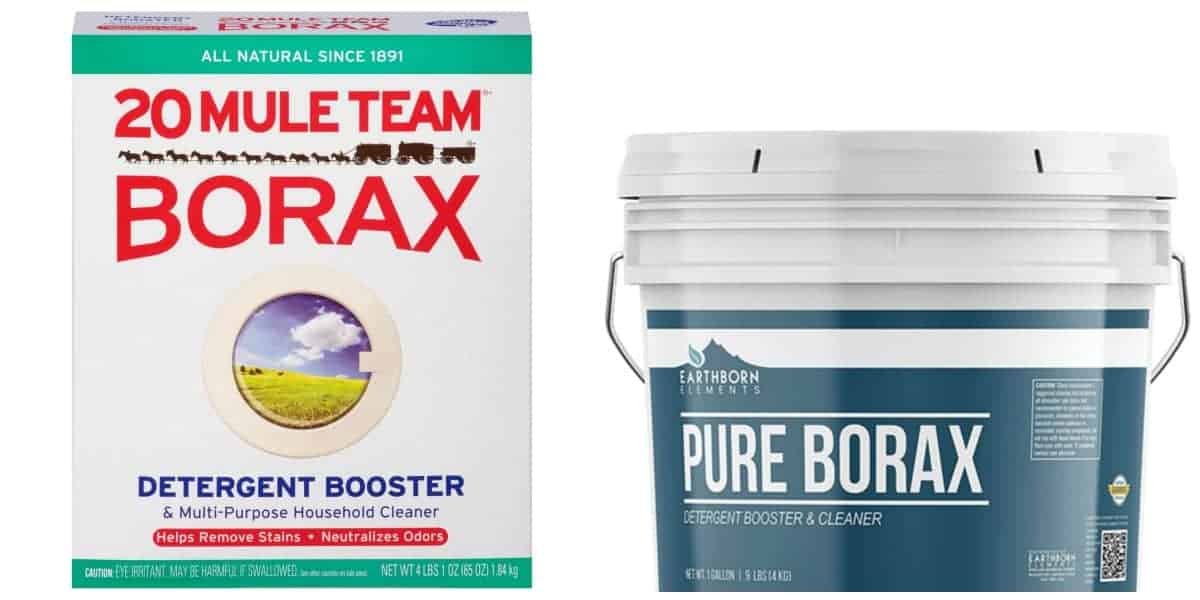 Adding up to 1/2 cup (depending on your water hardness) to each load—whether it’swhites or colorfast fabrics (just be sure to check those care labels!)—works wonders. Not only does it help keep whites bright, but it also neutralizes odors in your laundry and even freshens up your washing machine.
How to Use Borax in Your Laundry Routine
The amount of borax you use depends on your water’s hardness. For softer water, like where I live, I use about 1/4 cup for a full load and just a tablespoon for smaller ones. If you’ve got hard water, you might need up to 1/2 cup for a full load to get the best results.
Can You Mix Borax and Bleach?
Good news—yes, you can safely mix borax with bleach! While it’s true that combining bleach with highly acidic substances like vinegar can create harmful chlorine gas (yikes!), borax isn’t one of those risky ingredients. In fact, it’s perfectly safe to use borax with chlorine bleach and your favorite detergents. Even better, borax actually boosts the cleaning power of bleach, helping you get whiter whites and a deeper clean.
No need to stress—just avoid mixing bleach with anything acidic, and you’re in the clear!

Why You Should Add Borax to Every Load
Borax is like your laundry’s best-kept secret, bringing a host of benefits to every wash. Here’s why you’ll want to make it a laundry staple:
1. Borax Whitens Whites—Naturally
Think of borax as your go-to for maintaining crisp, bright whites. When paired with bleach, it supercharges the whitening effect. But even if bleach isn’t your thing, borax still gets the job done as a natural whitener. It’s like a brightening boost for everything from t-shirts to towels.
2. Borax Softens Hard Water—Making Your Detergent Work Better
Hard water can really mess with your detergent’s ability to clean, but borax helps fix that. With a pH of 9.24, borax changes the entire wash load’s pH to make the water more alkaline—perfect for cleaning. You can even feel the difference when you touch the water. It feels slick or slightly “slimy,” which is a sign the water is now softer. Soft water helps release dirt and stains more easily, making your detergent work so much better.
3. Borax Releases Soap Residue—Say Goodbye to Stiff Towels
Ever notice your towels come out scratchy or your whites look a bit gray after washing? That’s usually leftover soap and detergent clinging to fabric, especially in hard water. Borax prevents that buildup by dispersing the soap, so it doesn’t stick to your clothes. That means your towels come out soft, and your whites stay bright, not dingy.
4. Borax Tackles Stubborn Odors—Even the Worst Ones
Borax is a powerhouse when it comes to odor-fighting. It attacks the mold, fungi, and bacteria that cause musty smells in your laundry and your washing machine. Whether you’re dealing with stinky gym clothes, baby items, or linens from a sick room, borax helps eliminate those tough odors, leaving everything smelling fresh.
5. Borax Disinfects Your Laundry—Naturally
Need an extra layer of clean? Borax has antibacterial and antifungal properties, helping to inhibit bacteria, mold, and mildew in your laundry. It’s an easy, natural way to disinfect without harsh chemicals.
6. Borax Works as a Stain Fighter—Tough on Grease and Grime
Stubborn stains like tomato, mustard, and grease don’t stand a chance against borax. Pre-soak your laundry for 30 minutes in a mixture of borax and warm water (1 tablespoon per gallon) or add 1/2 cup of borax to your washer’s pre-soak cycle. You’ll be amazed at how it helps lift those tough stains before the wash even starts.
Important Precautions When Using Borax
By taking these precautions, you can enjoy all the benefits of borax while keeping yourself, your family, and your home safe from any unintended side effects.
Protect Your Eyes
Borax is no friend to your eyes. It’s corrosive, and if it comes into contact, you could end up with irritation, burning, or worse—an unexpected trip to the ER. If this happens, flush your eyes with water for a good 15 minutes. To avoid that scenario altogether, always wear safety glasses when handling borax.
Beware of Borax Dust
You may have heard that sprinkling borax on carpets to eliminate odors is a handy trick. The truth? It’s a bad idea. According to the National Library of Medicine, borax dust can irritate your respiratory tract. So, breathing it in while vacuuming could cause more harm than good. Stick to other methods for freshening up your carpets.
Homemade Slime: Not with Borax!
Kids love making slime, but borax doesn’t belong in their recipe. Borax can cause skin irritation or, in extreme cases, chemical burns, which makes it unsuitable for those fun slime parties. Before you host or send your child off to a slime-making event, double-check that borax isn’t on the supply list. And if you’re still looking for a slime recipe, there are plenty of safe, borax-free alternatives.
Handle With Gloves
Whether you’re working with borax directly or using homemade cleaners that contain it, always wear gloves. Prolonged skin exposure can lead to redness, rashes, or even burns. If borax does touch your skin, wash it off immediately with soap and water.
Don’t Use Borax on Toys
When cleaning kids’ toys, skip the borax. Even a tiny bit of residue could trigger respiratory issues in children. Stick with gentler, non-toxic cleaners that are safer for little hands and mouths.
Borax is NOT a Skin Treatment
You might come across DIY skincare recipes that suggest using borax to treat acne or clean your skin. But here’s the truth: borax should never be applied directly to your skin. It can cause irritation, rashes, and even toxicity. Stick with proven, gentle skincare products, and avoid borax altogether.
Skip the Aluminum Cookware
Borax and aluminum cookware don’t mix. The reaction can cause unsightly dark stains that are nearly impossible to scrub off. Just avoid using borax near aluminum pans, pots, or bakeware. And remember, aluminum doesn’t belong in the dishwasher—hand-wash only!
Frequently Asked Questions About Borax for Laundry
Can Borax Be Used on All Types of Laundry?
Yes! Borax is safe for most fabrics, but there’s always a better safe than sorry approach. For delicate fabrics like silk, wool, or any item labeled as dry clean only, it's best to skip the borax. Otherwise, it's great for whites, colorfast items, and even bedding. Just check those care labels to be sure.
How Much Borax Should I Add to My Laundry?
The golden rule here is: it depends on your water hardness. For softer water, you can get away with ¼ cup per load, but if you have hard water (like many of us), go up to ½ cup per full load. For smaller loads, scale it down to about 1 tablespoon. If you're not sure about your water, you can experiment a bit until you find your laundry sweet spot.
Is It Safe to Mix Borax with Bleach?
Absolutely. Unlike vinegar or ammonia, which can cause a dangerous chemical reaction with bleach, borax plays nice! In fact, it can actually boost the power of bleach, making your whites even whiter. Just be mindful to use both products as directed.
Can Borax Damage My Washing Machine?
Not at all! In fact, borax can help maintain your washing machine by keeping odors and mold at bay. It dissolves in water and won’t leave any harmful residue, so it’s safe for both top-loaders and front-loaders. If you’re worried about buildup, run an empty cycle with just hot water and borax every once in a while to keep your washer sparkling clean.
Does Borax Work in Cold Water?
Yes, borax can still work in cold water, but it dissolves best in warm water. If you’re doing a cold water wash, it helps to dissolve the borax in a cup of warm water first before adding it to the machine. This ensures it’s evenly distributed and gives you the best results.
Is Borax Safe to Use Around Kids and Pets?
Borax is a natural product, but like any cleaner, it should be used with caution. Keep it out of reach of kids and pets, and always follow the instructions on the packaging. If you're using borax in laundry or other cleaning tasks, be sure to store it in a safe, dry place where little hands or paws can’t get to it. For slime-making, though, borax should be avoided due to potential skin irritation.
Can I Use Borax in HE Washing Machines?
Yes! Borax is perfectly safe for High-Efficiency (HE) washers. Since HE machines use less water, the detergent and additives you use are more concentrated. Borax can actually help boost your HE machine's cleaning power by softening the water and breaking down stains and odors.
Does Borax Expire?
Technically, borax doesn’t expire! If stored in a dry, cool place, it’ll last indefinitely. However, over time it can clump up, which might make it harder to use. If that happens, just break it up with a spoon or give the box a little shake. It's still good to go!
Question: What’s your favorite laundry hack to keep clothes looking and smelling fresh? Do you use any additives like borax or baking soda? Let’s share our secrets.
EverydayCheapskate™ is reader-supported. We participate in the Amazon Services LLC Associates Program and other affiliate advertising programs, designed to provide a means for us to earn from qualifying purchases, at no cost to you.

More from Everyday Cheapskate
 https://www.everydaycheapskate.com/wp-content/uploads/20261012-Woman-using-smartphone-while-checking-monthly-cellular-data-usage-on-laptop.png
800
1200
Mary Hunt
https://www.everydaycheapskate.com/wp-content/uploads/EC-Logo-by-Mary-Hunt-Tagline-Trimmed.png
Mary Hunt2026-10-12 10:51:112026-10-12 10:51:11Do You Really Need Unlimited Data? Check Before You Pay
https://www.everydaycheapskate.com/wp-content/uploads/20261012-Woman-using-smartphone-while-checking-monthly-cellular-data-usage-on-laptop.png
800
1200
Mary Hunt
https://www.everydaycheapskate.com/wp-content/uploads/EC-Logo-by-Mary-Hunt-Tagline-Trimmed.png
Mary Hunt2026-10-12 10:51:112026-10-12 10:51:11Do You Really Need Unlimited Data? Check Before You Pay https://www.everydaycheapskate.com/wp-content/uploads/20261011-Woman-Adjusting-Smart-Home-Device-on-the-Wall-how-to-lower-your-electric-bill.png
800
1200
Mary Hunt
https://www.everydaycheapskate.com/wp-content/uploads/EC-Logo-by-Mary-Hunt-Tagline-Trimmed.png
Mary Hunt2026-10-11 23:01:562026-10-11 23:01:56Stop Chasing Pennies on Your Electric Bill. Do This
https://www.everydaycheapskate.com/wp-content/uploads/20261011-Woman-Adjusting-Smart-Home-Device-on-the-Wall-how-to-lower-your-electric-bill.png
800
1200
Mary Hunt
https://www.everydaycheapskate.com/wp-content/uploads/EC-Logo-by-Mary-Hunt-Tagline-Trimmed.png
Mary Hunt2026-10-11 23:01:562026-10-11 23:01:56Stop Chasing Pennies on Your Electric Bill. Do This https://www.everydaycheapskate.com/wp-content/uploads/20261007-red-present-sitting-in-autumn-leaves-Amazon-Prime-Big-Deal-Days-gifts.png
800
1200
Mary Hunt
https://www.everydaycheapskate.com/wp-content/uploads/EC-Logo-by-Mary-Hunt-Tagline-Trimmed.png
Mary Hunt2026-10-06 23:09:432026-10-06 23:09:43Christmas Shopping in October? These Prime Day Gifts Make Sense
https://www.everydaycheapskate.com/wp-content/uploads/20261007-red-present-sitting-in-autumn-leaves-Amazon-Prime-Big-Deal-Days-gifts.png
800
1200
Mary Hunt
https://www.everydaycheapskate.com/wp-content/uploads/EC-Logo-by-Mary-Hunt-Tagline-Trimmed.png
Mary Hunt2026-10-06 23:09:432026-10-06 23:09:43Christmas Shopping in October? These Prime Day Gifts Make Sense https://www.everydaycheapskate.com/wp-content/uploads/20261006-prime-big-deal-days-have-landed.png
800
1200
Mary Hunt
https://www.everydaycheapskate.com/wp-content/uploads/EC-Logo-by-Mary-Hunt-Tagline-Trimmed.png
Mary Hunt2026-10-05 11:01:432026-10-07 09:02:53EC’s Top Picks from Amazon Prime Big Deal Days 2026
https://www.everydaycheapskate.com/wp-content/uploads/20261006-prime-big-deal-days-have-landed.png
800
1200
Mary Hunt
https://www.everydaycheapskate.com/wp-content/uploads/EC-Logo-by-Mary-Hunt-Tagline-Trimmed.png
Mary Hunt2026-10-05 11:01:432026-10-07 09:02:53EC’s Top Picks from Amazon Prime Big Deal Days 2026 https://www.everydaycheapskate.com/wp-content/uploads/20261004-reduce-healthcare-costs-with-three-habits-healthy-couple-walking-in-autumn-leaves.png
800
1200
Mary Hunt
https://www.everydaycheapskate.com/wp-content/uploads/EC-Logo-by-Mary-Hunt-Tagline-Trimmed.png
Mary Hunt2026-10-04 23:08:572026-10-04 23:09:47How to Reduce Healthcare Costs With 3 Free Daily Habits
https://www.everydaycheapskate.com/wp-content/uploads/20261004-reduce-healthcare-costs-with-three-habits-healthy-couple-walking-in-autumn-leaves.png
800
1200
Mary Hunt
https://www.everydaycheapskate.com/wp-content/uploads/EC-Logo-by-Mary-Hunt-Tagline-Trimmed.png
Mary Hunt2026-10-04 23:08:572026-10-04 23:09:47How to Reduce Healthcare Costs With 3 Free Daily Habits https://www.everydaycheapskate.com/wp-content/uploads/20241004-news-you-can-use-october-everyday-cheapskate-top-news-articles.png
800
1200
Mary Hunt
https://www.everydaycheapskate.com/wp-content/uploads/EC-Logo-by-Mary-Hunt-Tagline-Trimmed.png
Mary Hunt2026-10-04 01:04:052026-10-19 09:46:10News You Can Use • October 2026
https://www.everydaycheapskate.com/wp-content/uploads/20241004-news-you-can-use-october-everyday-cheapskate-top-news-articles.png
800
1200
Mary Hunt
https://www.everydaycheapskate.com/wp-content/uploads/EC-Logo-by-Mary-Hunt-Tagline-Trimmed.png
Mary Hunt2026-10-04 01:04:052026-10-19 09:46:10News You Can Use • October 2026 https://www.everydaycheapskate.com/wp-content/uploads/20261003-woman-hugging-elderly-mother-sandwich-generation-caring-for-aging-parents.png
800
1200
Mary Hunt
https://www.everydaycheapskate.com/wp-content/uploads/EC-Logo-by-Mary-Hunt-Tagline-Trimmed.png
Mary Hunt2026-10-03 10:47:222026-10-03 10:47:25Sandwiched Between Aging Parents and Adult Children
https://www.everydaycheapskate.com/wp-content/uploads/20261003-woman-hugging-elderly-mother-sandwich-generation-caring-for-aging-parents.png
800
1200
Mary Hunt
https://www.everydaycheapskate.com/wp-content/uploads/EC-Logo-by-Mary-Hunt-Tagline-Trimmed.png
Mary Hunt2026-10-03 10:47:222026-10-03 10:47:25Sandwiched Between Aging Parents and Adult Children https://www.everydaycheapskate.com/wp-content/uploads/20260927-impossible-lasagna-pie-recipe-with-wooden-serving-spoon-in-white-casserole-dish.png
800
1200
Mary Hunt
https://www.everydaycheapskate.com/wp-content/uploads/EC-Logo-by-Mary-Hunt-Tagline-Trimmed.png
Mary Hunt2026-09-28 09:38:592026-09-28 22:48:34Impossible Lasagna Pie: All the Flavor, None of the Noodles
https://www.everydaycheapskate.com/wp-content/uploads/20260927-impossible-lasagna-pie-recipe-with-wooden-serving-spoon-in-white-casserole-dish.png
800
1200
Mary Hunt
https://www.everydaycheapskate.com/wp-content/uploads/EC-Logo-by-Mary-Hunt-Tagline-Trimmed.png
Mary Hunt2026-09-28 09:38:592026-09-28 22:48:34Impossible Lasagna Pie: All the Flavor, None of the Noodles https://www.everydaycheapskate.com/wp-content/uploads/20260925-best-inexpensive-coffee-grinders-burr-manual-and-electric.png
800
1200
Mary Hunt
https://www.everydaycheapskate.com/wp-content/uploads/EC-Logo-by-Mary-Hunt-Tagline-Trimmed.png
Mary Hunt2026-09-25 11:06:342026-10-10 15:49:09The Best Coffee Grinder Upgrade That’s Actually Worth It
https://www.everydaycheapskate.com/wp-content/uploads/20260925-best-inexpensive-coffee-grinders-burr-manual-and-electric.png
800
1200
Mary Hunt
https://www.everydaycheapskate.com/wp-content/uploads/EC-Logo-by-Mary-Hunt-Tagline-Trimmed.png
Mary Hunt2026-09-25 11:06:342026-10-10 15:49:09The Best Coffee Grinder Upgrade That’s Actually Worth ItPlease keep your comments positive, encouraging, helpful, brief,
and on-topic in keeping with EC Commenting Guidelines
Last update on 2026-10-20 / Affiliate links / Images from Amazon Product Advertising API


Hi, Mary! LOVE your tips! Can borax or washing soda ever cause a bleaching reaction? I have bleach spots in some of my bathroom towels and pillowcases. I don’t remember which product I was using at the time. In fact, it’s possible that I may have used some of each at the same time! Would that cause a problem?
While I have never experienced what you describe or any noticeable bleaching effect at all even with colors (and I’ve been adding borax to every load for years now), the manufactures advise:
“Borax can have a mild bleaching effect when used as a laundry additive. It works as a laundry booster by softening water, helping to remove stains, and brightening fabrics. Borax also enhances the effectiveness of detergents, and while it’s not as strong as chlorine bleach, it can help with whitening whites and brightening colors without being too harsh on fabrics. It’s a more gentle option for stain removal and deodorizing, especially when you’re looking to avoid the stronger chemicals in regular bleach.
“Just be mindful with delicate fabrics or dark colors, as using too much could lead to some fading over time.
“Super washing soda (sodium carbonate) can also have a mild bleaching effect when used in laundry. It works similarly to borax by softening water, which allows detergents to clean more effectively. It helps remove tough stains, deodorizes, and can brighten whites, though it’s not as powerful as bleach.
“However, it’s slightly more alkaline than borax, so it can be more effective at breaking down grease and grime but also potentially harsher on fabrics, especially dark or delicate items. Overuse of washing soda on colored fabrics could lead to some fading over time, so it’s best to use it sparingly for those loads.”
Thanks to you Mary I use Borax in every load of laundry! I buy it on Amazon – 10lbs.! I am going to try it on my stainless steel sink! Keep all of the great tips coming!!
You bet, Barbara!
Mary,
Doesn’t Vinegar take the soap out of you clothes (in the washer machine)?
Yes, adding vinegar to the rinse cycle can help remove detergent residue from laundry. White distilled vinegar acts as a natural fabric softener and can help break down any leftover detergent that didn’t fully rinse out during the wash cycle. It works by neutralizing the alkaline detergent, making it easier to wash away.
Vinegar is particularly useful for those with sensitive skin, as it helps ensure that clothing is free of residue that might cause irritation. Just add about half a cup to the rinse cycle, and your clothes will come out feeling softer and cleaner without any strong vinegar smell, as it typically dissipates during drying.
I add baking soda to cat litter to prevent clumping. Would Borax be ok? Concerned about fumes.
Also, what is in Zout that makes it so effective in stain removal? (Is it the same as Fels Naphtha?)
Another also, please. What’s the difference between Dawn Ultra and the ‘Professional’ Dawn Ultra Closed Loop?
Thank you so much.
Baking soda added to cat litter does not cause clumping on its own. Clumping cat litters typically use ingredients like sodium bentonite, which are specifically designed to absorb moisture and form clumps. Baking soda is primarily used in cat litter to help control and neutralize odors, but it doesn’t have the same absorbent or clumping properties.
Adding borax to cat litter can help with odor control, but it doesn’t contribute much to clumping. Borax is known for its ability to neutralize odors because of its deodorizing and antimicrobial properties. When mixed with cat litter, it can help reduce unpleasant smells by inhibiting the growth of odor-causing bacteria.
Dawn Ultra Heavy Duty Degreaser Closed Loop cuts through tough jobs with the grease-cutting power of Dawn. This industrial degreaser is designed to clean your toughest grease problems. It can be used as a multi surface cleaner on buildup on range hoods, fryers, ovens and walls. It is safe for use on food-contact surfaces when followed by rinsing with water. Dawn degreaser is excellent for cleaning corral areas and dumpsters and can even be used for cleaning heavy crank case oil from concrete drive-thru pads and sidewalks. This Dawn professional product is phosphate-free, noncaustic, nonflammable, and formulated for user safety.
Help! I can’t find the clue in question 6 down of the #12 crossword. I’ve read every email at least twice and haven’t found the clue. I do think I saw it in an email you quoted from but now when I look back I can’t find it. Any hints? I’ve got it all finished except this one clue.
Readers’ Unpredictable Responses
Two years ago I took over the laundry chores to lighten the work on my wife. I don’t do any cleaning around the house without checking out your web sight first, you’re the best. I’ve been using Borax with great success in every load I do.
Best part. My wife can’t believe how soft and fresh all her clothes and bedding come out.
Dear Wife: He’s a keeper. 🙂
Hi Mary. When you use Borax in a front loader, do you put it in the drum? Or do you put it in the powdered detergent dispenser along with your regular powdered detergent? Thank you!
Yes in the drum and I put it in first thing. Good question, and I’ll amend the post to add this. Thanks!
Are the 20 Mule Team and Earthborn borax the same strength? It seems in prior columns you had said that the name brand had additional inert ingredients, but maybe I’m confusing 20 Mule Team with the sodium percarbonate in OxiClean. Thanks for all the tips!
Exactly the same. Here are the 20 mule team borax ingredients as listed on the box: Sodium Tetraborate (a natural mineral). That’s it. It’s actually 95% Boron, mixed with sodium and oxygen and is mined in California, as explained in the post.
You may be recalling Oxiclean, which is only partly percarbonate with inert additives.
Hi Mary,
I live in MN, in an area where we have our own well. Our water is pretty soft, but I do have dingy whites, and some stains that will not come out of clothes. I add vinegar to the final rinse. I use a liquid detergent and my confusion lies in when/where to add the borax!? I have a HE Kenmore, top loading machine (which I loathe) and it frequently leaves a residue on clothes. I have had it serviced, so it is not malfunctioning.
Any tips you can give would be greatly appreciated! Thanks!
Susan
Add the borax first thing before the clothes. Then make sure you are not overloading the machine. But before you do anything, check out this post. I think it just may hold the solution to your problem. “Laundry Stripping” is the Easy Solution for Dingy Gray Sheets, Towels, Underwear
Would adding more Borax on top of what’s in the DIY laundry soap recipe be appropriate?
Yes this is in addition to your detergent, whatever type you are using. Borax IS one of the ingredients in homemade detergent, but it is a very small amount per load.
I accidentally spilled some Borax in my stainless steel sink and was amazed to see how it cleaned my sink. Since then I have used Borax to clean it. It cleans unbelievably well and stays clean much longer than using other products.
You’re right! Amazing. Also great in the toilet to removed stains. Just don’t get carried away and use it to clean anything aluminum. You won’t be happy with the results and I know this from firsthand experience!
Mary, I had a question and then Debbie asked it. But I don’t feel that you answered her/my
question, or I just am not understanding it. I use your laundry recipe that already has borax in it.
Am I to used more? Thanks. (I so enjoy the laughter segment…)
Yes this is in addition to your detergent, whatever type you are using. Borax IS one of the ingredients in homemade detergent, but it is a very small amount per load.
Mary,
I use Borax to clean my stainless steel sink. It does a fantastic job and stays cleaner longer than when I used other products.
Yes, that and lots more! 13 Reasons You Need to Keep Borax in the House (and Why It’s Safe!)
Hi Mary! Love your ideas and wanted to make my laundry detergent! I am having a problem locating washing soda and Fels Naptha bar of soap. The receipe calls for Borax. There are several types!
Please clarify!
Thank you!
Borax is generic so any brand will do. Twenty-Mule Team Borax brand is found is most supermarket laundry aisles. Super washing soda is more challenging but not at all impossible. The most common brand is Arm and Hammer. But “washing soda” is the common name for soda ash. You can get soda ash in 50 lb bags at swimming pool supply stores or the pool aisle at Walmart or Target. And you can find borax in large quantities on line. Both soda ash and borax get clumpy and can harden like a brick under high humidity conditions. I live where it’s very dry so the problem is less pronounced. But when it happens, I hit it with a hammer and break it up. Works well.
Fels Naptha bar soap is still available in most large supermarkets, again in the laundry aisle. Also online. The challenge I am facing is soaring prices. Thankfully I bought two cases of borax and a pail of washing soda (soad ash) before the prices began to climb.
Your comment has prompted me to prepare another post to address these products and where to find the best prices when the shelves are bar. Watch for that … I’ll do some deep-digging to get as many sources as possible. Thanks for that nudge!
I’m convinced, I’ll do it! 😀
Thanks so much!
I think you are going to be amazed, Lija. Actually I was embarrassed at first, but that went away quickly when I saw the outcome!
Mary, first, I love you for all the tips you are sharing with so many people. You surely are an angel.
I am 80 and absolutely love my “water-hog,” top-loading, older Whirlpool washing machine. I hope it outlasts me. I cannot understand the less-water, front-load machines, sorry. My question: Can I/should I up the Borax and white vinegar to 1 cup in my loads?
I think 1/2 cup of each will do just fine in your machine, even allowing for the great water capacity.
Hi Mary, thank you for all the money saving tips! What are your thoughts on using baking soda alone as a laundry detergent?
Thanks
I wouldn’t even think of it. You need some type of detergent to kill germs and bacteria and baking won’t do that. Baking soda, has some water softening properties, and that allows soap or deterent to clean a lot better. It’s a booster. Super washing soda is similar to baking soda, but much more effecived
Find it cheaper from the Walmart, WinCo I use it often in my wash
Yes, always check your local retailers. I give you resources in the column that make it available to everyone.
For Christmas I made your “home made rolls” they were so easy! Big and beautiful and delicious! Thank you for all you great ideas!
I have lung disease and want to use borax, so what precautions should I use? Just goggles and a hepa mask, or what kind of mask?
I suppose the regular face mask you believe thwarts you against COVID-19 would also protect you against any inhaling borax particulates. However, you would be best advised to check with your pulmonologist!
HI MARY
I ORDERED OVEN CLEANER TABLETS AND SUPPOSE TO COME WITH A MIXING BOTTLE WELL I NEVER GOT THEM. PAID FOR VIA PAY PAL PLEASE HELP
Sorry Emma … I don’t know anything about this and I have never offered or recommended such a thing. Did you respond to an advertisement? You’d be best to contact your credit-card provider to dispute the charge. That will get you a refund at least.
Hi Mary – My husband has a respiratory disease COPD. Since he would not be exposed to Borax dust, could I use it in our laundry?
Check with his Dr. I am not a doctor, and don’t pretend to be. That being said, if borax becomes a routine addition to the laundry, I would make sure he NEVER does the laundry. Look at the disappointment on his face. But I would continue to use it because in my mind the borax is dissolved, does its job and then residue is rinsed out because I add an extra rinse with white vinegar to make sure that happens.
Can borax be used in newer machines that say you should only use detergents for HE washing machines? I appreciate your daily advice!!
I cannot make any hard and fast guarantees but I have a front loading HE as do many of your fellow ECers. We use borax religiously. I mostly add it to the reservoir for “Prewash” and then select the cycle that starts out with a prewash soak. But you can alternatively add borax to the detergent reservoir for a cycle that does not include prewash. OR just throw it in with the clothes before you shut the door.
Here’s the deal with HE and all the warnings and scare tactics. An HE washer uses precious little water. That’s what makes it “high efficiency.” If you dump in a detergent that creates a lot of suds, that’s a big problem. The drum fills up with suds and then all the mechanics of being able to wash and rinse with hardly any water goes awry. I’ve read horror stories.
You want a detergent that makes few if any suds (our homemade detergent is perfect because it is all but suds-less) known as HE compliant detergent. Borax does not make suds. That is the key piece of information. Neither does washing soda. Fels Naptha makes no suds. Blue Dawn DOES make suds, but we use so little of it in the homemade detergent that it becomes negligible and perfect for HE machines. Hope that helps.
Thanks for your kind words. That recharges my batteries 🙂
Hi Mary. We have a whole house water softener. I also add ~1/2 c. white vinegar to each load, per your past suggestion (really helped w/my husband’s work out clothes odors and musty towels!). Do you think I should add the Borax in addition to the vinegar? Thanks, as always.
Hi Pam … The water softener is already taking care of the pH situation, so I wouldn’t add borax.
Hi Mary.. I use your homemade laundry soap – should I still add more borax?
ps. Thank you for all your great tips & ideas! Now when we have a household dilemma, my husband says
“What does Mary say about it?”, he thinks your fab too!
(Hello to hubs!) Yes, especially if you are seeing dingy whites. If you are not and your water is naturally soft, it would be optional. The amount of borax depends on the hardness of your water. For example, where I live the water is not extremely hard, so I add about 1/4 cup to a full load in the prewash cycle (which I use routinely), one tablespoon for a small load. For areas with hard water, 1/2 cup for a full load would be more appropriate.