
How to Read Your Water Bill and Lower Your Monthly Costs Now


Be honest. When your water bill shows up, do you actually read it? Or do you glance at the total, wince, and move on? I did that for years until one summer my bill jumped $40. Turns out a worn toilet flapper had been quietly leaking the whole time. A $5 replacement fixed the problem, and my bill dropped right back down. That’s the thing about water bills. Nobody really teaches you how to read one, so most of us don’t. And a bill you can’t read is a bill you can’t fix.
Here’s the good news: once you know what you’re looking at, most households can trim their water use by 15 to 30 percent through leak repairs and a few habit changes, no comfort sacrificed and no big purchases required. Let’s get you fluent.
First, Decode the Bill Itself

Your bill probably has three or four parts. Once you know what each one means, the whole page stops looking like a foreign language.
Water Usage Charge
This is what you actually used, measured in gallons or in CCF, which stands for “hundred cubic feet” (whoever named that wasn’t thinking about the rest of us). One CCF is 748 gallons. So 8 CCF on your bill means you used about 5,984 gallons that month.
Sewer Charge
Many utilities base this on how much water went into your home, on the assumption that most of it eventually flows back out through the sewer. Some charge sewer based on your total metered water use. Others set a winter average and charge that rate year-round, since winter usage doesn’t include lawn watering.
That last detail matters more than you’d think. If you water your yard all summer, you may be paying sewer charges on water that soaked into your lawn and never touched a sewer pipe. Some utilities offer a “summer averaging” adjustment to fix that. It’s worth asking about, because it usually has to be requested. Nobody’s going to volunteer it.
Service Charge
A flat monthly fee for infrastructure and meter reading, whether you used one gallon or one thousand. Usually somewhere between $15 and $40 these days, more in bigger metro systems.
Everything Else
Stormwater fees, conservation fees, watershed fees. These vary a lot by city, so check your bill’s fine print for what applies to you.
Then, Find Your Baseline
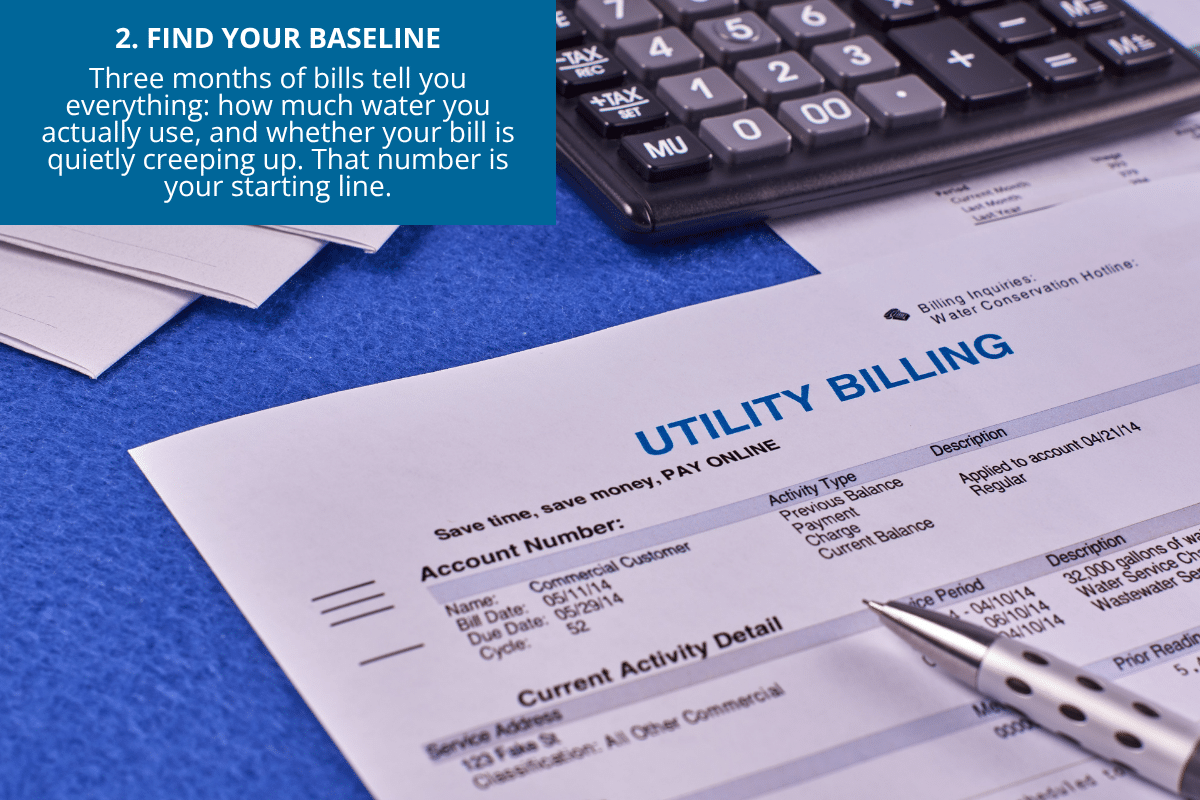
Pull your last three bills. Write down the gallons or CCF for each month. If you can dig up last year’s bills for the same months, even better.
You’re looking for two things: how much water your household typically uses, and whether that number is climbing. The average American household now spends around $120 a month on combined water and sewer service, though your bill could be much higher or lower depending on where you live, your local utility’s rates, and how much water your household uses.
A sudden spike almost always means a leak. Steady high usage usually just means it’s time to change a habit or two. Either way, now you know which problem you’re solving.
The Leak Hunt
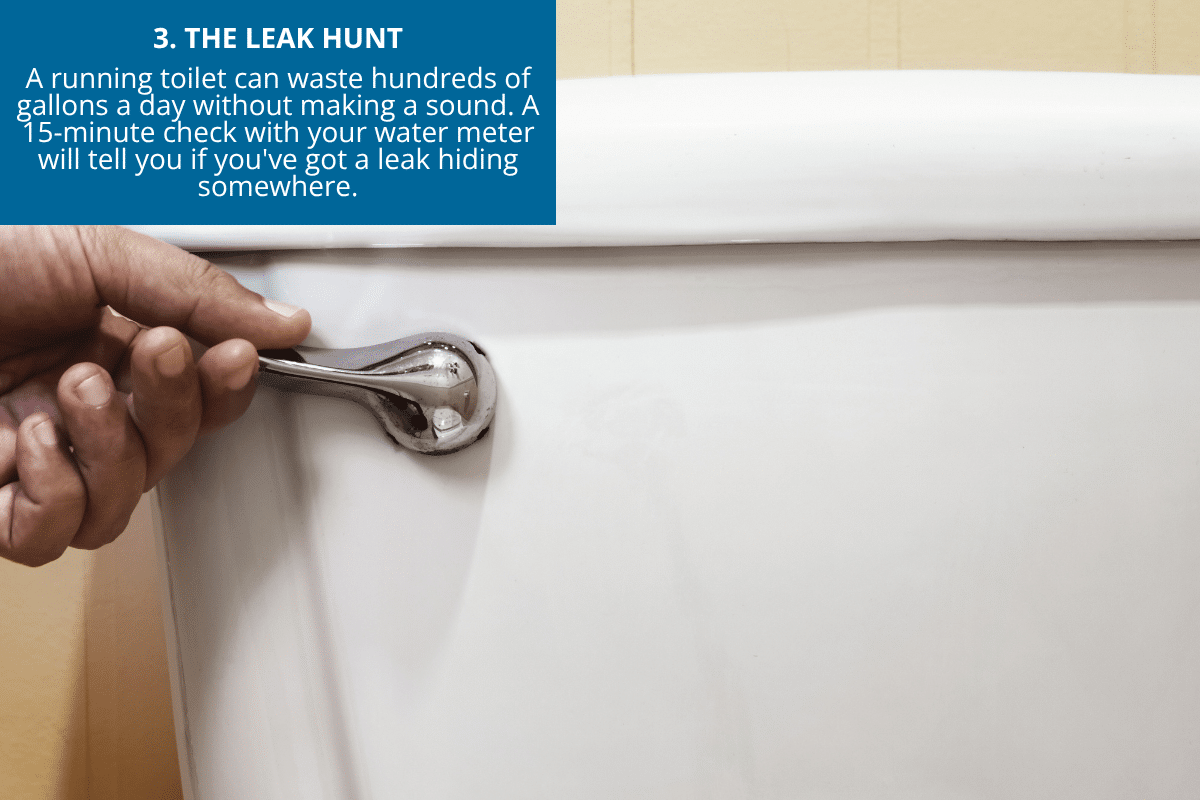
Small leaks are the single biggest reason water bills creep up without anyone noticing. A running toilet can waste hundreds of gallons a day, sometimes climbing into the thousands if it’s bad enough, and most people never hear a drop.
The 15-Minute Leak Check
Turn off every water-using appliance in the house (dishwasher, washer, ice maker) and don’t use any water for 15 minutes. Then read your water meter. Wait 15 minutes with no water use. Read the meter again.
If the numbers changed, you have a leak somewhere. Common sources:
- Toilets: Drop some food coloring into the tank and wait 15 minutes without flushing. Color in the bowl means the flapper is leaking. A replacement flapper runs about $5 and can genuinely turn into real monthly savings.
- Faucets: Even a slow drip adds up to several gallons a day. Fix it with a new washer or cartridge, usually $10 to $15 in parts.
- Outdoor spigots: Check the spigot itself and the hose connection. It’s almost always a worn rubber washer, and those cost pennies.
- Sprinkler heads: Walk your yard while the system runs. Look for heads spraying the driveway instead of the grass, or heads that are just broken. A single bad head can waste a surprising amount of water in one watering cycle.
- Water softener: Older timer-based softeners often regenerate more often than they need to, dumping water down the drain on a schedule instead of based on actual use. Check your settings.
The Habits That Actually Move the Needle
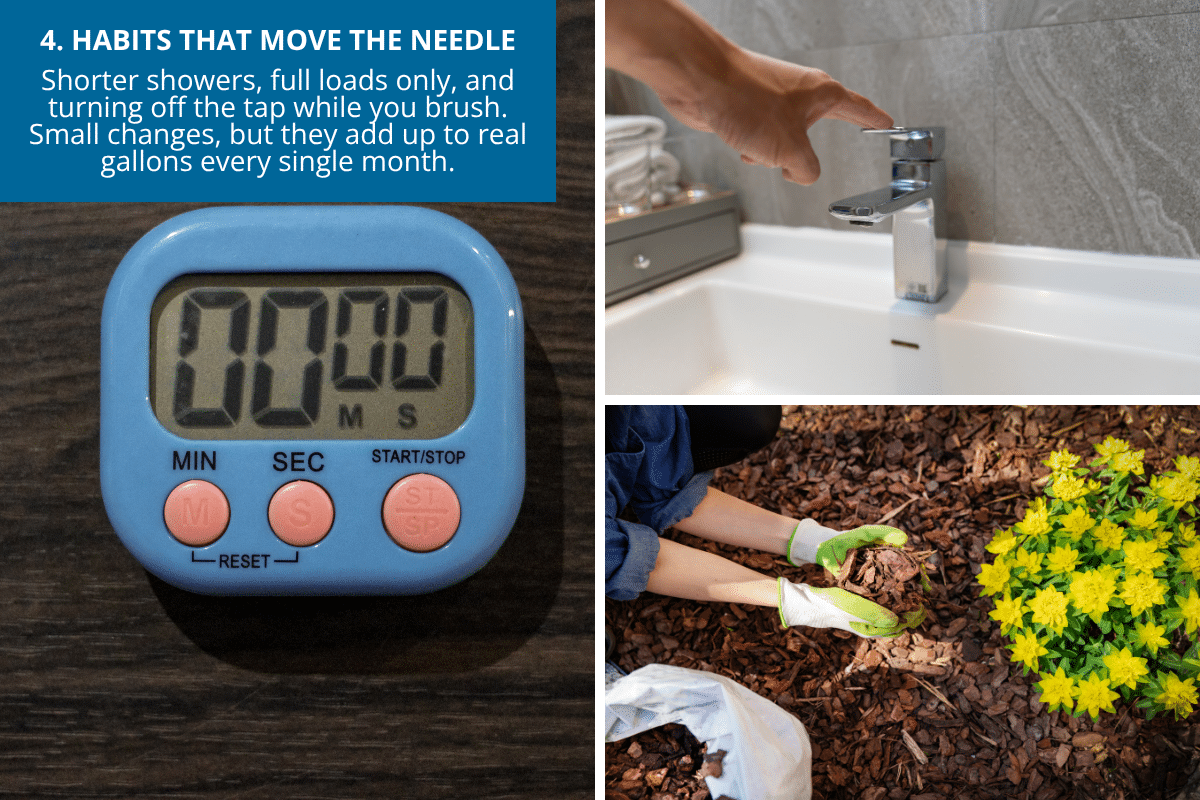
Once the leaks are handled, this is where the real savings live.
Shorter Showers
A typical showerhead runs 2 to 2.5 gallons per minute. Cut a 10-minute shower to 5 and you save around 12 gallons a day, per person. For a family of four, that adds up to roughly 1,500 gallons a month. A shower timer, or just a favorite song that runs about 5 minutes, works better than willpower ever will.
Run Full Loads Only
Dishwashers and washing machines use close to the same amount of water whether they’re full or half-empty, so make them earn their keep. And skip the pre-rinse. Modern dishwashers are built to handle food scraps, and pre-rinsing can waste thousands of gallons a year for no real benefit.
Stop Letting the Water Run
Turning off the tap while you brush your teeth saves several gallons a day. Same for shaving. Scraping dishes into a bowl of water instead of running the tap over them saves more than you’d guess, meal after meal.
None of these feel like much on their own. Stack them together and you’re looking at well over 1,000 gallons a month for a typical family, without anyone in the house noticing a difference.
Outdoor Watering… The Big One
If you’re going to focus your energy anywhere, focus it here.
- Water early, between 5 and 8 a.m. Evening watering invites fungus, and midday watering loses a lot more to evaporation than morning watering does.
- Water deeply and less often. One inch of water a week in one or two sessions beats a light daily sprinkle every time, because it trains roots to grow deeper instead of staying near the surface.
- A rain sensor for your sprinkler system costs $30 to $100 and can cut unnecessary watering by roughly 15 to 30 percent, depending on your climate.
- Mulch, 3 to 4 inches around your plants, slows evaporation and can meaningfully cut how often you need to water.
- And wash your car at a car wash instead of your driveway. Most commercial car washes recycle a good chunk of their water, which makes them more efficient than a garden hose running for 20 minutes in your driveway.
Contact Your Utility About Adjustments

Two conversations that can save money without changing anything:
Ask About Leak Forgiveness.
If you had a genuine leak and fixed it, many utilities will forgive some or all of the extra charges, usually if you can show a repair receipt. Ask specifically about their leak adjustment or one-time credit policy. Nobody will offer this unprompted.
Ask About Sewer Averaging
If you water a lawn or garden, ask whether your utility caps summer sewer charges based on your winter usage. Some do, some don’t. It’s regional. But if yours does, it can save you real money in the warm months.
Ask About Assistance Programs
For lower-income households or seniors, many water utilities have discount programs. It’s worth a call to ask what’s available.
What This Looks Like in Practice
Take a family of four with a $110 monthly water and sewer bill:
- Fix a running toilet: save 6,000 gallons/month = $18 lower bill
- Cut shower times from 10 to 6 minutes: save 1,200 gallons/month = $4 lower bill
- Adjust sprinkler schedule and add rain sensor: save 4,000 gallons/month in summer = $12 lower bill (summer)
- Enroll in sewer averaging program: $18 lower bill (summer)
- Stop pre-rinsing dishes: save 500 gallons/month = $2 lower bill
Add it up and you’re often looking at a 20 to 35 percent reduction, more in homes with real leaks or heavy outdoor watering, less in homes that were already pretty efficient. Your exact numbers will depend on your local rates, which vary more than you’d think from one town to the next. But the direction is always the same: down.
Set a Monthly Review Habit
Once you’ve done the initial work, don’t stop there. Once a month, open your water bill, note the gallons used, and compare to the previous month. Any surprise spike is a signal to check for leaks.
Water bills are one of the few household expenses that respond quickly and predictably to attention. Pay attention once, and the savings compound month after month for years.
Question: Now I want to hear from you. What’s the one fix that actually moved the needle on your water bill? A toilet repair, a sprinkler tweak, finally breaking the long-shower habit? Tell me in the comments. I read every one.
EverydayCheapskate™ is reader-supported. We participate in the Amazon Services LLC Associates Program and other affiliate advertising programs, designed to provide a means for us to earn from qualifying purchases, at no cost to you.

More from Everyday Cheapskate
 https://www.everydaycheapskate.com/wp-content/uploads/20261004-woman-dreaming-about-her-financial-and-life-goals.png
800
1200
Mary Hunt
https://www.everydaycheapskate.com/wp-content/uploads/EC-Logo-by-Mary-Hunt-Tagline-Trimmed.png
Mary Hunt2026-10-04 12:50:422026-10-04 12:50:42She Lived in a Basement for $100 a Month. Here’s Why.
https://www.everydaycheapskate.com/wp-content/uploads/20261004-woman-dreaming-about-her-financial-and-life-goals.png
800
1200
Mary Hunt
https://www.everydaycheapskate.com/wp-content/uploads/EC-Logo-by-Mary-Hunt-Tagline-Trimmed.png
Mary Hunt2026-10-04 12:50:422026-10-04 12:50:42She Lived in a Basement for $100 a Month. Here’s Why. https://www.everydaycheapskate.com/wp-content/uploads/20260920-small-money-mistakes-woman-sitting-at-her-laptop-reviewing-bills.png
800
1200
Mary Hunt
https://www.everydaycheapskate.com/wp-content/uploads/EC-Logo-by-Mary-Hunt-Tagline-Trimmed.png
Mary Hunt2026-09-20 11:34:162026-09-28 22:48:40Small Money Mistakes: How to Fix Them Before They Grow
https://www.everydaycheapskate.com/wp-content/uploads/20260920-small-money-mistakes-woman-sitting-at-her-laptop-reviewing-bills.png
800
1200
Mary Hunt
https://www.everydaycheapskate.com/wp-content/uploads/EC-Logo-by-Mary-Hunt-Tagline-Trimmed.png
Mary Hunt2026-09-20 11:34:162026-09-28 22:48:40Small Money Mistakes: How to Fix Them Before They Grow https://www.everydaycheapskate.com/wp-content/uploads/20260918-man-and-woman-signing-an-extended-warranty-in-a-car-dealership.png
800
1200
Mary Hunt
https://www.everydaycheapskate.com/wp-content/uploads/EC-Logo-by-Mary-Hunt-Tagline-Trimmed.png
Mary Hunt2026-09-18 15:23:432026-09-18 15:25:43Is an Extended Warranty Ever Worth It? The Truth for 2026
https://www.everydaycheapskate.com/wp-content/uploads/20260918-man-and-woman-signing-an-extended-warranty-in-a-car-dealership.png
800
1200
Mary Hunt
https://www.everydaycheapskate.com/wp-content/uploads/EC-Logo-by-Mary-Hunt-Tagline-Trimmed.png
Mary Hunt2026-09-18 15:23:432026-09-18 15:25:43Is an Extended Warranty Ever Worth It? The Truth for 2026 https://www.everydaycheapskate.com/wp-content/uploads/20260915-overspending-habits-man-opening-empty-wallet.png
800
1200
Mary Hunt
https://www.everydaycheapskate.com/wp-content/uploads/EC-Logo-by-Mary-Hunt-Tagline-Trimmed.png
Mary Hunt2026-09-15 20:24:412026-09-28 22:48:50How to Stop Overspending Habits for Good, Starting Today
https://www.everydaycheapskate.com/wp-content/uploads/20260915-overspending-habits-man-opening-empty-wallet.png
800
1200
Mary Hunt
https://www.everydaycheapskate.com/wp-content/uploads/EC-Logo-by-Mary-Hunt-Tagline-Trimmed.png
Mary Hunt2026-09-15 20:24:412026-09-28 22:48:50How to Stop Overspending Habits for Good, Starting Today https://www.everydaycheapskate.com/wp-content/uploads/20260914-101010-rule-gold-numbers-on-teal-background.png
800
1200
Mary Hunt
https://www.everydaycheapskate.com/wp-content/uploads/EC-Logo-by-Mary-Hunt-Tagline-Trimmed.png
Mary Hunt2026-09-14 11:31:532026-09-28 22:48:53The 10/10/10 Rule Every Overthinker Needs to Try Today
https://www.everydaycheapskate.com/wp-content/uploads/20260914-101010-rule-gold-numbers-on-teal-background.png
800
1200
Mary Hunt
https://www.everydaycheapskate.com/wp-content/uploads/EC-Logo-by-Mary-Hunt-Tagline-Trimmed.png
Mary Hunt2026-09-14 11:31:532026-09-28 22:48:53The 10/10/10 Rule Every Overthinker Needs to Try Today https://www.everydaycheapskate.com/wp-content/uploads/20260913-how-to-winterize-your-home-snowy-driveway-suburban-home.png
800
1200
Mary Hunt
https://www.everydaycheapskate.com/wp-content/uploads/EC-Logo-by-Mary-Hunt-Tagline-Trimmed.png
Mary Hunt2026-09-13 15:32:142026-09-28 22:48:55The Complete Guide to Winterizing Your Home This Fall
https://www.everydaycheapskate.com/wp-content/uploads/20260913-how-to-winterize-your-home-snowy-driveway-suburban-home.png
800
1200
Mary Hunt
https://www.everydaycheapskate.com/wp-content/uploads/EC-Logo-by-Mary-Hunt-Tagline-Trimmed.png
Mary Hunt2026-09-13 15:32:142026-09-28 22:48:55The Complete Guide to Winterizing Your Home This Fall https://www.everydaycheapskate.com/wp-content/uploads/20260909-annualize-your-spending.png
800
1200
Mary Hunt
https://www.everydaycheapskate.com/wp-content/uploads/EC-Logo-by-Mary-Hunt-Tagline-Trimmed.png
Mary Hunt2026-09-08 20:17:552026-09-28 22:49:02Annualize Your Spending: See What It Really Costs You
https://www.everydaycheapskate.com/wp-content/uploads/20260909-annualize-your-spending.png
800
1200
Mary Hunt
https://www.everydaycheapskate.com/wp-content/uploads/EC-Logo-by-Mary-Hunt-Tagline-Trimmed.png
Mary Hunt2026-09-08 20:17:552026-09-28 22:49:02Annualize Your Spending: See What It Really Costs You https://www.everydaycheapskate.com/wp-content/uploads/20260905-college-student-credit-card-debt-male.png
800
1200
Mary Hunt
https://www.everydaycheapskate.com/wp-content/uploads/EC-Logo-by-Mary-Hunt-Tagline-Trimmed.png
Mary Hunt2026-09-05 11:26:562026-09-05 11:36:10Should You Bail Your College Kid Out of Credit Card Debt?
https://www.everydaycheapskate.com/wp-content/uploads/20260905-college-student-credit-card-debt-male.png
800
1200
Mary Hunt
https://www.everydaycheapskate.com/wp-content/uploads/EC-Logo-by-Mary-Hunt-Tagline-Trimmed.png
Mary Hunt2026-09-05 11:26:562026-09-05 11:36:10Should You Bail Your College Kid Out of Credit Card Debt? https://www.everydaycheapskate.com/wp-content/uploads/20260829-fall-yard-projects-to-tackle-before-the-first-frost-foilage-front-yard-home.png
800
1200
Mary Hunt
https://www.everydaycheapskate.com/wp-content/uploads/EC-Logo-by-Mary-Hunt-Tagline-Trimmed.png
Mary Hunt2026-08-29 17:25:422026-09-28 22:49:2010 Fall Yard Tasks to Complete Before First Frost Hits
https://www.everydaycheapskate.com/wp-content/uploads/20260829-fall-yard-projects-to-tackle-before-the-first-frost-foilage-front-yard-home.png
800
1200
Mary Hunt
https://www.everydaycheapskate.com/wp-content/uploads/EC-Logo-by-Mary-Hunt-Tagline-Trimmed.png
Mary Hunt2026-08-29 17:25:422026-09-28 22:49:2010 Fall Yard Tasks to Complete Before First Frost Hits

Hi Mary!
Our local assemblyman arranged for a free rain barrell giveaway. I use rainbarrell water to water my small gardens, front and back. About 10 gallons day. It helps keep runoff out of the bay and saves money at the same time. If everyone had a rain barrell, it would help ease flooding and lessen harmful bacteria and excessive minerals flowing into our waterways. Its a win win.
I just moved into a new apartment and will pay for the water usage each month. I take short showers, I don’t leave the water running while brushing, I don’t water outside, I don’t pre-rinse. I will keep a record of my gallons used, and I’ll check for leaks.
it takes a few minutes for the shower water to get to a comfortable temperature. i catch that water that runs in an empty kitty litter jug. the first time i fill the jug i use it to flush. this rinses the clay residue. the second time i store it against future need. when we have a power failure, we have no water. this water is good for washing and flushing but i wouldn’t drink it. when they are all full, i use the last one to flush. i can usually get two flushes out of one jug. then i refill it and use it again
Our city gave a senior discount on the mpnthly sewer charge…but you had to ask!
We had a water leak in the pipe coming into the house. We noticed the water meter dial spinning. That helped us clarify a problem and the water company had to come and fix it. Plus our sump pump was running every 15 minutes, rain or shine for days on end. They changed meters now for the whole town, “smart” meters that they read electronically. There is no way to tell how much water you are using. There is no way to verify anything because there is no number to read anywhere on there. I have always kept track of the number of gallons used every month for a couple of years now. I don’t trust any of these companies – water, gas or electric.
Our town provides a second water meter to monitor just the irrigation system. No charge for sewer on this side.