
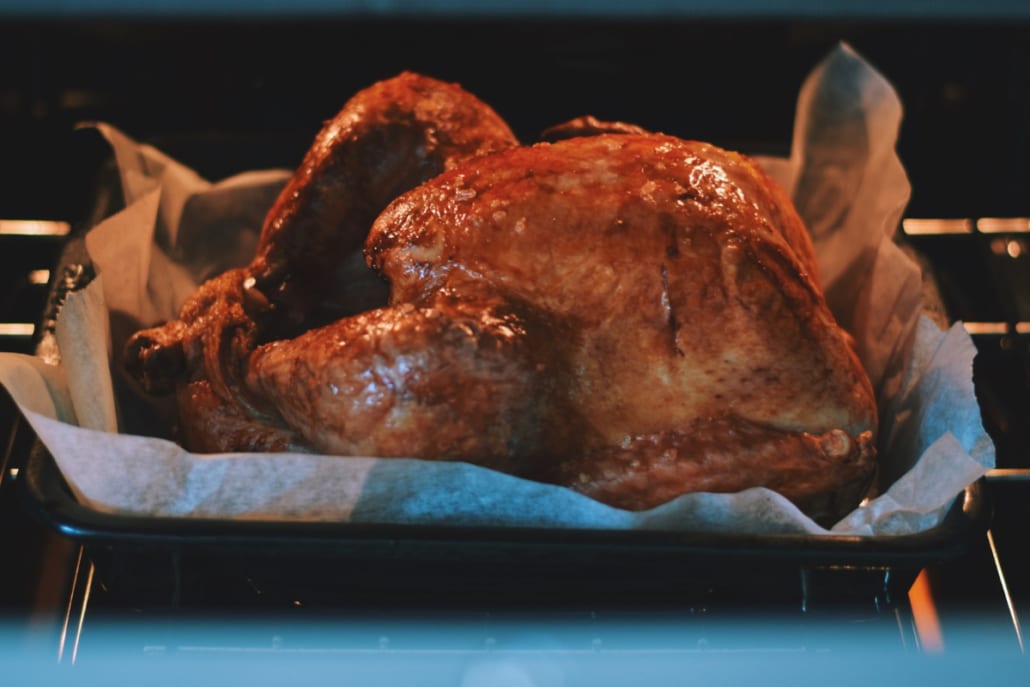
The Thanksgiving Oven Schedule: How to Get Everything Hot at Once

Thanksgiving dinner may be the only meal where a perfectly cooked turkey can still leave you in trouble. All those side dishes need oven space, too! I’ve put together a sample cooking schedule and a free, one-page planner you can fill out for your own menu. Because it’s much better to discover an oven scheduling problem today than at 4:30 on Thanksgiving afternoon.

There’s a moment on Thanksgiving when you realize the turkey is still roasting, the green bean casserole needs 35 minutes at 350°F, the rolls want 400°F, and somebody just remembered the stuffing.
You have one oven. And everyone expects dinner to be hot.
Fortunately, getting everything to the table at the same time doesn’t require a second oven or a degree in logistics. It requires a plan, and knowing which dishes can wait their turn.
Here’s how to make a Thanksgiving oven schedule that actually works.
First, figure out what really needs the oven
Before you assign a single cooking time, write down every dish on your Thanksgiving menu. Then separate the ones that absolutely need the oven from those that can be made ahead, reheated elsewhere, or served cold.
A traditional Thanksgiving menu can run a dozen dishes, and plenty of them have no business in the oven on Thursday. This is where you win back some room.
Dish |
Where It Belongs |
|---|---|
| Turkey | Oven |
| Stuffing or dressing | Oven, unless you use a stovetop recipe |
| Green bean casserole | Oven |
| Sweet potato casserole | Oven, or make ahead and reheat |
| Mashed potatoes | Stovetop or microwave |
| Gravy | Stovetop |
| Dinner rolls | A few minutes in the oven, a toaster oven, or room temperature |
| Cranberry sauce | Refrigerator |
| Salad | Refrigerator |
| Pumpkin pie | Bake the day before and refrigerate |
See what happened? Several dishes just gave up their oven reservations.
Potatoes and gravy are especially easy to move. My Make-Ahead Mashed Potatoes and Gravy can be prepared days before Thursday, so all that’s left on Thanksgiving is reheating them.
Warm the potatoes in a saucepan or the microwave while the casseroles bake, adding a splash of warm milk or cream if needed. Reheat to 165°F and keep them hot until dinner. If you’d rather use a slow cooker to hold them, reheat them first, then transfer them to a preheated cooker that keeps them at 140°F or above. Don’t use a slow cooker to reheat cold leftovers.
The gravy can wait on the stovetop for the turkey drippings.
Make ahead what you can
One of the best ways to solve an oven scheduling problem is to eliminate some of the cooking altogether.
If your casserole recipe allows it, prepare and fully bake the dish a day or two ahead. Cool and refrigerate it promptly, then reheat it on Thanksgiving. This works especially well for dishes like macaroni and cheese, sweet potato casserole, and some versions of green bean casserole. Just follow the recipe’s make-ahead instructions, since not every dish holds up equally well.
A casserole that only needs reheating gives you far more flexibility than one that has to be baked from scratch. And if you’re planning a crunchy topping, you may be able to add it during the final few minutes in the oven.
Dinner rolls can be baked ahead, too. Warm them briefly if you have oven space, use a toaster oven, or simply serve them at room temperature with good butter. I’m fairly certain nobody has ever turned down a perfectly good dinner roll because it wasn’t served at 400°F.
Work backward from dinnertime
Say you’re eating at 5:00. Not 5-ish. Five. Start there and work backward.
The turkey gets first claim on the oven because it takes the longest. But it also needs time to rest before carving, and that gives you an opportunity to finish the other dishes.
A fully thawed, unstuffed 14- to 18-pound turkey generally needs about 3¾ to 4¼ hours in a 325°F oven, according to FoodSafety.gov’s roasting chart.
Treat that as a forecast. The clock doesn’t tell you when a turkey is done. A thermometer does: 165°F in the thickest part of the breast, the innermost part of the thigh, and the innermost part of the wing.
For everything about choosing, thawing, and roasting the bird itself, see Thanksgiving on a Budget. Here, we’re concentrating on getting everything else to the table hot.
The trick is to schedule the turkey to finish early enough that the oven can handle whatever still needs baking or reheating.
And I do mean early enough. Don’t assume you can roast a turkey, bake three casseroles, and warm the rolls during a 20-minute resting period. That would be quite a talented oven.
A sample Thanksgiving oven schedule
Picture one oven, a fully thawed, unstuffed 14- to 16-pound turkey, and two casseroles that were fully cooked ahead and need approximately 40 minutes at 350°F to reheat. They could be any two oven dishes that share a temperature.
The casseroles have to fit side by side with room for hot air to circulate. The rolls are already baked and wrapped in foil.
Your recipes, pans, and refrigerator temperatures will affect reheating times, so check them before you borrow any of mine.
Time |
What Happens |
|---|---|
| 11:15 a.m. | Preheat the oven to 325°F and get the turkey ready. |
| 11:30 a.m. | Turkey goes into the oven. |
| 3:00 p.m. | Start checking the turkey’s temperature in all three spots. |
| 3:15 to 3:45 p.m. | Target window for the turkey to finish. Remove it only when it reaches 165°F in all three places. Tent loosely with foil and allow at least 20 minutes to rest. |
| 3:45 to 4:00 p.m. | Once the turkey is out, increase the oven temperature to 350°F and allow it to preheat. |
| 4:00 p.m. | Put both prepared casseroles in the oven to reheat. |
| 4:15 p.m. | Reheat potatoes and gravy on the stovetop or in the microwave. Stir the turkey drippings into the gravy. |
| 4:30 p.m. | Carve the turkey after it has rested. Keep it safely hot until serving. |
| 4:40 p.m. | Check the casseroles. Once both reach 165°F, remove them and keep them hot. Warm the foil-wrapped rolls in the oven for a few minutes. |
| 4:50 p.m. | Transfer everything to serving dishes. Bring out the cranberry sauce, salads, and other cold sides. |
| 5:00 p.m. | Dinner! |
Now, a couple of things about that table.
It’s an example, and turkeys don’t read schedules. If yours isn’t at 165°F when the table says it should be, it stays in the oven. Same goes for the casseroles. Push dinner back, use the microwave, rearrange whatever you have to, but don’t serve food that hasn’t reached its safe cooking or reheating temperature.
And if the turkey finishes early, remember that resting and holding aren’t quite the same thing. A loosely tented turkey can stay warm for a while, but foil alone won’t guarantee it stays at a safe hot-holding temperature. For an extended hold, keep it at 140°F or above, checking with a food thermometer. Perishable foods shouldn’t spend more than two hours at room temperature.
What if everything needs a different oven temperature?
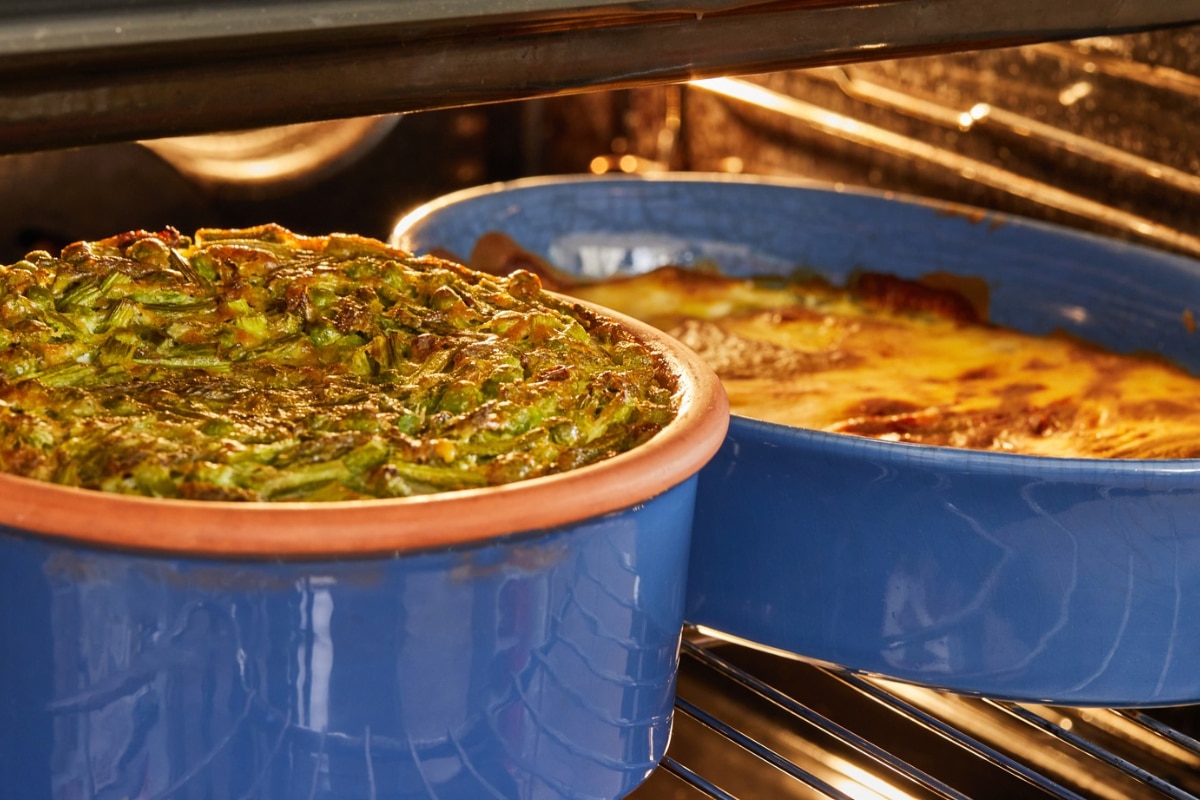
One casserole wants 325°F, another wants 350°F, and the macaroni and cheese insists on 400°F. You can’t average those and hope for the best.
Start by grouping dishes that share a temperature. If two recipes both say 350°F and the pans fit without crowding, they can bake together. Check both for doneness, though. Two pans in one oven can take longer than either recipe says.
Some recipes forgive a different temperature if you adjust the time. Others don’t, especially anything with eggs, meat, or other ingredients that have to cook all the way through. Follow the recipe.
A dish that won’t cooperate needs a different time slot or a different appliance. And remember that the oven needs a little while to heat up or cool down between settings.
One more thing to do before Thanksgiving: set your empty baking dishes in the oven side by side.
Two casseroles that look perfectly reasonable on the counter may not fit together. Better to find that out on Tuesday.
If guests are bringing food, give them an oven assignment
Potluck Thanksgivings are wonderful. They also produce the guest who walks in at 3:30 with a cold casserole that needs 45 minutes at 375°F while your turkey is still in the oven.
Before Thursday, ask anyone bringing a hot dish three questions:
- Is it arriving fully cooked or does it still need baking?
- What oven temperature and how much time does it need?
- Can it arrive ready to serve without using my oven?
Then add it to the schedule.
If there’s no room, ask them to bake it at home and transport it safely, keeping hot food hot until it arrives. Or suggest something that doesn’t need heating at all.
A salad never needs your oven, and a pie can be finished the day before.
Ask about slow cookers, too. They don’t take up oven space, but they do need counter space and an electrical outlet. It’s surprisingly easy to end up with three slow cookers and one outlet.
A quick conversation ahead of time can prevent an impressive amount of kitchen confusion.
When the turkey won’t cooperate
It happens. The turkey runs long, a casserole is still cold in the middle, somebody suddenly remembers the cornbread needs 45 minutes.
Moving dinner back 15 or 20 minutes solves more problems than any clever maneuver, so do that first.
Then shift whatever you can to the stovetop or microwave. If you own a countertop or toaster oven, rolls and small dishes can finish there.
A casserole that was fully cooked ahead can be reheated in the microwave, then slid under the broiler for a crisp top once the turkey is out (in a broiler-safe dish, of course).
Put somebody in charge of the last 15 minutes, too. Warming the gravy and finding serving spoons are jobs that don’t need you.
Whatever happens, don’t trade food safety for a serving time.
A turkey that isn’t done needs more heat. Optimism doesn’t cook anything.
Put your Thanksgiving oven schedule on one page
Before Thursday, take five minutes and write down the information that actually matters.
- Dinner time: When do you want everyone sitting down?
- Turkey: When does it go in, and when should you start checking its temperature?
- Oven dishes: What still needs baking or reheating, at what temperature, and for how long?
- Other appliances: What can move to the stovetop, microwave, or toaster oven?
- Final jobs: Who’s carving, warming gravy, setting out dishes, and getting everything to the table?
Now assign the oven times, working backward from dinner. Allow time for the oven to change temperatures, and make sure every dish actually fits into the schedule.
Tape the finished plan to the refrigerator where you can see it without hunting through your phone, or send it to everyone who’s cooking. Check off each dish as it comes out.
Want to make your own oven schedule?
I’ve made a free, one-page Thanksgiving Oven Planner you can print and fill in with your own menu. Nothing fancy. Just a place to work out what goes in, what comes out, and when, before everybody shows up hungry.
PRINT YOUR FREE THANKSGIVING OVEN PLANNER →
Dinner doesn’t need to be timed to the second. It needs to be hot, and you need enough energy left to sit down and enjoy it.
If it lands ten minutes late because the turkey had other plans, I wouldn’t lose a minute of sleep. Nobody hands out ribbons for punctual casseroles.
Question: What’s the one Thanksgiving dish that always seems to need the oven at the worst possible moment?

More from Everyday Cheapskate
 https://www.everydaycheapskate.com/wp-content/uploads/20261116-Assortment-of-homemade-Christmas-cookies-arranged-on-a-table-for-a-holiday-cookie-exchange-party.jpg
800
1200
Mary Hunt
https://www.everydaycheapskate.com/wp-content/uploads/EC-Logo-by-Mary-Hunt-Tagline-Trimmed.png
Mary Hunt2026-11-17 10:32:042026-11-17 10:32:04How to Host a Cookie Exchange Party Without the Fuss
 https://www.everydaycheapskate.com/wp-content/uploads/20261113-everyday-cheapskate-holiday-gift-guide-2026-for-young-adults-and-college-students-him-her.jpg
800
1200
Mary Hunt
https://www.everydaycheapskate.com/wp-content/uploads/EC-Logo-by-Mary-Hunt-Tagline-Trimmed.png
Mary Hunt2026-11-14 17:40:592026-11-16 20:45:30Best Christmas Gifts for College Students & Young Adults 2026
 https://www.everydaycheapskate.com/wp-content/uploads/20261113-everyday-cheapskate-holiday-gift-guide-2026-for-teachers-instructors-him-her-principal-school.jpg
800
1200
Mary Hunt
https://www.everydaycheapskate.com/wp-content/uploads/EC-Logo-by-Mary-Hunt-Tagline-Trimmed.png
Mary Hunt2026-11-13 18:29:492026-11-13 18:31:50Best Christmas Gifts for Teachers 2026: What They Truly Want
 https://www.everydaycheapskate.com/wp-content/uploads/20261112-everyday-cheapskate-holiday-gift-guide-2026-for-homechefs-foodies-cooks-food-lovers.jpg
800
1200
Mary Hunt
https://www.everydaycheapskate.com/wp-content/uploads/EC-Logo-by-Mary-Hunt-Tagline-Trimmed.png
Mary Hunt2026-11-12 15:31:372026-11-12 15:37:52Best Christmas Gifts for Foodies & Home Cooks in 2026
 https://www.everydaycheapskate.com/wp-content/uploads/20261110-everyday-cheapskate-holiday-gift-guide-2026-for-grandparents-grandma-grandpa-seniors-him-her.jpg
800
1200
Mary Hunt
https://www.everydaycheapskate.com/wp-content/uploads/EC-Logo-by-Mary-Hunt-Tagline-Trimmed.png
Mary Hunt2026-11-11 15:17:182026-11-11 15:19:29Best Christmas Gifts for Grandparents 2026: Thoughtful Ideas
 https://www.everydaycheapskate.com/wp-content/uploads/20261110-everyday-cheapskate-holiday-gift-guide-2026-for-teens-boys-girls.jpg
800
1200
Mary Hunt
https://www.everydaycheapskate.com/wp-content/uploads/EC-Logo-by-Mary-Hunt-Tagline-Trimmed.png
Mary Hunt2026-11-10 11:23:432026-11-11 15:29:57Shopping for Teens? These Christmas Gifts Get It Right
 https://www.everydaycheapskate.com/wp-content/uploads/20261108-everyday-cheapskate-holiday-gift-guide-2026-for-kids-toddlers-children-tweens.jpg
800
1200
Mary Hunt
https://www.everydaycheapskate.com/wp-content/uploads/EC-Logo-by-Mary-Hunt-Tagline-Trimmed.png
Mary Hunt2026-11-08 18:27:222026-11-08 18:29:13Best Christmas Gifts for Kids 2026: Fun for Every Age
 https://www.everydaycheapskate.com/wp-content/uploads/20261108-everyday-cheapskate-holiday-gift-guide-2026-for-women-her-mom-grandma-sister-woman.jpg
800
1200
Mary Hunt
https://www.everydaycheapskate.com/wp-content/uploads/EC-Logo-by-Mary-Hunt-Tagline-Trimmed.png
Mary Hunt2026-11-08 10:31:212026-11-08 10:35:39Best Christmas Gifts for Women 2026: Thoughtful Finds
 https://www.everydaycheapskate.com/wp-content/uploads/20261107-everyday-cheapskate-holiday-gift-guide-2026-for-men-him-dad-grandpa-brother-man.jpg
800
1200
Mary Hunt
https://www.everydaycheapskate.com/wp-content/uploads/EC-Logo-by-Mary-Hunt-Tagline-Trimmed.png
Mary Hunt2026-11-07 12:29:532026-11-07 12:32:28Best Christmas Gifts for Men 2026: Gifts He’ll Actually Use

Leave a Reply
Want to join the discussion?Feel free to contribute!